One night in 1909, in Peterborough, a police constable named Kettle looked up and saw ‘a strange cigar-shaped craft passing over the city’. This was the start of the great Zeppelin panic that preceded the first world war. There were dozens of sightings, newspaper editorials, and questions in parliament, but it was all a fantasy: not a single Zeppelin had actually crossed the North Sea. What Constable Kettle saw was a kite with a Chinese lantern attached. Today, we have the makings of a similar panic over Iranian drones.
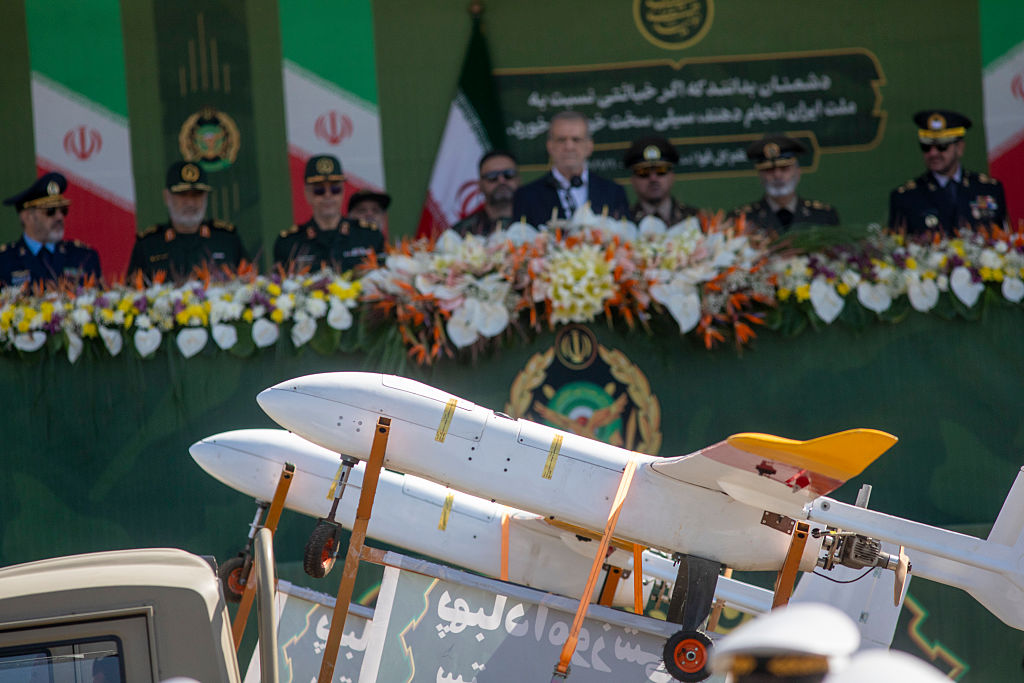
Zeppelins were dangerous: eventually, they did bomb London during the first world war. Iranian Shahed drones, too, are deadly, and they could cause mayhem if ever used here: each has a 50 kg payload of explosives, roughly equivalent to a car bomb. Imagine, as some writers have done recently, such a kamikaze drone crashing into Liverpool Street Station at rush hour.
In this scenario, the drones are launched from ships that have approached the UK from the North Sea. But the question is whether Iran really can get these weapons close enough to threaten the British mainland. And why the mullahs would risk drawing Britain into the war with the United States when the Starmer government is trying so hard to keep us out.
The US has already had one Iranian drone panic. It was in December of 2024, just over a year before the start of Donald Trump’s war with Iran. A Congressman declared on Fox News that ‘very qualified sources’ had revealed an Iranian ‘mothership’ was launching drones at New Jersey. It wasn’t true. More recently, the FBI issued a warning that Iran could attack California with drones launched from a vessel at sea. So far, though, it seems this is just based on rumour.

Britain is much closer to Iran than California. Even so, the ship needed to launch a drone would still have to make its way through the Strait of Hormuz, which is being watched by every satellite the US has in the region. It probably couldn’t pass through the Suez Canal, another narrow waterway which is being closely monitored. So it would have to go down,around South Africa. It would have to make this long voyage undetected. It would take weeks. All this makes a seaborne drone attack on Britain unlikely…unless Vladimir Putin has allowed Iran to put drones on one of the ships in his shadow fleet, used to smuggle Russian oil.
That’s a possibility that Brooks Newmark says we should take seriously. Newmark was a Conservative government minister who later reinvented himself as the head of a charity evacuating casualties in Ukraine. He now runs a company making deep strike drones for the Ukrainians and so knows how Iran could use this technology to threaten Britain.
As he says, tankers from Russia’s shadow fleet regularly approach from the North Sea and pass through the Dover Strait. This is narrow enough, and the drones can fly far enough, to make it possible to attack military sites across south-east England. We are ‘vulnerable’, he says.
It’s not just the big, relatively slow-moving Shaheds we should worry about, he says. Iran could copy Operation Spider Web, in which the Ukrainians launched more than a hundred drones from the back of trucks that had been driven deep into Russia. In the equivalent attack here, perhaps an Iranian sleeper agent opens up the doors of a shipping container in Southwark, and hundreds of drones, each with a kilo of high explosive, swarm towards Downing Street.
Newmark says: ‘Given the ease with which drones can get assembled, transported and put in the back of a van… there is a clear and present danger.’ He wants the government to immediately start recruiting Gen Z video gamers, training them in drone warfare. The task, he says, is urgent. ‘You know who in the UK has the ability to combat an attack from drones? The answer is, nobody.’
Dr Matthew Powell, who teaches at the RAF air college, disagrees with this pessimistic view. He acknowledges there are problems with Britain’s air defences after years of underinvestment. But he thinks that radar would spot a drone launched from sea, and an RAF fast jet would be able to shoot it down. This would still be a kind of victory for the Iranians: a fast jet costs hundreds of thousands of pounds to put in the air, against a drone costing tens of thousands. Similarily, a volley of surface-to-air missiles fired in Dubai or Qatar costs millions. This is asymmetric economic warfare.
Powell says the chances of any kind of drone attack on Britain are ‘minimal’ because of Iran’s success in this economic warfare, aimed at the price of oil. Closing the Straits of Hormuz and hitting the Gulf states is forcing up the price of gas for Trump’s supporters, making the war ‘so much more expensive’ that increasingly they are questioning it. An attack on London or California might rally the American public. It might even prompt a response from Nato, under Article Five of Nato’s founding treaty. ‘I’m not sure what Tehran would gain from doing it,’ Powell says. ‘This is a regime that is [always] calculating, how does it survive?’
With the war now in its third week, for the Iranian regime, simply enduring is a victory. As in the long wars in Iraq and Afghanistan, the US can win every battle but still lose the war. The Iranian regime has been planning for this kind of conflict for years. They practise ‘strategic patience’. Even now, with the regime fighting for survival, Iranian strikes have been carefully directed at ‘belligerent’ nations: Israel and the Gulf States that host US forces, or the US base in Cyprus, with the British military unlucky to be in the firing line.
The real threat to Britain from Iran is not a Shahed over London. It is what MI5 has been quietly tracking for years: spying on dissidents, plotting to harm the Jewish community, recruiting criminals for assassinations. No doubt Iran’s agents here are primed for what the IRA used to call a ‘spectacular’ – but not until Britain joins the war.
Iran’s aim in this conflict is to divide the West, not unite it. Iran’s leaders may be brutal, but they are not stupid.






Comments