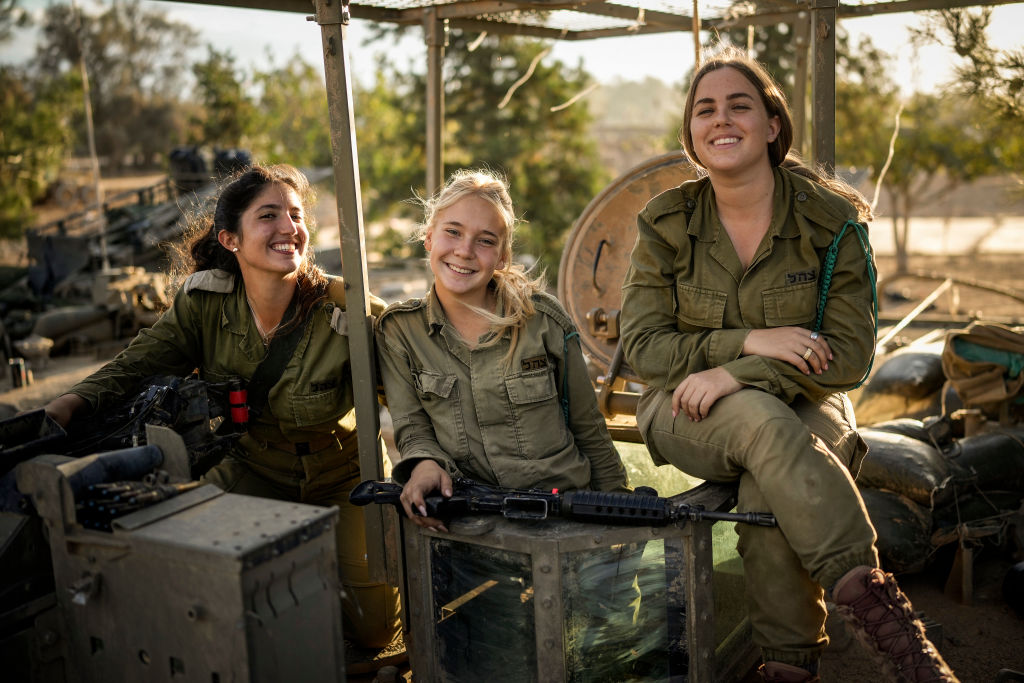
It is impossible to imagine the Israel Defence Forces (IDF) functioning without its female soldiers. In the last week alone, over 30 Israeli female combat pilots and navigators participated in long-range strikes on Iran. Since 2023, hundreds of women have crossed enemy lines and fought in hostile territory; among them medics who have rescued people under fire and combat dog handlers searching Hamas tunnels. On October 7 there were countless heroic stories about female soldiers. From non-combat surveillance operators (‘spotters’) who didn’t abandon their command posts until their last breath, to navy fighters who stopped much of Hamas’s naval invasion.
The IDF – as well as being one of the world’s most effective fighting forces – is also one of the most ‘feminine’ militaries, with women making up about 35 per cent of its regular non-reserve force.
More striking is what’s happening at the sharp end: one in five Israeli combat soldiers are female – a record high in Israel’s history. While the general high number of female personnel can be explained by the mandatory draft, women in combat must volunteer for these roles.
In Britain the situation is rather different. Despite the 2018 decision to make all roles open to women, the British military is far more male-dominated. As of April 2025, women still only make up around 12 per cent of the UK’s regular armed forces.
Like other western armies, Britain continues to struggle with recruitment generally. Defence Secretary John Healey admitted last year that there had been ‘15 years of a recruitment and retention crisis in our armed forces,’ shrinking the army to the smallest it has been for more than 300 years. Could women make up some of the shortfall? In 2021, the MoD set an ambitious target for 30 per cent of its intake to be female by 2030 but so far it has fallen far short of this goal.

As a former Israeli soldier myself, who served as an army field reporter from 2010 to 2013 and covered non-combat and combat women up close, I know what women are capable of in the army. And I witnessed both the raw struggles of women and their successes firsthand.
Many of the issues with female recruitment are practical, military and solvable. The first lesson is structural: don’t pretend integration will magically happen just by dropping a handful of women into fully male formations and hoping for the best. Instead, Israel began in 2000 by piloting a scheme where women were allowed to try their luck as infantry fighters, with new units were set up to accommodate female fighters.
The first unit was ‘Caracal’, a 70 per cent female light infantry battalion. These young women were not mollycoddled. When I marched with trainees from Caracal in the desert, they were carrying full infantry gear, equipment and stretchers with soldiers on. The platoon commander’s radio operator – one of the most trusted roles in infantry units – was a short blond fierce-looking woman, who ran with a heavy radio forwards and backwards to keep the comms alive.
Dozens of miles later, I was chatting with a male soldier, who told me: ‘I was disappointed when I first got this placement, like what, a girls’ unit? But now I know that we are doing the same tasks and girls can do as well as boys. When I look at friends who serve only with guys I think “poor them”, they’re surrounded with baboons there,’ he laughed.
A 2022 report for the British Army about female integration by Professor Anthony King concluded that the central problem was that the army ‘is coded male’. King argued that the British Army ‘needs to re-code itself from a masculine institution into a hyper-professional force’ through reforms to foster cohesion and pride. In Israeli mixed units, shared standards and professional goals help ‘re-code’ male soldiers, who recognise their fellow female soldiers as sisters in arms. More importantly, the whole system has been slowly transformed as mixed units have proven their worth.
Caracal evolved that way. It was initially dismissed as a unit ‘that only stops smugglers’ on the Egyptian border. Yet it was soon fighting terrorists from Isis-torn Sinai. It then took on Hamas, on October 7th and later in Gaza.
On October 7, an all-female armoured new unit in Caracal took part in combat operations. Seven young female soldiers fought Hamas for 17 hours with three tanks. They eliminated about 50 Hamas members, saved countless lives and entered history as the first known all-female armoured crew taking part in combat.
The IDF had refused to let women serve as tankers until 2022. For years, religious and political figures criticised the participation of women in combat units, namely in tanks. After the battle of the female tankers, the former IDF Chief of Staff Herzi Halevi stated: ‘I think that in this case we got an answer with no words, an answer of action and fighting’.
Of course, it’s not all been plain sailing for women in the IDF. Only 90 per cent of Israeli military positions are currently open to women, and some of the IDF’s integration schemes have failed. But over the years, the IDF has built up a better understanding of the limits of female versus male physiology. Where appropriate, it has adjusted uniform and equipment for the female physique and updated its fitness programmes.
Making women feel safe in the armed forces is also vital. In my own experience, there was no big difference between being a woman in the military and in civilian life. Surveys show that sexual harassment rates in the IDF and in the general population, while still too high, are broadly similar – with one third of women affected. If IDF members are impacted by sexual harassment or assault, they have access to a comprehensive service which provides 24/7 confidential emotional, medical and legal assistance.
An MoD survey from November 2025, on the other hand, found that two-thirds of women in the military were sexually harassed in the past year. Last October, a former army sergeant major was sentenced to six months in jail for sexually assaulting Jaysley Beck, a 19-year-old soldier who later killed herself. A British support system exists, but it has been criticised for being scattered across various channels and too entangled with the chain of command. As well as making a clear commitment to stopping inappropriate behaviour, fixing support systems is important to ensuring women feel safer in the armed forces.
Israel has shown what an asset women can be to a modern military. Women shouldn’t be treated as an ‘inclusion’ issue – but as a serious, underused resource, who can bring their own unique skills to the armed forces. British history is full of fearless female fighters. It mustn’t miss out on the Boudicas of tomorrow.




Comments