I got my first paid writing gig back in the early 2010s, for an online magazine fixated on the then-current phenomenon we were already calling ‘post-internet art’. The journal was all but unreadable, its house style both po-mo and po-faced to the extent that contributors were obliged to adopt pseudonymous bylines. I went with ‘Screamin’ Jay Jopling’, which counted for a rare laugh. Yet the tone was very much in tune with the art we covered. Whether it was video, sculpture, photography or pretty much any other medium, it was chiefly concerned with the intrusion of digital technology into – the style guide’s punctuation, not mine – ‘real’ life. Regardless of the medium they worked in, its leading lights – Cory Arcangel, Ryan Trecartin, Hito Steyerl – always reverted to particular visual references: 1990s computer graphics; violent imagery derived from video games and online porn; green-screen technology and language – aesthetics that replicated the look of the current social-media craze. I found it annoying and conceited, its practitioners’ ambitions frequently crossing the line into outright pretension. Nevertheless, it seemed new and unknowable and genuinely avant-garde. Perhaps I’m showing my age, but I couldn’t say the same for any subsequent tendency in contemporary art.
The pictures might look great in a wellness spa. But in a serious art gallery, in 2026?
In its wake came crazes for pseudo-feminist textile installations and identity-political agitprop. These were retrograde in form and earnest but, in some instances, at least visceral in their anger. Even less seductive was a concurrent fashion for faintly surreal representational painting and pseudo-mystical abstraction embodied by artists like the American painter Loie Hollowell (b.1983), whose faintly mystical abstract canvases call to mind the sort of thing a third-tier progressive rock band might have used for an LP sleeve. Hollowell’s current show at Pace already seems like a throwback to the recent past, a witchy fantasia of brightly coloured, geometric esoterica that is, apparently, dead serious in its intent. The pictures might look great in a wellness spa, or indeed on the cover of an ELP record. But in a serious art gallery, in 2026?
In search of the current register, I went down to Camberwell to check out the latest iteration of the annual New Contemporaries show, this time held at the South London Gallery. Pulling in work by the most impressive recent art-school graduates, the programme aims to distill the essence of the moment, laying bare the material and intellectual preoccupations shared by the next wave of cutting-edge creation. There are works exploring the legacy of brutalist architecture, pastel-hued figurative paintings and video works that aspire to poetry – but approximate it only infrequently. There’s some larky conceptualism, at least one inarticulate rant at colonial legacies and a brave failure of an attempt to turn a gallery into a piece of kinetic art. It’s just a bit dispiriting that nothing here would have looked out of place in this context a decade ago.

This isn’t necessarily the artists’ problem: it’s a challenge to express any sense of vision in a group exhibition, and only one participant, Anglo-Libyan Alia Gargum, cracked this. Her sculptural installation ‘This Was A Mosque’ sees long swathes of fabric in the green of Libya’s Gaddafi-era national flag – a sacred shade in Islam – draped from ceiling height, its flow interrupted by rusty metal bars. Leaving aside discussion of history and regional turmoil, it’s uncanny and imposing, an unignorably charismatic and confident presence in an otherwise unremarkable room.
If there is a new spirit in art, it’s probably the recent vogue for visions of a post-human world – of the last vestiges of a synthetic civilisation slurped up by the muck of time. Taking its cues from J.G. Ballard (a deeply 1980s art-college reference) and the French artist Pierre Huyghe (who did much the same thing rather better as long ago as 30 years) it’s hardly radical. But if you want to see what it’s all about, look to the current solo show by Klara Hosnedlova (b.1990) at White Cube Bermondsey. One gallery contains a monumental sculpture hewn from hundreds of thousands of strands of brown cotton thread, cascading from the ceiling and separating into a tentacular delta as they hit the floor; if the Titans had sported dreadlocks, they might have looked a lot like this.
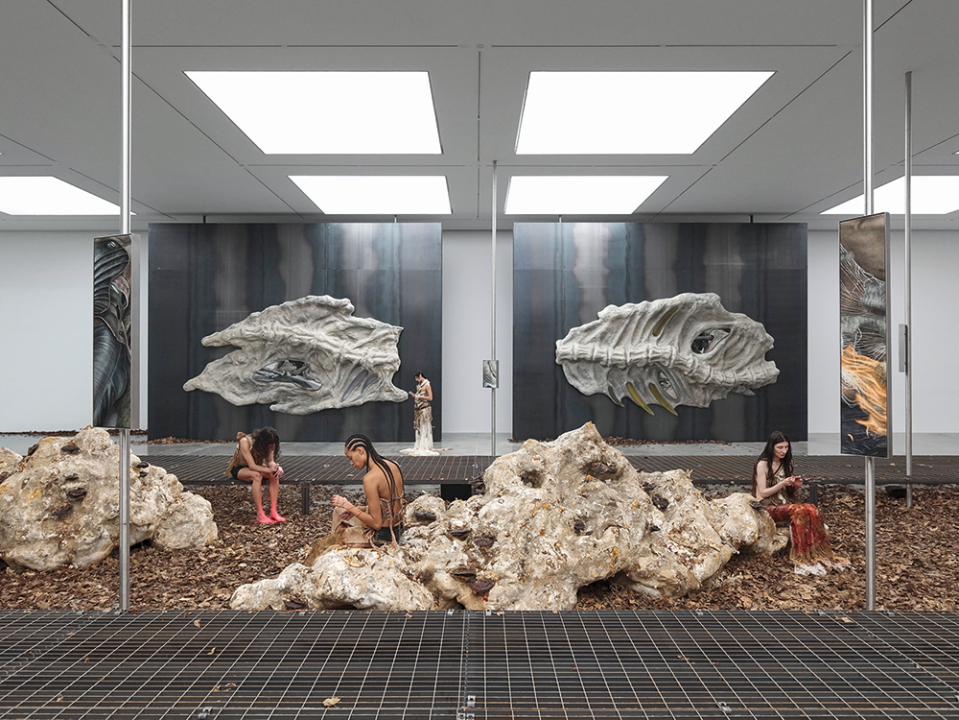
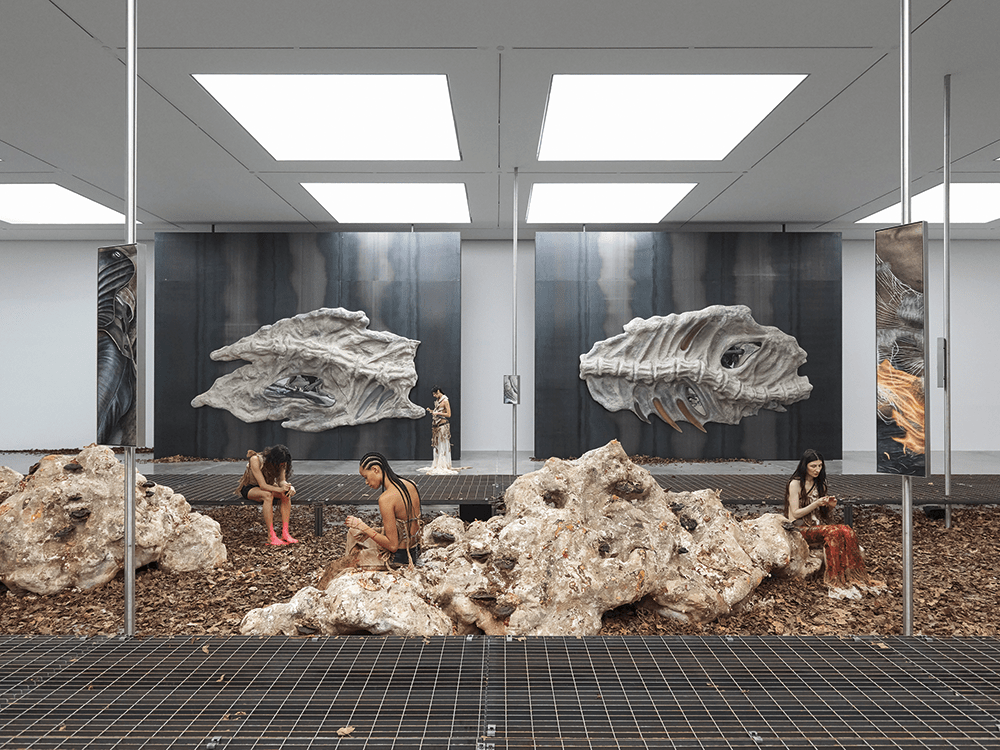
Another space contains a vast metal platform with a recess at its centre, in which colossal fungal forms cultivated from mycelium stand tall as public sculptures; dead leaves are piled up in corners, oddball clay forms scattered around, seemingly at random. Billboard-sized steel panels stand upright around the room’s edges, their surfaces decked out with colossal resin forms resembling fossilised trilobites. As with all of this post-human stuff, it seems to be making the obvious point that, whatever we do, organic matter will find a way around us. It’s not original and I didn’t love it. Yet, perhaps on account of the scale at which Hosnedlova works, I can’t pretend it isn’t impressive.




Comments