
The war in the Middle East widened further over the past 24 hours, with missile interceptions stretching from Turkey to Saudi Arabia, naval clashes in the Indian Ocean and mounting pressure inside Iran itself. Nato air defences shot down an Iranian missile heading toward Turkish airspace, Saudi forces intercepted cruise missiles near Riyadh, and reports emerged that Kurdish militants may be preparing to exploit the conflict along Iran’s western border. Taken together with continuing Israeli and American airstrikes across Iran and escalating fighting in Lebanon, the developments suggest the confrontation is steadily spreading.
Tens of thousands of residents have fled Tehran since the escalation began
Israeli and American aircraft continued striking targets across Iran throughout Wednesday, with attacks focused heavily on missile launch sites and military infrastructure. Analysts say the pattern of strikes indicates a concerted attempt to dismantle Iran’s ballistic missile network, which has formed the backbone of Tehran’s retaliation since the war began five days ago. Western officials say the campaign appears to be degrading Iran’s ability to launch large-scale missile barrages.
Speaking at the Pentagon, US Defence Secretary Pete Hegseth said the joint US–Israeli operation had already struck more than 2,000 targets inside Iran and was entering a more intensive phase. He said the campaign now involves roughly twice the air power used during the 2003 invasion of Iraq, underscoring the scale of the aerial offensive under way. Hegseth added that the United States and Israel expect to achieve full control of Iranian airspace within days, after which coalition aircraft would be able to operate continuously across the country.
He said the campaign has no fixed timetable, and operations will continue until Washington’s strategic objectives are achieved: principally the destruction of Iran’s missile infrastructure, the weakening of its naval capabilities and the broader dismantling of its ability to threaten the region militarily.

Hegseth also praised Israel’s military performance, describing the Israeli air force and intelligence services as “extraordinary” in the opening phase of the campaign and crediting them with many of the early strikes on Iranian missile infrastructure. He added that Israel had shown the kind of military capability “many partners talk about but very few can actually deliver”, a remark widely interpreted as a subtle comparison with other US allies.
General Dan Caine, chairman of the Joint Chiefs of Staff, said the sustained strikes appear to be rapidly eroding Iran’s retaliatory capacity: Iranian ballistic missile launches have fallen by roughly 86 per cent compared with the first day of fighting, while suicide drone attacks have dropped by about 73 per cent. He also said more than twenty Iranian naval vessels have been destroyed since the campaign began.
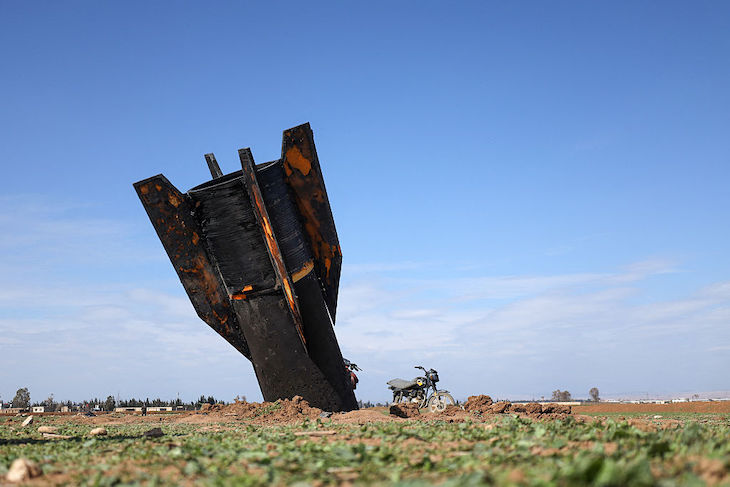
Despite that decline, Iranian missiles and drones have continued to be fired across the region. One ballistic missile was intercepted by Nato air defence systems as it was heading for Turkish territory, although debris from the interception fell in Hatay Province near the Syrian border. Ankara later summoned the Iranian ambassador and said it would consult with Nato allies following the incident.
Saudi Arabia also reported new missile activity. Overnight, Saudi officials said their air defences shot down three cruise missiles near the city of Al-Kharj, south of Riyadh, in what appears to be part of Iran’s broader attempt to target American and allied assets across the Gulf.
The maritime dimension of the conflict has intensified as well. American officials confirmed that a US submarine struck an Iranian naval vessel near Sri Lanka with a torpedo, reportedly sinking the ship. The attack forms part of a wider effort to cripple Iran’s naval capabilities and prevent the regime from threatening shipping routes across the Indian Ocean and the Gulf.
Inside Iran itself, the conflict is beginning to produce visible social strain
Meanwhile the fighting on Israel’s northern front continues to escalate. Israeli airstrikes targeted Hezbollah positions in Beirut’s southern suburbs, particularly in the Dahiya district, long regarded as the group’s main stronghold, while ground forces reportedly advanced further into areas of southern Lebanon. Hezbollah claims its fighters have engaged Israeli units near several border villages, raising the prospect of a broader ground confrontation along the frontier.
Another potentially destabilising development has emerged along Iran’s western frontier. Iranian forces have reportedly deployed armoured units and rocket launchers along the border with Iraq in an effort to prevent Kurdish militants from crossing into Iranian territory. Tehran fears Kurdish groups operating in Iraqi Kurdistan may attempt to exploit the weakening of Iranian security forces during the current conflict. Any such incursion would open a new internal front against the Iranian regime at a moment when its military is already under sustained attack from the air.
Inside Iran itself, the conflict is beginning to produce visible social strain. Reports indicate that tens of thousands of residents have fled Tehran since the escalation began, while Iranian officials claim more than a thousand bodies have already been brought for burial since the start of the war.
Iranian rhetoric has also grown increasingly severe. An Iranian military official told the state news agency ISNA that if the United States and Israel attempt to overthrow the Iranian government, Tehran would respond by attacking Israel’s Dimona nuclear reactor, one of the country’s most sensitive strategic facilities.
With missile interceptions now occurring across multiple countries, Nato air defences engaging Iranian weapons and American naval forces openly striking Iranian vessels, the confrontation is increasingly taking on the shape of a regional war rather than a contained conflict between the U.S., Israel and Iran.
Throughout the Middle East conflict, Jonathan Sacerdoti will be providing daily situation updates each morning






Comments