Direct US-brokered talks between Israeli and Lebanese representatives are set to take place in Washington this week. The Israeli delegation will be headed by Yehiel Leiter, Jerusalem’s ambassador to the US. Lebanon will be represented by Nada Hamadeh, the Lebanese ambassador to Washington. The State Department will host the negotiations.
In his statement on Thursday announcing the talks, Israeli Prime Minister Benjamin Netanyahu framed their purpose as “disarming Hezbollah and establishing peaceful relations between Israel and Lebanon.” Lebanese Prime Minister Nawaf Salam, for his part, expressed his hope that Beirut should become a “demilitarized city.”
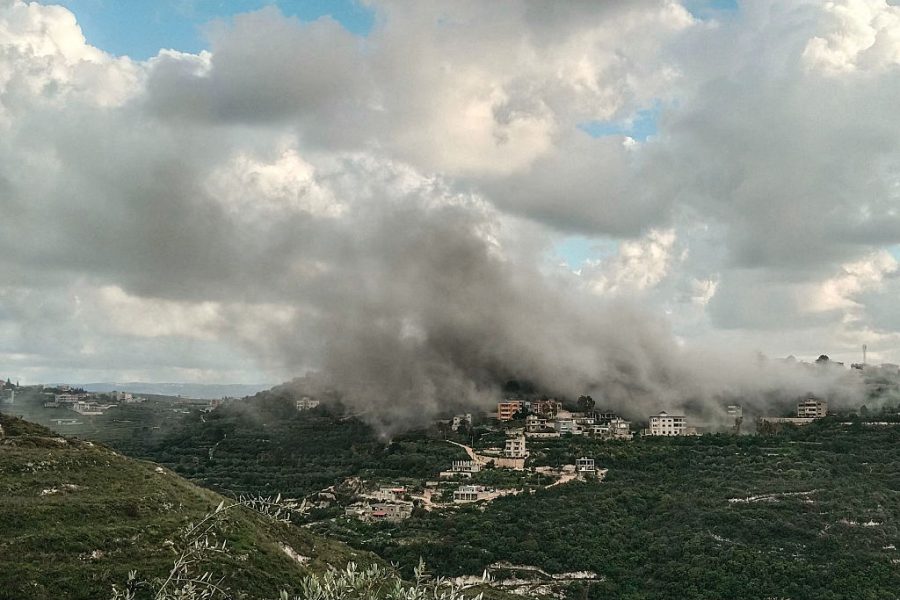
Even as the talks were announced, Lebanese Hezbollah’s attacks on Israeli population centers and Israel’s wide-ranging ground and air offensive against the terror group continued. The IDF has now completed its deployment along a line of control north of the Israel-Lebanon international border. This buffer zone is intended to place Israel’s border communities out of the range of Hezbollah’s anti-tank rockets (which the organization routinely employs against civilian targets). It is also intended to make impossible any October 7-style attack from this border.
Hezbollah remains the strongest military player in Lebanon
The announcement of the first direct and public negotiations between Beirut and Jerusalem is of obvious significance at a symbolic level. It reflects the weariness of a significant part of the Lebanese political elite with Hezbollah, and with the destruction caused by the party’s use of Lebanese soil to prosecute its part of Iran’s long war against Israel. Beyond symbolism, what is the reason for holding these talks at the present time? Does their announcement presage any likely diplomatic breakthrough?
The reason for the timing of the talks is fairly clear, and it belongs to the broader regional context. The fighting in Lebanon is taking place because Hezbollah chose to join the Israel-Iran war after the killing of Iranian Supreme Leader Ali Khamenei last month. This is the second time that the organization has plunged Lebanon into conflict in the course of the last half-decade. The first was on October 8, 2023 when it chose to intervene in support of its ally Hamas in Gaza. The net result of both interventions has been displacement, chaos and suffering for inhabitants of both Lebanon and northern Israel.

The Israel-US-Iran war is now subject to a two-week ceasefire. There was a flurry of Israeli diplomatic activity last week intended to separate the campaign in Lebanon from the broader ceasefire with Iran. Despite lukewarm statements by the US President and Vice President, Donald Trump and J.D. Vance, appearing to endorse this separation, it was never likely to hold.
Last Wednesday, Netanyahu spoke with President Trump and envoy Steve Witkoff. US officials, according to a number of reports, requested that Israel reduce the intensity of strikes in Lebanon and begin negotiations. The swift subsequent announcement of talks with Lebanon offered a handy way to comply with the preferred US direction of events. As an unnamed Israeli official told the well-connected Israeli journalist Ben Caspit:
Israel was being perceived as spoiling the chances of ending the war with Iran, and Netanyahu was facing heavy international pressure.
Israeli officials have acknowledged that the goal of the complete disarmament of Hezbollah cannot be achieved by air action and ground maneuvers close to the border. The terror group maintains its core strength and assets north of the Litani. The only way that these could be destroyed in their entirety would therefore be a full-scale invasion of the country, bringing Israeli forces to Beirut and into the Beka’a. There is no prospect for an operation of this magnitude.
Israel therefore elected to pursue in Lebanon a similar approach to that employed in Iran. It is aware that it is facing an enemy committed to a long war and to its destruction. As such, Israel has sought to use the window of opportunity afforded by the US war on Iran to inflict as much damage on Tehran and its proxies as possible within the timeframe allowed.
The expanded buffer zone and the damage inflicted on Hezbollah represent tangible gains. The expectation is that further future rounds will come. With the US apparently committed to the ceasefire and efforts to wind down the current round of fighting, the promise of talks offered proof that Israel was not seeking to impede progress in this direction.
US enthusiasm for the ceasefire with Iran appears now to have given way to preparations for a naval blockade of the Strait of Hormuz, with all that this could entail in terms of escalation. As such, it might be argued that the commitment to readiness for talks with Lebanon has already served its purpose. Still, might the talks scheduled in Washington nevertheless bear fruit? Is there any prospect for normalization or a peace deal between Beirut and Jerusalem?
The answer, though it becomes wearying to repeat it, is that for as long as the government of Lebanon fails to exert full sovereignty over the area under its notional jurisdiction, there is little or no prospect for tangible diplomatic progress. Hezbollah remains the strongest military player in Lebanon. Any agreement signed with the official government would be meaningless for as long as Hezbollah can – at the behest of its masters in Tehran – launch war on Lebanon’s southern neighbor at a time of its choosing.
As has been obvious for a while, the government of Lebanon has no intention and also no ability to disarm Hezbollah by force. (The Lebanese Armed Forces are around 40 percent Shia and would almost certainly fall apart should such an effort be commenced. They are also, in any case, militarily weaker than the terror group). Hezbollah, equally obviously, has no intention of voluntarily disarming. The Lebanese government wants an end to Israel’s attacks on its soil, while also avoiding confronting the terror group. Israel is unlikely to be interested in such an arrangement for as long as Iran and Hezbollah remain committed to their long war for the Jewish state’s destruction.
From this point of view, it is a mistake to consider the events in Iran, Israel, Iraq, Hormuz and Lebanon since February 28 as constituting a “war.” Rather, they are a round of fighting in a much longer conflict that has been under way for decades and is likely to end only when the regime in Tehran falls. Short of that, prepare for more of the same.



Comments