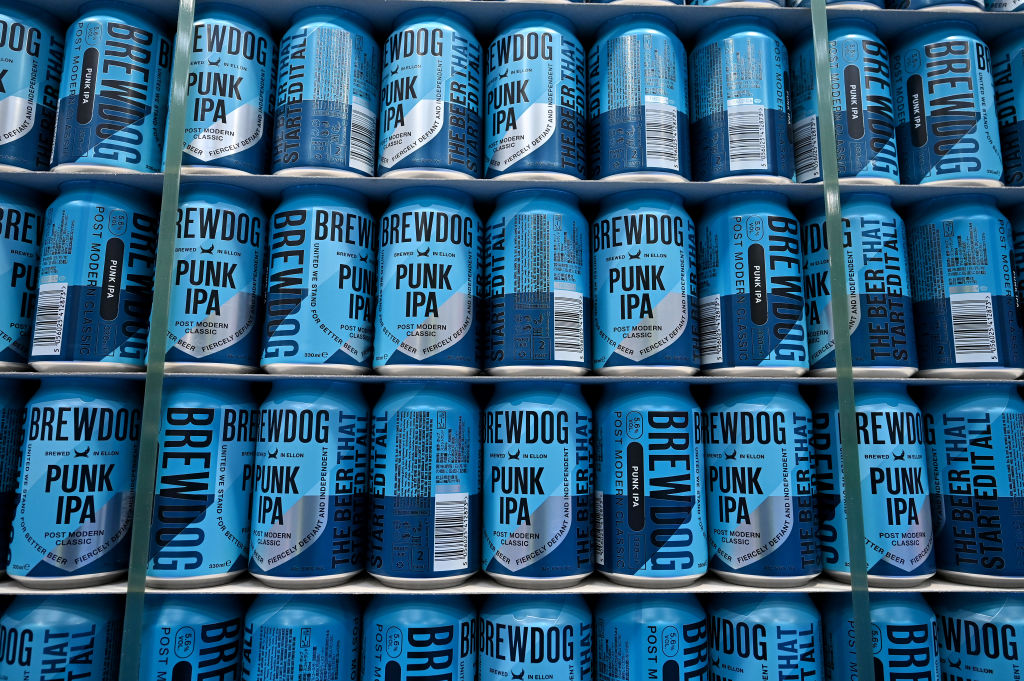
The news that the Scottish beer company BrewDog has put itself up for sale has been greeted with a mixture of sorrow and shrugs by drinks commentators and enthusiasts. Those who have been stalwart fans of BrewDog – an organisation that always valued PR stunts as much as it did brewing –will mourn its diminished presence in our high streets and pubs, as well as the potential end of beers like Punk IPA and Elvis Juice. While those who viewed the company as a triumph of style over substance may now feel vindicated by their belief that the craft beer renaissance in Britain was always driven as much by hype as good drinks.
If you visit BrewDog’s gigantic, hubristic bar in Waterloo, which is nothing less than a management consultant’s fantasy of what a huge pub should be, it is a uniquely depressing experience
BrewDog has not shut up its doors just yet, but has instead brought in the financial experts AlixPartners to try and see whether the company can be divided up into its component parts – presumably the high street bars, its brewing arm and its other ventures, including its hotels or ‘DogHouses’ – and continue to trade. They have informed their understandably apprehensive workers that the move is ‘a normal and prudent step’, taking place in ‘a challenging economic climate’, and that if they act appropriately now, it would lead to the ‘long-term strength and sustainability’ of the company. Many of its 1,400 staff are unconvinced, citing everything from the recent closure of ten bars – including my local in Oxford, which was bizarrely situated on the Cowley Road in the east of the city and so lacked footfall – to many of their working hours being cut from 32 to 24 a week.
The news comes at a time when BrewDog has been facing a perfect storm of problems and woes. Its cofounder Martin Dickie, who launched the business with James Watt in 2007, left the company last year, citing ‘personal reasons’. It has not helped that, in 2021, BrewDog was accused of intimidating staff and creating ‘a culture of fear’.
It has shuttered its Scottish distillery, which produced spirits such as Lonewolf Gin and Abstrakt Vodka, and has continued to lose vast amounts of money year after year. Those so-called ‘Equity Punks’, individuals who invested small sums in the company with the promise of considerable profits when the company went public, are unlikely to be rewarded with any significant return on their investment – if, of course, they ever see their money back at all.
The decline of BrewDog is symptomatic not only of public weariness with overhyped brands that cannot deliver on their promises, but also of the rise and fall of craft beer itself. When Watt and Dickie’s company emerged in 2007, it chimed with public interest in unusual, interesting beverages that were miles away from the gassy lagers and old-school ales that most pubs sold. Yet as most independent breweries have been bought up by the huge conglomerates they once challenged – if you think Beavertown or Meantime are ‘craft’ any more, I have a bridge to sell you – so BrewDog has now gone full corporate. If you visit its gigantic, hubristic bar in Waterloo, which is nothing less than a management consultant’s fantasy of what a huge pub should be circa 2015, it is a uniquely depressing experience, and put into sharp relief by the rather homelier (and cheaper) charms of the Wetherspoon next door.
It may be that BrewDog can rise, like a pint-swilling phoenix, from the ashes, and that its undeniably drinkable beers (mine’s a Hazy Jane) will continue to be found in bars and supermarkets throughout the country. Yet at a challenging time for every aspect of the hospitality industry, it seems most likely that the beer empire will be coming to a shuddering halt before too long. Look on my bevvies, ye mighty, and despair.




Comments