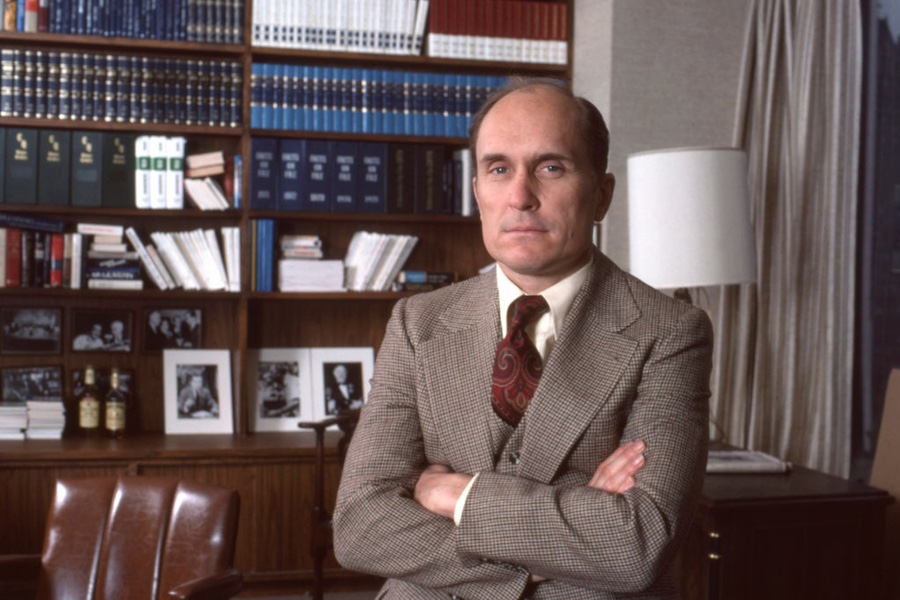
The death of the actor Robert Duvall at the age of 95 – almost exactly a year after that of his friend Gene Hackman – brings to the end another chapter of Old Hollywood. But unlike Hackman, who combined on-screen brilliance with a combustible, confrontational personality, Duvall was a thoroughly professional and popular figure who was a delight to work with, by all accounts.
Over the course of a career that spanned six decades – beginning with his performance as the misunderstood Boo Radley in the instant classic To Kill A Mockingbird in 1962 and ending with his supporting appearance in the intriguing 2022 gothic drama The Pale Blue Eye – Duvall was a chameleon-like actor who could segue between charm, folksiness, chilling villainy and whatever he came up with in The Godfather and its sequel as the consigliere Tom Hagen, the kind of man who would put a knife in your back with a smile on his face. He worked especially well with Godfather director Francis Ford Coppola and this led to many of his most memorable performances. This included his unhinged Lt Colonel Kilgore in Apocalypse Now, in which Duvall delivered the immediately memorable line, ‘I love the smell of napalm in the morning’ and conducted his fleet of helicopters to the accompaniment of Wagner’s ‘Ride of the Valkyries’.
He was not a Method actor in the conventional sense of the term, but he managed to disappear into every part he played with charm and commitment
He could do big – insanely big – but Duvall could also do small, too. He won an Oscar for his performance as an alcoholic country and western star in the Christian-themed picture Tender Mercies, and exhibited a fine singing voice. He had it written into his contract that he would perform his own songs, saying ‘What’s the point if you’re not going to do your own singing? They’re just going to dub somebody else? I mean, there’s no point to that.’ That epitomised Duvall’s professionalism. He was not a Method actor in the conventional sense of the term, but he managed to disappear into every part he played with charm and commitment. However, he was nobody’s fool; when the producers of the belated Godfather sequel The Godfather Part III refused to pay him what he considered a fair fee, he refused to reprise his role as Hagen, and left a significant gap in what ended up being a far inferior picture to its predecessors.
He was unusual in contemporary Hollywood in that he was a conservative Republican who variously supported George W. Bush – who awarded him a National Medal of Arts in 2005 – Mitt Romney and Rudy Guiliani in senior political roles. But he was never a MAGA figure, and said towards the end of his life that he considered his one-time party to be a mess. Duvall was his own man, and, although in typical Hollywood style, he was married four times, he stayed on good terms with his former wives. He preferred to live on a ranch in Virginia rather than in some Beverly Hills mansion, and although he was a Christian, eschewed grand demonstrative displays of his faith, allowing his work to speak for itself through pictures such as his evangelical-themed drama The Apostle.
Duvall was close to both Dustin Hoffman and Hackman, and said of the latter, with whom he starred in Coppola’s The Conversation, that, ‘A friend is someone who many years ago offered you his last $300 when you broke your pelvis. A friend is Gene Hackman.’ Now that both actors – along with Duvall’s The Natural co-star Robert Redford – have left the scene, Hollywood seems a less interesting, less distinguished place. But we will always have Hagen, Kilgore and many others, and for that the great Robert Duvall deserves every cineaste’s lasting affection.



Comments