
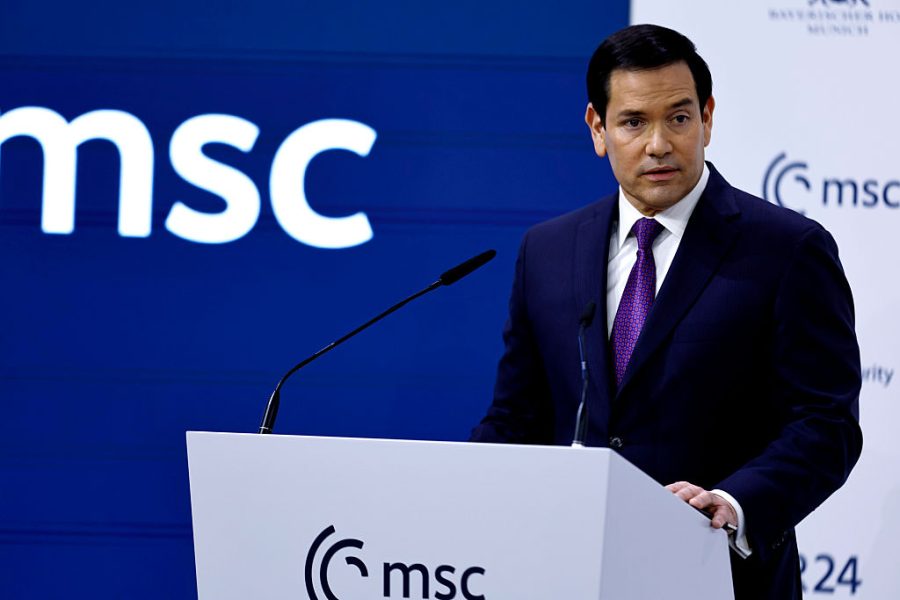
As Marco Rubio boarded his flight for Munich on Thursday night, he sought to reassure nervous Europeans that they weren’t about to be berated by America. “We’ll be good,” he said. It appears the US Secretary of State kept his word when he addressed the Munich security conference this morning.
Rubio kicked off his speech by harking back to 1963, the year Munich played host to the first security conference. Back then, he said, “the line between communism and freedom ran through the heart of Germany. Soviet communism was on the march and thousands of years of western civilization hung in the balance.” Triumphing over communism had, however, allowed the West to be seduced by the “dangerous delusion that we entered ‘the end of history’.” The West’s leaders, he said, had made mistakes allowing free trade to flourish globally; they had “appeased a climate cult” and invested in “massive” welfare states at the cost of defense.
Mass migration featured heavily in Rubio’s speech. The West, he said, had opened its “doors to an unprecedented wave of mass migration that threatens the cohesion of our societies, the continuity of our culture and the future of our people.” This was a theme the Secretary of State returned to regularly throughout his address. He said the term “rules-based global order” – bandied around a lot this weekend – was “overused.”
Rubio’s message is really the same as Vance’s last year
It is no understatement to say that everything at the Munich security conference was building up to the US Secretary of State’s speech this morning – everyone I have spoken to in the last couple of days has brought up Rubio’s address. The key driver of this nervous anticipation was the speech Rubio’s colleague, US vice president J.D. Vance, gave at last year’s summit when he declared that the biggest threat to Europe was not Russia or China but “from within.”
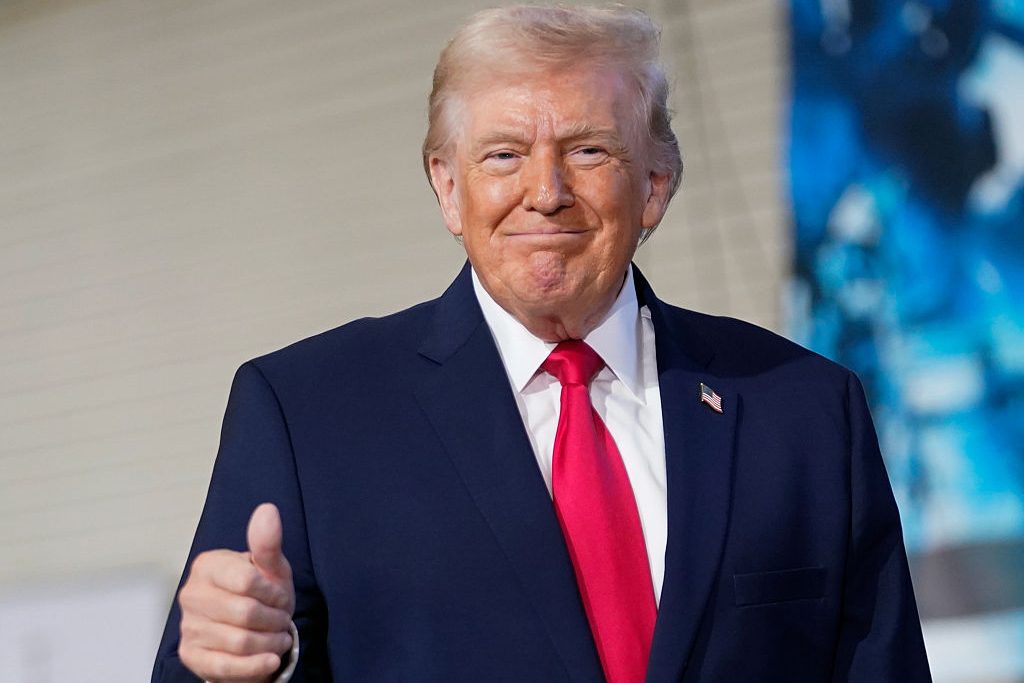
Where Vance used his adversarial speech to denounce mistakes, as he saw them, on migration, the economy, defense and climate as Europe’s alone, Rubio took a more communal approach:
We made these mistakes together, and now together, we owe it to our people to face those facts and to move forward.
Rubio jumped through phases of American history in his speech, paying tribute to his country’s European heritage – from the first colonies founded by English settlers to the Scots-Irish pioneers of the American frontier. “Our most iconic city was named New Amsterdam before it was named New York,” he declared. He also repeatedly referenced America and Europe’s shared Christian culture; this was a speech designed to hammer home the message that America and Europe are two parts of the same civilization.
The Secretary of State also tackled the elephant in the room, implicitly referring to Vance’s Munich speech last year and the wrecking ball outbursts of president Donald Trump over the past year: “This is why we Americans may sometimes come off as a little direct and urgent in our counsel.” “We care deeply,” he said.
Intriguingly, Rubio offered an olive branch of sorts to the European nations who took umbrage last month when Trump claimed that allied nations “stayed a little back, a little off the frontlines” while fighting in Afghanistan alongside the US. Rubio proclaimed: “We have bled and died side-by-side on battlefields from Kapyong to Kandahar.” This is certain to have gone down well with America’s Nato allies.
But while his delivery was softer and more diplomatic, Rubio’s message is really the same as Vance’s last year. “We are prepared if necessary,” he said, “to do this alone; it is our preference and our hope to this together with you, our friends here in Europe.” Being “polite caretakers of the West’s managed decline” is something America has no interest in being, he added.
With his speech today, Rubio had a tightrope to walk between maintaining civility with already tetchy and mistrustful Europeans and, with Trump listening back in Washington, delivering the US administration’s key messages. Coming to the end of his address, Rubio said: “For us Americans, our home may be in the western hemisphere but we will always be a child of Europe.” This may have been intended to create affinity with the European politicians in the audience. But whether they will swallow another – albeit sweeter – dose of Maga medicine is another question altogether.
The standing ovation Rubio received at the end of his speech shows there was relief in Europe that he refrained from taking another whack at the continent. But the stony faces of the EU’s top politicians – chief among them Kaja Kallas – suggest that Rubio’s speech will have done little more than paper over some already large cracks between America and Europe.



Comments