
Munich, Germany
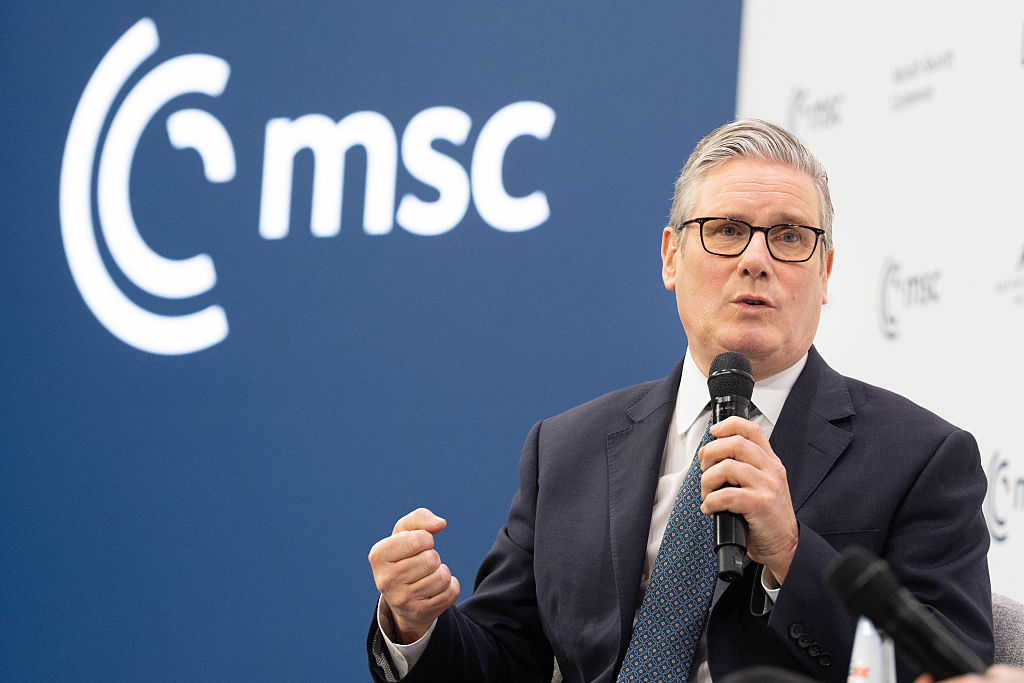
It’s no secret that Keir Starmer prefers foreign diplomacy to the domestic side of his job. So after perhaps the most difficult week of his leadership so far, the Prime Minister was no doubt relieved to have made it to the Munich security conference today, addressing delegates in the main conference hall this morning.
Starmer was unexpectedly forthright in his address: Britain would be prepared to fight
Starmer began by warning that the prospect of war for Britain was no longer a remote one. Russia, he warned, could be ready to use force against the Nato alliance ‘by the end of this decade’. In doing so, he echoed key figures of the British armed forces and intelligence services who, in recent months, have said much the same. ‘The world has changed fundamentally,’ he said. ‘We must find new ways to uphold our values and the rule of law.’ He repeated this last point on the ‘rule of law’ at least twice more in the course of his speech.
Starmer was unexpectedly forthright in his address: Britain would be prepared to fight. He underlined the importance of the Nato’s Article 5, a Musketeer-type clause that commits members of the alliance to mutual defence in the event of an attack. ‘If called on, the UK would come to your aid today,’ he declared.
It had been trailed in the press before he spoke that Starmer would declare that ‘we are not the Britain of the Brexit years anymore.’ When he read this sentence out, it received a large round of applause from the audience – perhaps to be expected given the crowd was predominantly made up of Europeans.
The Prime Minister went on to call for greater cooperation with the continent, declaring that Britain must ‘move closer to the single market’ in a variety of undisclosed areas. He presented a vision of European security that ‘does not herald US withdrawal but answers the call for more burden-sharing in full’. He called on European allies to work with Britain to continue building a joint defence industry – although, given the collapse in the talks regarding the UK joining the EU’s defence procurement scheme, it is unclear what shape Starmer now wanted this collaboration to take.
Starmer’s big announcement of the day was that the UK will deploy its carrier strike group to the North Atlantic and high North later this year. This would be led, Starmer said, by the HMS Prince of Wales, Britain’s biggest warship – although the Prime Minister didn’t say when the deployment would begin. This is a clear response to Donald Trump’s overtures earlier this year towards Greenland. Asked in the question and answer session that followed if Starmer thought the threat to Greenland had faded, the Prime Minister avoided giving a direct answer.
Starmer’s key message to Europe was that Britain is ready to work ever more closely with the continent. But coming at the end of a week in which he had to fight for his political life, the Prime Minister seemed arguably more preoccupied with foes closer to home than Russia.
His speech was full of double-entendres directed at critics back in Britain as much as at European and American allies in the room. The need for Europe to ‘stand on our own two feet now’ means ‘putting away petty politics and short-term concerns’. It was hard not to read this as a challenge to Labour MPs who, in recent days and weeks, have been growing increasingly febrile since the fallout from the Jeffrey Epstein scandal. ‘I will always fight for what’s best for my country,’ he added defiantly.
At times Starmer’s speech felt more appropriate for a general election campaign rather than an international defence conference. He pointedly criticised the ‘peddlers of easy answers’ who were ‘soft on Russia’ and ‘weak on Nato if not outright opposed’ to it. Without naming them, he hit out at Reform UK and the Green party, saying while ‘some of the extremes of our politics chip away at’ Britain’s membership of Nato, ‘we defend it’. He honed his attack further in the Q&A session: ‘Reform are pro-Putin. Imagine if they were in power in the UK. The coalition of the willing could not exist,’ he claimed.
He also appeared to issue a rebuke to those who have dubbed the Prime Minister ‘never-here-Keir’, declaring that staying in control as the world grew more dangerous was ‘why I devote time as Britain’s Prime Minister to leadership on the world stage’. Asked directly by the moderator if he thought he had come close to being toppled last week, he said: ‘I ended the week much stronger than I stared it and that’s a great position to be in.’
But the inconvenient truth is that the chaos back in Westminster has been noticed by Europeans here in Munich. Starmer doesn’t need to utter more words of friendship to convince the continent that his government is ready to work closer with Europe. Instead, he needs to prove that he’s going to be here for the long haul.





Comments