
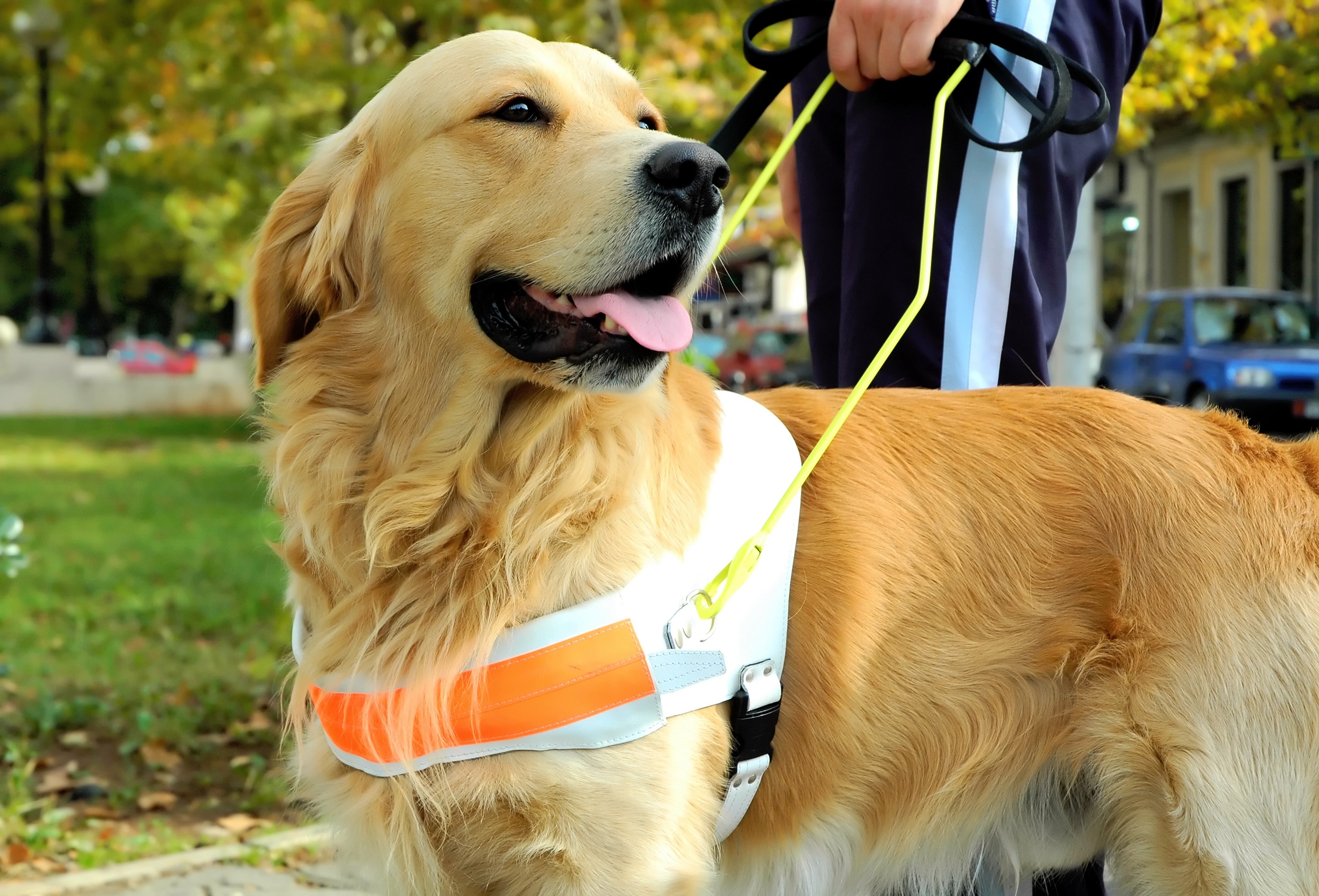
I’ve long clung hold of one small crumb of comfort from my encroaching blindness. Namely that if and when my deteriorating vision (I have albinism and nystagmus) packs up completely, I can become one of those blokes who takes his guide dog to the pub and teaches it to drink beer from an ashtray.
But I won’t be doing that at any branches of J.D. Wetherspoon as things stand. As of this week, flyers alighting at Alicante airport can get a morning pint at the first branch of the chain to open on Spanish soil. Back at home, however, the issue facing the pub concerns hounds, not holidaymakers. The equality watchdog has taken the mega-chain to task for its policy of refusing to serve customers with disabilities whose assistance dogs do not have their own photo ID.
The charity Assistance Dogs UK claims this policy is discriminatory and that no identification for dogs is legally required. The Equality and Human Rights Commission is now investigating, while numerous blind people have recounted their stories of being refused a drink with their guide dog in tow to the BBC.
The reasoning Wetherspoon has given is fairly extraordinary. The chain states that the guide dog ID rule was brought in after a spate of people tried to get a drink with ‘fake’ guide dogs, using bogus IDs and dog jackets, which, admittedly, can be purchased online.
I contacted the Wetherspoon press office to get some hard stats on roughly how many incidents of people attempting to bring fake guide dogs in had actually been recorded in its hundreds of pubs nationwide. I got a written reply that stated: ‘We do not have information as to the numbers of dog owners bringing official-looking documentation purchased on the internet.’
As always when I receive responses like these, my conclusion is that if a company isn’t inclined to give me specific stats and data, then I’m inclined not to believe that there’s a problem.
How likely do you think it is that someone would go to the trouble and expense to truss up their hound as a guide dog just to drink at a ‘Spoons’? I’m amused by the idea of someone with a shih tzu or an English bulldog attempting to convince bar staff that they’re blind and that Rover is the real deal – but it seems fanciful.
How likely do you think it is that someone would go to the trouble and expense to truss up their hound just to drink at a ‘Spoons?’
More seriously, this means that people with disabilities (who have enough to deal with as it is) now have to grapple with obtaining yet another form of ID, simply to have a lager. Anyone who has had first hand or vicarious dealings with the avalanche of paperwork involved in a personal independence payment application will visibly sag at the prospect of yet more authentication being required, purely to appease a chain that seems to have a fierce dislike of dogs in general (they are completely banned in all Wetherspoon pubs) and a borderline neurotic paranoia about the guide dogs they are legally obligated to accept.
What is the issue exactly? Dogs don’t get drunk. They prefer sleeping under tables to barking and fighting and they always know how to get home. This puts them above many human Wetherspoon customers in terms of civic behaviour. Were it not for their lack of disposable income, dogs would be the ideal customer for any pub.
Yet the banishment of dogs from Britain’s biggest chain erodes a history that dates back to the mid-17th century when the pub name ‘Dog and Duck’ first came into usage. What would the pub scenes in Three Men In A Boat be without the famous four-legged member of their bumbling boating party Montmorency? And it’s hard to imagine Bill Sikes stewing and conspiring in the Three Cripples, without his dog Bullseye.
Some dogs have bad owners. Some owners have bad dogs. And, yes, it might be possible that, somewhere in the UK, there is a dachshund with a fake guide dog ID that’s been used to gain service at a Spoons. But, ultimately, if I’m given a choice between sharing a pub with a few dogs or a few children, then my preference would be a yappy jack russell over a two-year-old screaming for their games console.
In a time when pubs are on their knees (even Wetherspoon potentate Tim Martin claims that his brand is paying more than £800 million in tax per year) it seems ludicrous to continue this stand-off. We’re a nation of drinkers and a nation of dog lovers. For a brand like Wetherspoon that claims to be so proud of its Britishness, this enforced separation appears even more ludicrous than a pomeranian with a work harness and yellow fluorescent stripes.





Comments