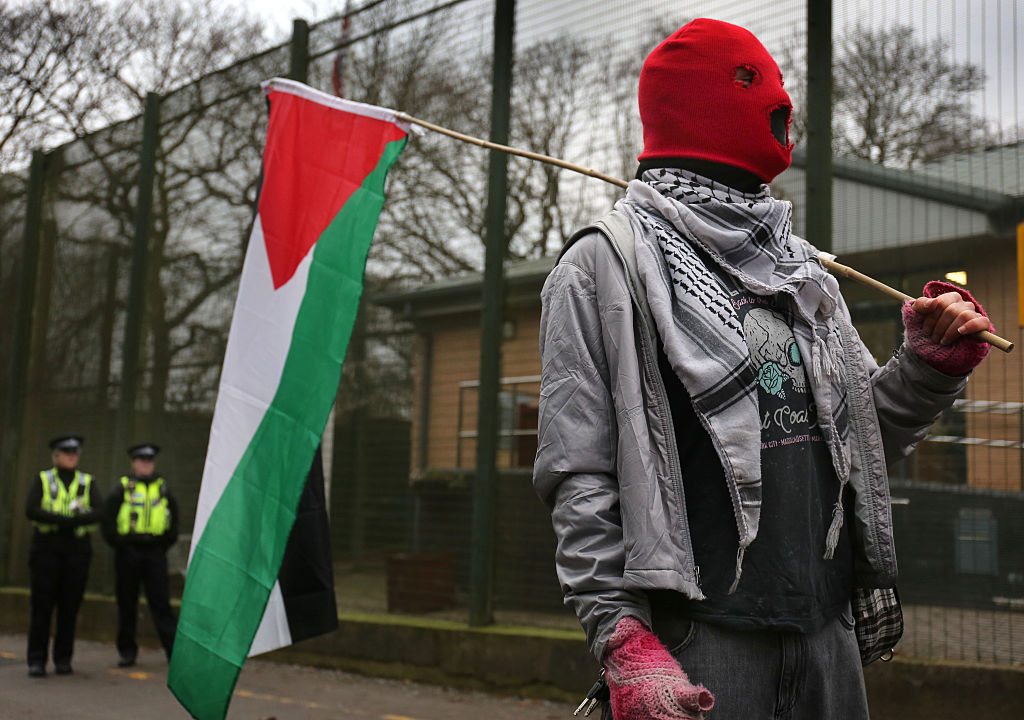
Five out of six Palestine Action protesters on trial in relation to a break-in at the Elbit Systems factory in Filton in 2024 were released on bail on Wednesday. The verdicts handed down to them at Woolwich crown court over events at the UK subsidiary of the Israeli defence manufacturer – reported to have caused over £1 million’s worth of damage – will not have pleased the government. Labour has been desperate to show its zeal in fighting violent protest and assure supporters of Israel that it hasn’t abandoned them.
Nevertheless, despite whoops of delight from left-wingers including Jeremy Corbyn and Zack Polanski – together with others who ought to have known better – the result was very far from a vindication of the defendants’ actions. Still less did it vindicate any belief that jurors have the right to express their dislike of the law by refusing to convict someone based on their conscience.
Today, protests – especially those aimed at buildings and property – are depressingly normal
For one thing, the Palestine Action protestors were only actually acquitted on charges of aggravated burglary and violent disorder. These verdicts were entirely defensible. The defendants had stoutly denied that they had gone in looking for trouble or tooled up for personal violence, which the prosecution had to prove. Whatever readers may think, it is a fair inference that the jury believed them – as they had a right to do. On the other charges, notably criminal damage and intentionally causing grievous bodily harm to a policewoman, the jury could not agree and was discharged. The result is that the accused, far from being cleared, now face a retrial later this month.
Despite suggestions to the contrary by progressives, there is no indication that the jurors in this case were exercising a perceived prerogative to disregard the law, or anything like it. They specifically asked the judge whether the reasons given by the accused for being there – that disabling the factory would hamper alleged Israeli genocide – amounted to an excuse for the crime they were charged with. They were equally specifically told that it did not, and the defence barrister, while addressing the jury, never suggested that it did either.
It is perhaps best at this point to shut up about these defendants. You may like or detest Palestine Action zealots, but whatever you think, their right (and that of the Crown) to a fair retrial must be carefully preserved.
However, all this should make us think twice about something more general. Should we, like many from both left and right, still maintain hard-line support for preserving jury trials come what may? Should we do so despite suggestions from Sir Brian Leveson and now Justice Secretary David Lammy to curtail it? True, the reasons for these suggestions don’t have much to do with justice: Leveson is more interested in administrative efficiency and Lammy, frankly, in saving money. But there is a point to be made on justice too.
The jury may be an ancient institution, but the idea of a principled need to retain it for all high-profile cases, including serious public order offences and criminal damage, is newer. It became accepted dogma at a time when violent and destructive political protests were fairly rare. For that matter, juries themselves were also more selective (only in 1972 was the requirement for jurors to own or rent a property of a certain value scrapped).
Today, however, such protests, especially those aimed at buildings and property, are depressingly normal. Furthermore, in recent years there have been increasing numbers of cases of this kind where juries have simply refused to convict: think of the 2023 case involving the toppling of the Edward Colston statue in Bristol or the climate protesters who vandalised Stonehenge in 2024. Both resulted in acquittals in the face of fairly clear evidence.
This is important. Protecting individuals acting alone or in small groups from state overreach is one thing. But once there is a perception that even if the people taking part are arrested, local juries will refuse to convict them, there is a risk it becomes difficult to suppress open threats to peace and public order. This is a different matter. Whatever we may think about making the state convince twelve citizens of someone’s guilt before it can punish individual speech or action, there is a strong democratic case for saying that protest movements aimed at changing state policy have to act by persuasion rather than force. If so, then collective attacks on public order aimed at bypassing this requirement should be suppressed without particular regard for how popular the cause they support is.
Indeed, this may well be a suggestion for where in future jury trials should end and judge-only trials begin. There are cases where juries are indeed necessary to safeguard the small man or woman against an overweening state. State offences, charges arising from whistleblowing, speech offences and cases where householders are charged with using force against intruders all involve fairly vague ideas such as offensiveness or reasonableness. It is quite right that these issues should be decided by citizens rather than state officials.
But when more hard-edged crimes such as criminal damage or violent disorder are involved, things become different. They threaten the body politic; the body politic has a right to deal with them clearly and unequivocally. If doing this means cutting back on the right to jury trial, so be it.




Comments