Over the last week, the USS Abraham Lincoln aircraft carrier, additional F-15 fighter planes and naval vessels carrying sea-launched cruise missiles have been making their way to the Middle East in what can only be described as a bid by President Trump to squeeze Iran into submission. In case anybody doubted this is what Trump was after, he took to Truth Social early in the morning to send the Iranians a message: give me what I want or face bombing the likes of which you’ve never seen. “A massive Armada is heading to Iran. It is moving quickly, with great power, enthusiasm, and purpose,” Trump wrote. “Hopefully Iran will quickly “Come to the Table” and negotiate a fair and equitable deal – NO NUCLEAR WEAPONS – one that is good for all parties.”
What deal is Trump referring to? In short: surrender. It’s less a deal per se and more straight-up capitulation, whereby the Iranians hand over their nuclear and missile programs on a silver platter to the Americans. According to some reports, the Trump administration is aiming for a masterstroke: Iran destroys its nuclear program, moves all of its enriched uranium out of the country, agrees not to enrich again, caps its long-range ballistic missile stockpile and cuts ties with the very proxy groups – Lebanese Hezbollah, Iraqi Shia militias, Hamas, Palestinian Islamic Jihad and the Houthis – it has spent decades supporting. If some of this sounds familiar, that’s because it is – during nuclear negotiations last spring between Washington and Tehran, the White House resisted any arrangement that provided Iran with even a cursory uranium enrichment program on Iranian soil. The Iranians kept pushing time and time again, Trump got frustrated with talking and eventually decided to support Israel’s 12-day war.
Iranian Supreme Leader Ayatollah Ali Khamenei doesn’t appear any more amenable to Trump’s demands now than he was back in June. “Last time the U.S. blundered into wars in Afghanistan and Iraq, it squandered over $7 trillion and lost more than 7,000 American lives,” Iran’s UN Mission blasted out in response to Trump’s post. “Iran stands ready for dialogue based on mutual respect and interests – BUT IF PUSHED, IT WILL DEFEND ITSELF AND RESPOND LIKE NEVER BEFORE!” Translation: if you expect us to submit, you will be sadly mistaken.
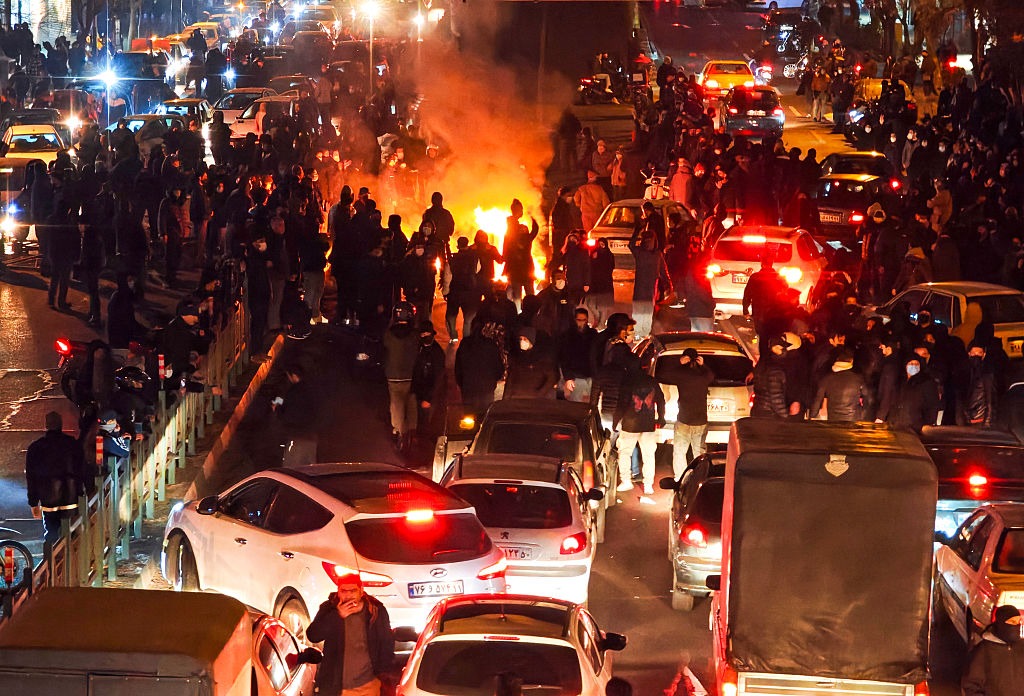
Bombastic language from the mullahs is par for the course. But the reality is that Iran doesn’t have a good set of options. In fact, their choices range from really bad to the worst. The Iranian economy is a mess, a consequence of tight US sanctions, runaway inflation and an overabundance of supply on the global oil market. The regime holds no enduring value for the people they ostensibly represent, and any covenant the Islamic Republic held with the Iranian population was burned to embers in the weeks since the Iranian security forces snuffed out nation-wide protests with extreme violence (deaths range from 5,000 to 30,000). The Iranian security establishment is still recuperating from Israel’s relentless airstrike campaign in June, when half its missile launchers were destroyed, its military leadership was gutted and its crown jewel – the enrichment infrastructure it spent three decades building at a cost of hundreds of billions of dollars in lost commerce – was heavily damaged in a US attack.
Any choice Khamenei makes will be a losing one. Catering to Trump’s maximalism would expose the Islamic Republic as a weak state whose capacity to inflict damage on US interests in the Middle East was, if not inept, then at least greatly exaggerated. That’s not a great look for deterrence. Hardliners within the Iranian establishment – and yes, there are figures who are more hardline than the 86 year-old Khamenei – will cry foul and might even try to make a play for leadership.
Resisting, however, could be even more damaging. Trump doesn’t like hearing the word “no,” particularly when the person doing the naysaying is a long-lasting US adversary who frequently calls out the American president as an imperialistic lunatic during his Friday sermons. Trump has also proved that he’s willing to brandish the military stick when it suits him – in his first year, Trump bombed Islamic militants in Nigeria, waged a weeks-long air campaign against the Houthis in Yemen, flirted with taking Greenland by force and ordered a snatch-and-grab operation against Venezuela’s Nicolás Maduro. Iran was also a target of Trump’s wrath, which means the Iranians can’t simply assume that the loud-mouthed New Yorker is bluffing.
Yet as bad as Iran’s position is, Trump needs to ask some questions as well. Iran’s military apparatus is weaker than it was and can’t possibly compete with the United States conventionally, but it retains options – closing the Strait of Hormuz, sending ballistic missiles into any one of the US military bases that dot the Persian Gulf and encouraging Iraq’s militias to do the same – that can cause the United States pain. Last June, Iran retaliated to Trump’s airstrikes by launching a salvo of ballistic missiles toward the US Air Base in al-Udeid, Qatar. Those missiles were easily shot down, in part because Tehran deliberately telegraphed the response in order to minimize damage and create an off-ramp with Washington. US military planners can’t assume Iranian retaliation will be as symbolic as it was back then, especially if Khamenei and the Islamic Revolutionary Guard Corps (IRGC) conclude that Trump’s real purpose is to forcefully overthrow the regime.
Testifying to the Senate Foreign Relations Committee, Secretary of State Marco Rubio alleged that the current US military buildup in the region was strictly about defending US personnel based there. In the next breath, he left a preemptive US strike on the table. The mood is on tenterhooks, just as Trump likes it.
Daniel DePetris
Iran is out of good options
Trump is threatening bombing the likes of which Tehran has never seen




Comments