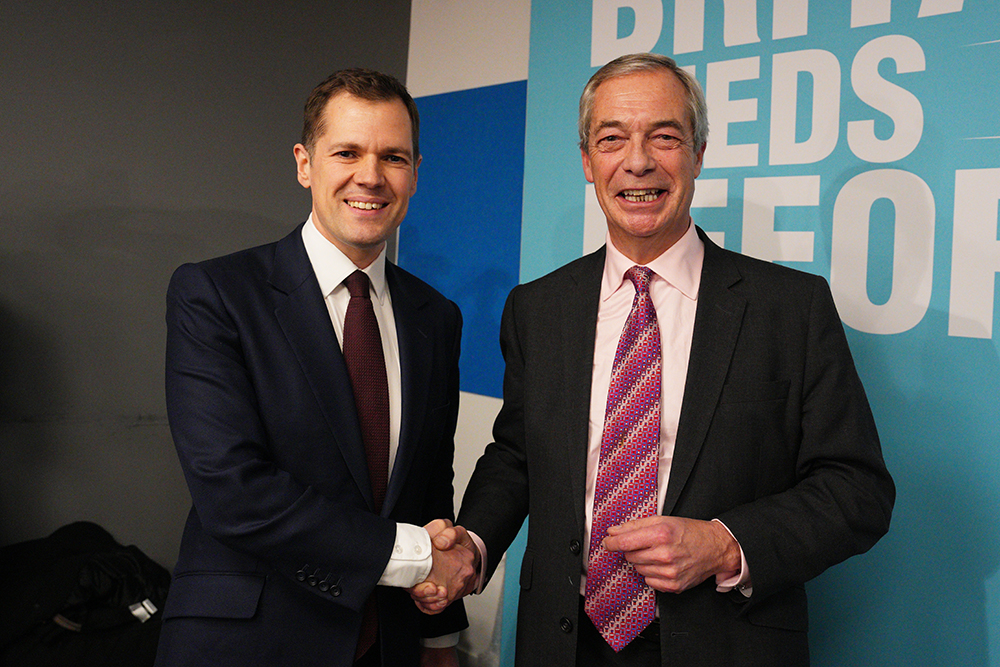
In the summer of 1643, as the dispute between Charles I and parliament raged on, Sir William Waller wrote to his friend Ralph Hopton to lament with ‘what a perfect hatred’ he detested ‘this war without an enemy’. The hardening of hearts between the Conservatives and Reform UK resembles a similarly self-defeating civil war – a family dispute more public and bitter even than the Fall of the House of Beckham.
Just over a year ago, Robert Jenrick narrowly lost the Tory leadership contest to Kemi Badenoch. For some, his defection to Nigel Farage’s party was the overdue exit of a shameless careerist who never accepted coming second. But for the Conservatives who supported him, Jenrick’s departure means the loss of one of the party’s most thoughtful and energetic MPs – who in his enthusiasm for taking the fight to Labour (and tackling fare-dodging) made him the shadow cabinet’s premier pugilist.
The battle line being drawn is over the central thrust of Jenrick’s defection speech: that Britain is broken. He anatomised what he saw as the principal areas of failure – real wages flatlining since the financial crisis; the highest house prices in the Organisation for Economic Co-operation and Development; one in five working-age Britons unemployed; and a halving of our heavy industry in two decades. According to a poll for the i newspaper, Jenrick’s diagnosis is one with which three-quarters of voters broadly agree.
But for many of his former colleagues, declaring Britain to be broken is unduly pessimistic. As fashionable as it has become to decry 14 wasted Tory years, doing so ignores genuine achievements by the governments Jenrick supported: better state schools, a simplified welfare system, Brexit delivered and a culture of technological and environmental innovation. Undoubtedly, mistakes were made. But talking Britain down only encourages fatalism.
The Tory-Reform split masks the emergence of a remarkably coherent right-wing solution to Britain’s ills
Yet for all their semantic disputes and personal rivalries, the Tory-Reform split masks the emergence of a remarkably coherent right-wing diagnosis of, and solution to, Britain’s ills: national conservatism. According to James Orr, Reform’s principal academic guru, this is a ‘politics of national preference’ that addresses ‘the growing sense of cultural erosion and economic decline’ experienced by millions. It prioritises restoring sovereignty, national pride and domestic production over globalisation, mass immigration and social liberalism.
Orr and Danny Kruger are among the most eloquent proponents of a renewed politics of national self-assertion. But the most detailed policy work by far in this area has been done by Tories – principally the MPs Neil O’Brien and Nick Timothy and the thinktankers Gavin Rice, Rachel Wolf, Peter Franklin and Henry George. The greatest tragedy of the right’s split is that these talents are working at cross-purposes, rather than uniting to produce the most coherent right-wing agenda for government since the late 1970s.
There is much in a politics of national interest with which Badenoch would agree. The policies of the two parties are similar. Both want to leave the European Convention on Human Rights, scrap Britain’s net-zero target and cut taxes. The major area of difference has been Farage’s enthusiasm for spending, whether on nationalisations of the steel and water industries or abolishing the two-child benefit cap. Then again, both parties have shown a timidity in areas where radical action would alienate their ageing bases, such as house-building or the pensions triple-lock.
Defectors might win Reform a day’s headlines, but it is how Jenrick, Kruger et al are deployed that will prove whether or not attacks on the records of ex-ministers are merely hostages to fortune. Kruger was appointed Reform’s head of preparing for government. For all his eloquence, his recommendations so far have amounted to cutting the civil service headcount rather than a truly radical prospectus – proposals more in the spirit of management consultancy than the sweep of Keith Joseph or Dominic Cummings.
Despite promises to cut waste and reduce bills, Reform-led areas have hiked council tax. Councillors have found themselves frustrated by local officials and distracted by rows over personnel, flags and green projects. The party’s much-hyped Doge unit, like its counterpart across the Atlantic, has faded into obscurity, its mission far from complete. If Reform cannot show that they would do anything differently to the two old parties, voters might look between them and conclude it is already impossible to say which is which.
Reform have now led in the polls for longer than the SDP/Liberal Alliance managed in the early 1980s. But rumours of the death of the Tories have been greatly exaggerated. Since Badenoch’s forceful party conference and response to the Budget, her ratings and those of her party have risen. The latest departures have done much to draw remaining Tory MPs together; with her recent economic focus, Badenoch is both outflanking Reform from the right and proving that a politics of national preference should also balance the books.
Ultimately, the similarities between the parties provides an opportunity. If the outcome of the next election forces Farage and Badenoch to work together, hashing out a common programme should not prove too difficult – a process smoothed by familiar faces. Unlike in the 1640s, no one should have to lose their head.






Comments