The Spectator

After Omicron: there’s no longer a case for restrictions on liberty

Covid-19 is in decline in Britain, with Omicron cases now falling as fast as they rose. The booster programme — which covers 95 per cent of pensioners — has helped fend off the risk of hospitals being overwhelmed. This gives Boris Johnson the chance to say that his plan worked, that Britain benefited from having the highest booster protection in Europe and that we can now repair the damage of a two-year crisis. The great recovery can begin — or it could if Johnson were able to lead. His bizarre decision to self-isolate last week — he was under no obligation to do so — gave the impression that he was hiding from questions about his parties and staff misbehaviour during lockdown.

Are tsunamis becoming more deadly?

Stumped again Were England always so hopeless playing Australia at cricket? Since the first match in 1877 there have been 72 series between England and Australia. Australia have a narrow advantage of 34 series wins against 32 to England, with six draws. But measured on individual matches, Australia have a far bigger lead, with 150 victories against England’s 110, with 96 draws. Licence to bill How many households have TV licences? 2011/12 25,226,070 2012/13 25,338,330 2013/14 25,419,300 2014/15 25,507,730 2015/16 25,558,190 2016/17 25,826,120 2017/18 25,836,500 2018/19 25,752,560 2019/20 25,527,840 2020/21 24,837,260 Source: TV Licensing Lethal wave Are tsunamis becoming more deadly?

Letters: Our broken civil service

Beyond the party Sir: Rod Liddle is spot-on in arguing that the attitudes revealed by ‘partygate’ extend to senior civil servants (‘The truth about that No. 10 party’, 15 January). He gets the extent wrong by tarring all public-sector workers with the same brush, which would include all NHS workers, and is not true. What is true is that the attitude has indeed spread in the civil service well beyond the public school and Oxbridge-educated elite. I spent a couple of years seconded to a department of state, trying to make progress on implementing reforms that had been approved by parliament. I failed. I was eventually blackballed for speaking truth to power — that is, reporting directly to a minister, as my contract said I should.

Portrait of the week: Saving Big Dog, scrapping the licence fee and tsunami hits Tonga

Home Sue Gray, Second Permanent Secretary at the Cabinet Office, having been asked by Boris Johnson to look into accusations of parties held at 10 Downing Street, in turn formally asked him about them. Newspaper reports about such gatherings continued day after day, and Dominic Cummings, the Prime Minister’s former chief adviser, said that he had warned Johnson in advance about one for 40 people in the garden on 20 May 2020, telling him: ‘You’ve got to grip this madhouse.’ ‘Nobody warned me that it was against the rules,’ the PM said. The commentariat at large talked of Operation Save Big Dog, by which officials would take the blame to preserve the Prime Minister.

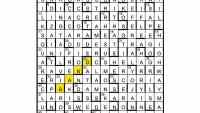
2536: At rest – solution

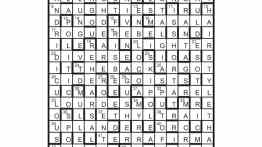
The unclued lights (3 composers, 3 artists and 3 writers) are all buried in Père Lachaise Cemetery. The name should have a grave (accent), which is also thematic as it is a cemetery. First prize Miss Charlotte Bull, Leyton, London E11 Runners-up Mrs J. Warburton, Hertford; Prof. Colin Ratledge, Leven, E.

Letters: Unfair care costs will turn the red wall blue

Take care Sir: Your editorial (‘Counting the costs’, 8 January) makes valid points regarding the funding of social care. The good people of the north in the red-wall seats will be rightly appalled. A couple who have worked hard and made their own way onto the property ladder must wonder what they have voted for. They sit on a property worth £100,000 to £200,000. If they need a care home, they will see their children’s legacy disappear into the hole of care costs while knowing that they are subsidising the same care costs of millionaires. This is deeply unfair and, I daresay, anti-Conservative. There should be no care costs on a modest legacy of, say, less than £250,000.

Portrait of the week: No. 10’s garden party, Djokovic’s visa row and France’s vaccine protests

Home Boris Johnson admitted to attending evening drinks for about 40 staff in the garden of 10 Downing Street on 20 May 2020, when lockdown regulations made social gatherings illegal. ‘We thought it would be nice to make the most of the lovely weather and have some socially distanced drinks in the No. 10 garden this evening,’ said an email from the Prime Minister’s principal private secretary, Martin Reynolds. ‘Please join us from 6 p.m. and bring your own booze!’ Mr Johnson said that he had been talking to Rishi Sunak, the Chancellor of the Exchequer, about how people could be helped with soaring energy bills.

When did the anti-vaxx movement begin?

No vax There is nothing new about the anti-vax crowds supporting Novak Djokovic. Organised protest in Britain began with the formation of the Leicester Anti-Vaccination League in 1869. Vaccination of children against smallpox had been compulsory since 1853, but faith in the vaccine plummeted with an epidemic which erupted in the city in spite of vaccination — 314 died from the disease in 1871/72. There was also increasing anger at the jailing of vaccine refuseniks, 61 of whom were imprisoned between 1869 and 1884. Thousands gathered on 23 March 1885 for an anti-vaccination march from the Temperance Hall to the Market Place. In 1898 the law was revised to allow conscientious objection.

Boris Johnson owes the country a proper apology

On 20 May 2020, the Metropolitan Police issued a statement on social media which summed up the conditions in the country. ‘Have you been enjoying the hottest day of the year so far?’ it asked. ‘You can relax, have a picnic, exercise or play sport, as long as you are: on your own, with people you live with or just you and one other person.’ To do otherwise, it didn’t have to say, would be a criminal offence. https://twitter.com/metpoliceuk/status/1263108555961442304?ref_src=twsrc%5Etfw In 10 Downing Street, however, Boris Johnson’s principal private secretary sent out a very different message to more than 100 staff members.

The cost of living – not Covid – could bring Boris down

Two and a half years into his premiership, Boris Johnson has enjoyed no more than a month of that time unencumbered either by Brexit negotiations or the public health emergency. Once Britain is through the worst of the Omicron wave, it would be understandable if the Prime Minister wanted to pursue some kind of political vision. The danger is that, as normality returns, his premiership will be further imperilled by the cost of living. An economic crisis is expected to hit households in April. In that month, National Insurance contributions (NICs) will go up by 1.25 per cent, a direct violation of Johnson’s manifesto pledge to protect voters from tax rises. The price cap on energy bills will also be raised, possibly doubling some customers’ costs as they come off fixed rates.

Letters: Afghan interpreters deserve better from Britain

Welcome changes Sir: Lloyd Evans’s sympathetic piece on the fate of Afghans once they arrive in the UK made for sobering reading (‘New arrivals’, 18 December). In the Sulha Alliance we are endeavouring to support those Afghans and their families who served with and alongside British forces in Afghanistan. That is not the totality of Afghan migrants, but of the former interpreters and their families it can be truly said ‘they are here because we were there’ — and we owe them. I will not go over the whole sorry saga of the UK’s mistreatment of this group, but we really need a step change in how they are looked after.

Portrait of the week: Face masks in schools, vegan nuggets in Burger King and Big Ben bongs again

Home The warmest New Year’s Day on record saw a temperature of 16.3˚C (61.3˚F) in St James’s Park, London. A restored Big Ben rang in the new year for the first time in four years. Boris Johnson,the Prime Minister, announced he would soldier on with Plan B against coronavirus. The government, he said, had identified 100,000 critical workers to receive daily lateral flow tests. Some people would be treated at home in 2,500 ‘virtual beds’. Covid was widespread, thanks to the Omicron variant. In the seven days up to the beginning of this week, 911 people had died with coronavirus (compared with 858 in a week a month earlier), bringing total deaths (within 28 days of testing positive) to 148,778.

2535: Triplets – solution

Each unclued lights include one letter three times. The wording of the preamble precludes ALLYLS (2D which would be the second plural) and IRITIC (an adjective). 29D can be either TANNIN or NANKIN.

Most-read 2021: It’s time for NHS GPs to stop hiding behind their telephones

We’re ending the year by republishing our ten most popular pieces from 2021. Here's number eight: a Spectator editorial written in September about the need for GPs to resume face-to-face appointments. Nye Bevan famously said that he was only able to persuade family doctors to support the creation of the NHS because he ‘stuffed their mouths with gold’. But at least he obtained good service from them — including home visits. Until Tony Blair awarded GPs hefty pay rises while allowing them simultaneously to opt out of night-time and weekend work, they were responsible for their patients’ care 24 hours a day, seven days a week — with practices often pooling resources to provide continuous cover.

Did the psychics’ predictions for 2021 come true?

Centenaries 2022 will see the 100th anniversary of: the BBC; Reader’s Digest; Ulysses by James Joyce; insulin treatment for diabetes; canned baby food; Fascist government (Mussolini’s arrival as Italian prime minister); the first female barrister; ski slalom race; Test matches between England and New Zealand; water skiing; football pools; discovery of Tutankhamun’s tomb; … but not, interestingly, the 1922 Committee, which wasn’t set up until April 1923. Talking shop How much Christmas shopping did we manage to do before last year’s ‘cancelled’ Christmas? Volume of sales in December 2020 relative to December 2019: Department stores –5.

Portrait of the year: Lockdown, protests, parties and Matt Hancock’s kiss

January The United Kingdom found itself in possession of a trade agreement with the EU. Coronavirus restrictions were tightened. The Oxford-AstraZeneca vaccine was administered with authorisation for the first time; retired doctors could not vaccinate before undergoing ‘diversity’ training. To prevent vaccines being exported from the EU to Northern Ireland, the EU prepared to invoke Article 16 of the Northern Ireland Protocol, but soon changed its mind. The Capitol in Washington, DC was overrun by weird people, one with horns, supporting President Donald Trump, despite his electoral defeat. Joe Biden was inaugurated as President a week later. February The government promised to legalise the drinking of coffee by two people on a park bench.

The best children’s books: a Spectator Christmas survey

J.K. Rowling Poignant, funny and genuinely scary, The Hundred and One Dalmatians was one of my favourite books as a child and the story has lingered in my imagination ever since. Blue iced cakes always put me in mind of Cruella de Vil’s experimental food colourings, and whenever our dogs whine to get out at dusk I imagine them joining the canine news network, the twilight barking. There’s simply no resisting a book containing the lines ‘There are some people who always find beauty makes them feel sadder, which is a very mysterious thing’, and ‘Mr Dearly was a highly skilled dog-puncher’.

How to cure what ails the NHS

Wrong cure Sir: In referring to the UK as the highest-spending European nation in healthcare proportionate to GDP (‘Hospital pass’, 4 December), Kate Andrews paints an exaggerated picture which is based upon additional expenditure in the NHS during the Covid pandemic, partly accounted for by £38 billion spent on test and trace. The figures are further inflated by the UK suffering a relatively greater fall in GDP. In reality, the NHS has been woefully under-resourced compared to its European counterparts over the past decade, leaving it with approximately 50,000 fewer doctors compared to OECD averages, the second-lowest numbers of hospital beds per capita, and the lowest numbers of MRI scanners.