The Spectator

The army can’t be deployed for every crisis

From our UK edition

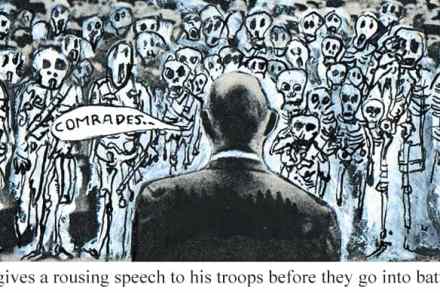
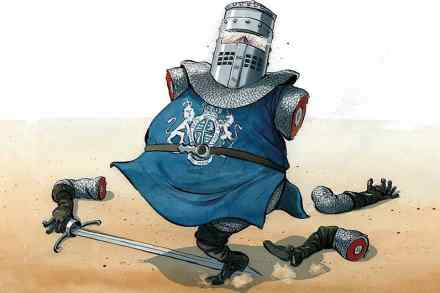
Last week, the government published its blueprint for how it intends to remodel the army. According to the plan, it won’t matter that the number of regular troops is being reduced to the smallest size since the Napoleonic wars because the remaining forces will be more ‘agile, integrated, lethal and expeditionary’. A strange theme is emerging in Boris Johnson’s government: the Prime Minister sees the army as the solution to any given problem — yet he is cutting it back to a record low size. Like Tony Blair before him, Johnson likes to deploy troops — but to help him win battles against his own government machine. He announced this week that the army will be helping out with a speeded-up vaccine booster programme.

How accurate is the ‘Waitrose test’?

From our UK edition

The Waitrose test Sir: Like Rod Liddle, I live in the north-east of England — a little further north and nearer to Sunderland (‘Keeping up appearances’, 27 November). The area is not particularly affluent and we do not have a Waitrose. For the first 30 years of my life there was an enormous slag heap in the area: a legacy of our coal-mining era and an eyesore. There was a deposit of open-cast, accessible coal next to the heap, and an opportunity arose to dig out the coal, deposit the slag heap into the space left, and then landscape the area into a beautiful country park with ponds and trees, suitable for walking, cycling and other pursuits.

A new Covid variant, a Labour reshuffle and a Twitter resignation

From our UK edition

Home In a nervous response to the entry into Britain of the Omicron variant of Covid-19 — B.1.1.529 — the wearing of face coverings in shops and public transport was made law again, though by statutory instrument not by an Act of Parliament. Anyone deemed to have been in contact with a Covid sufferer faced ten days’ house arrest. MPs voted in support of the measures after their introduction. Pubs and restaurants were exempt, but schoolchildren over the age of 12 had to wear masks in communal areas. ‘If we all decrease our social contacts a little bit, actually that helps to keep the variant at bay,’ said Dr Jenny Harries, the head of the UK Health Security Agency. But the government said people could go on with Christmas plans.

The true cost of Boris

From our UK edition

Earlier this week, the Conservative party sent an appeal to its registered supporters asking them to become members. ‘We’re delivering what you voted for in 2019,’ it read. ‘So why not help us keep going?’ Unfortunately for Boris Johnson, there are now several answers to that question. Two years ago, the Tories were re-elected on a promise to protect the public from the ever-rising cost of government. One of Johnson’s five pledges, personally signed by him, was not to raise taxation on ‘hard-working people’ and to stop any ‘jobs tax’. He has since changed his mind. In April, the Tory government will take a further 2.5 per cent of the salaries of those workers via National Insurance (i.e. a jobs tax).

Has Peppa Pig changed political sides?

From our UK edition

Red Peppa? In a rambling speech to the CBI, Boris Johnson praised Peppa Pig. Has she changed political sides? Peppa featured in advertising for New Labour’s Sure Start centres, and was booked to appear at the launch of Labour’s manifesto on families for the 2010 general election. However, her makers, E1 Entertainment, withdrew her at the last moment so as not to appear partisan. Lord Mandelson accused the BBC of being behind the move, suggesting the corporation was acting out of spite because Peppa was a star on rival Channel 5. Back on track Regular train services returned to Okehampton in Devon 49 years after the route was closed in the cuts proposed by British Rail chairman Richard Beeching.

Letters: Europe’s contribution to peace

From our UK edition

Peace project Sir: It was heartening to read your editorial on the peace which has reigned in Europe since 1945, in which you paid justified tribute to those who sacrificed their lives in the two world wars (‘Why we remember’, 13 November). You emphasised how Nato and the UN have contributed to the maintenance of peace, but sadly you failed to mention the European project and the EU. The first president of the European Council, Herman Van Rompuy, always insisted that the project of European integration, launched by Adenauer, Schuman and De Gasperi, was above all a ‘peace project’. That continues to be the view of today’s Commission president, Ursula von der Leyen. The peace dividend of the EU must not be overlooked. The UK may no longer be a member of the EU.

Portrait of the week: Boris’s shambolic CBI speech, more Covid protests and Kyle Rittenhouse is cleared

From our UK edition

Home Boris Johnson, the Prime Minister, praised Peppa Pig in a speech to the Confederation of British Industry: ‘Who would’ve believed that a pig that looks like a hairdryer... has now been exported to 180 countries?’ Then he lost his place and said: ‘Forgive me. Forgive me. Forgive me.’ Nineteen Conservative MPs voted against the government on a clause excluding means-tested council support payments from a new £86,000 lifetime limit on social care costs; it would mean a lost inheritance for heirs of people with assets worth no more than the limit. The writer J.K. Rowling was hounded by militant trans campaigners. ‘I’ve now received so many death threats I could paper the house with them,’ she said.

Books of the Year 2021

Matt Labash I read a lot of books. Probably well over sixty in the last year. I’m not saying that in some little-kid braggadocious way. After all, I’m fifty-one years old. Though some have said I read on a fifty-two-year-old level. In addition to the couple of books I have open at any time, a good deal of my book consumption comes via audio: I have an audiobook going in my car or on my MP3 player at all times. And at my advanced age, if I don’t dog-ear and underline a book, it’s lost down the memory hole forever, no matter how much I liked it. But one I do remember liking so much that it bears mentioning, is John Green’s The Anthropocene Reviewed: Essays on a Human-Centered Planet (Penguin, $28).

books

Emad Al Swealmeen should not have been in Britain

From our UK edition

Emad Al Swealmeen, who blew himself up in a taxi outside the Liverpool Women’s Hospital, is not believed to have been identified by security services as a terror suspect. Nevertheless, he should not have been in Britain. He lied about where he had come from, which ought to have been a red flag, enough in and of itself to warrant his return to his home country. Indeed, his application for asylum was rejected in 2014, but he was never removed. Instead, he reinvented himself as a Christian convert, gaining himself time and grounds for appeal and last Sunday, on Remembrance Day, he attempted to commit what could easily have been a devastating attack. Only a closed road, the fact that the bomb partially detonated and the bravery of the taxi driver prevented a dramatic death toll.

Books of the year II — a further selection of the books chosen by our regular reviewers

From our UK edition

Jonathan Sumption The reputation of Sir Edward Grey, Britain’s foreign secretary from 1905 to 1916, has never recovered from the pasting he received in Lloyd George’s war memoirs. Lloyd George thought that his deliberate ambiguity about Britain’s intentions led us into the first world war. If you read just one book of history this Christmas, it should be T.G. Otte’s re-evaluation in Statesman of Europe: A Life of Sir Edward Grey (Allen Lane, £35). This beautifully written biography of one of the most humane, perceptive and intelligent diplomats is a wistful reminder of what Britain might have been like if Lloyd George had not destroyed the Liberal party. If one is not enough, try Ambrogio A.

Letters: it isn’t climate change scientists who are the hysterics

From our UK edition

Balance of power Sir: Ross Clark sums up the problem with wind power (‘Storing up trouble’, 13 November). It is often inadequate or alternatively excessive, leading in the latter case to the ludicrous position of making payments to operators for producing nothing. A solution to the question of storing electricity to even out the peaks and troughs of wind power would clearly be of great benefit in our quest for net zero. Mr Clark does not appear to be keen on batteries, which make demands on our finite sources of rare metals and can be dangerously volatile. Pumped water storage has limited application. What he did not mention was hydrogen.

Portrait of the week: a Liverpool terror attack, the end of COP26 and the Belarus migrant crisis

From our UK edition

Home The UK terror threat level was raised to severe after a taxi exploded and burst into flames just before 11 a.m. on Remembrance Sunday outside Liverpool Women’s Hospital, killing the passenger. He was Emad Al Swealmeen, 32, a failed asylum-seeker from the Middle East, who had converted from Islam, and was confirmed in 2017 at Liverpool Anglican Cathedral nearby. He had previously been sectioned for six months under the Mental Health Act because of his behaviour with a knife. The detonator seemed to have gone off but not the bomb. The taxi driver, whose wounds required hospital treatment, was praised for his courage. The Countess of Avon, widow of the former prime minister Anthony Eden, died aged 101.

2530: Ups and downs – solution

From our UK edition

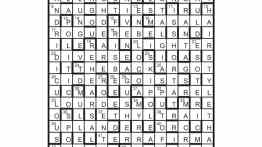
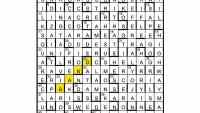
The quotation is ‘LAUGH, AND THE WORLD LAUGHS WITH YOU; WEEP, AND YOU WEEP ALONE’ from Solitude by Ella Wheeler Wilcox. Her two unclued novels are SWEET DANGER (34/24) and A DOUBLE LIFE (3/29). ELLA (on the perimeter), WHEELER (12) and WILCOX (diagonally from 12) were to be shaded.

It’s not too late to scrap HS2

From our UK edition

There are government projects gone haywire – and then there’s HS2. The High Speed rail project should never have been given the nod in the first place. Costs spiralled out of control from the very beginning: it was estimated to cost £32.7 billion in 2012, now this is set to surpass £100 billion. The technology will be out of date before it even comes online. The government is right to ditch plans for an easterly arm of HS2 from Leeds to Birmingham. In contrast to the London to Birmingham section, no buildings have yet been flattened, no earth has been moved. Now is the chance to abandon it, before any more money and effort is spent.

The power of remembering

From our UK edition

On the advice of doctors, Queen Elizabeth II will not attend this year’s Festival of Remembrance at the Albert Hall. Her absence will be poignant. The Queen was 19 on VE Day in 1945. She served in uniform in the war, in the Auxiliary Territorial Service. She represents the very youngest generation who fought in the second world war. That generation will not be with us much longer. The Queen does still hope to lay a wreath at the Cenotaph on Sunday. But we have to face up to the reality that one day there will be no one left who knew the world at war; there will be no reunions, no one to attend solemn remembrances, no one left to pass on their experiences to relatives. This is the purpose of Remembrance Sunday: to ensure that war does not recede into a distant historical memory.