The Spectator

Letters: How to reform the GMC

Overhaul the GMC Sir: Max Pemberton’s cogent criticism of the GMC (‘Unfit for purpose’, 20 August). is one of the more nuanced and on the nose of those that I have read. A client of mine was reprimanded and subjected to a fitness-to-practise investigation after an attempted suicide following a financial crisis. The experience worsened his mental health, which then prolonged the investigation. Other clients have been forced to sell their homes or relocate. Some initial steps I implore the GMC to take include limiting the length of investigations, improving mental health reporting, providing more support for doctors about fitness-to-practise issues, and overhauling how evidence is handled.

Portrait of the week: Drought in Europe, property crisis in China and barristers and binmen strike

Home Inflation would reach 18.6 per cent by January and the energy price cap £5,816 in April, according to a forecast by Citi, the investment bank. An annual National Grid exercise simulating a gas supply emergency has been extended from two days to four in September. Workers at Felixstowe, Suffolk, Britain’s biggest container port, handling 48 per cent of traffic, went on strike for eight days. Strikes by Scottish dustmen spread from Edinburgh. Barristers belonging to the Criminal Bar Association voted to go on an indefinite strike in England and Wales after their demand for a 25 per cent increase in pay for legal aid work was denied. A man was charged with the murder of Rico Burton (a cousin of the boxer Tyson Fury), who was stabbed to death in Altrincham at 3 a.m.

What the Tory leadership rivals haven’t discussed

In just over a week, Britain will have a new prime minister. No one can say that the 160,000 or so Conservative party members who will have made the choice have been deprived of exposure to the two candidates. The leadership race has dragged on for longer than a general election campaign, with endless televised hustings and public appearances. The process is supposed to be a training ground, testing candidates on their answers to all the toughest questions that will confront them in government. But in this respect it has failed. High tax is a symptom of a wider problem: big spending. Unless spending changes, any tax cut will be temporary. Yet there has been very little acknowledgment from the candidates that government has grown out of all proportion to its usefulness.

Letters: Blame the regulators, not the water companies

No competition Sir: Ross Clark’s compelling critique of the water companies comes to the wrong conclusion (‘Water isn’t working’, 13 August). He is right to say that water privatisation has been a failure, but this was inevitable given the nature of the industry – a monopoly providing an essential public service. Clark’s suggestion that there should be more competition is unworkable for the simple reason that there is too much fixed investment stretching back to the 19th century and we all have only one pipe into our homes. There are parallels with the rail industry, where a quarter of a century of trying to introduce competition has resulted in a handful of open access services and vastly higher costs.

Somewhere XII – Solution

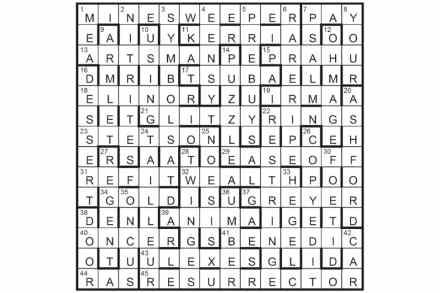
30 July is Independence Day in Vanuatu in MELANESIA (23D). Its capital city is PORT VILA (39/16), one of its volcanoes is LOPEVI (30), an indigenous reptile is the FLOWERPOT SNAKE (11/36) and its national anthem is YUMI YUMI YUMI (4/43A/43D). Its former name was THE NEW HEBRIDES (diagonally from 1) which must be shaded.

Don’t blame Brexit for our lack of workers

It has become received wisdom that Brexit has condemned Britain to chronic labour shortages. Many of the migrant workers who used to staff our hotels and restaurants, install our bathrooms and look after our children, returned home during lockdown and never returned. Sometimes that is blamed on the end of free movement, other times more generally on Brexit Britain somehow having become less attractive in the global competition for people. It is a notion which is easily disproved, however, by a simple figure published this week by the Office for National Statistics which went woefully under-reported. There has been no drop in migrant workers in Britain. On the contrary, there were 6.3 million foreign-born workers at the last count – a record high.

Do Brits take as many holidays as Boris?

Testing, testing When were A levels first sat? They can be traced back to the Oxford Local, an external examination for schools instigated by Oxford University in 1858. Out of 401 candidates only 150 passed, with the Educational Times complaining that the questions were more searching than those on Oxford’s BA exam two decades earlier. – The first standardised national exam designed to be taken at 18 was the Higher School Certificate introduced by the Board of Education in 1917. In order to pass, candidates had to satisfy the examiners in a minimum of five subjects. The certificate was replaced by A levels in 1951. Bone-dry Britain How unusual is the drought?

A-level results: has government reversed grade inflation?

As A-level results come out today, we will find out if the government has made any progress in stemming exam grade inflation. As always, some candidates will celebrate while others will be disappointed. This year, though, the latter group is expected to be more numerous because exam boards are supposed to be clamping down on the implausibly high grades awarded during the two years when school exams were suspended due to lockdowns. Anyone looking solely at exam grades without other information to hand might wonder: what was it about Covid that appeared to boost the educational attainment of so many 18-year-olds? In 2019, the last normal year, 76 per cent of A-level entries were awarded grades A* to C.

What are the rules around ex-presidents’ paperwork?

Tracing paper FBI agents raided Donald Trump’s estate in Mar-a-Lago, Florida, in search of papers he is accused of removing illegally from the White House. What are the rules? — The Presidential Records Act, passed in 1978 in the wake of Watergate, makes clear that documents relating to a president’s time in office are public property. They may not be destroyed or removed from the White House except with the written permission of the US archivist, which may be given if the records are no longer deemed to have historical or evidential value. — The public can obtain access to the records under freedom of information laws five years after a president has left office. However, in limited circumstances a former president can delay that for up to 12 years.

Portrait of the week: Energy bills up, NHS waiting lists down and hosepipes off

Home Energy bills will be £4,266 for a typical household by January, according to the consultancy Cornwall Insight, which had put the sum at £3,616 only a week earlier. Ofgem had decided since then to shorten the period over which suppliers can recover their costs. Gordon Brown, prime minister 2007-10, declared that Boris Johnson, the Prime Minister, and Liz Truss and Rishi Sunak, competitors to succeed him, must hold an emergency Budget to deal with the ‘financial timebomb’ of energy prices. ‘If they do not,’ he said, ‘parliament should be recalled to force them to do so.

2562: 3 X 2 – solution

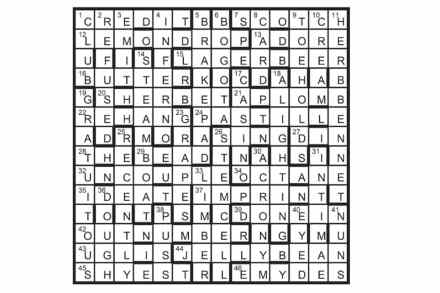
The unclued lights are words (or one phrase) which contain three pairs (3 x 2, in the title) of double letters: 13 Tennessee, 15/14 Sweet tooth, 17/37 Successfully, 21/24/39 Whippoorwill, 31/2 Bookkeeper, 41 Committee, 42/6 Barrenness.

Can Liz Truss be trusted?

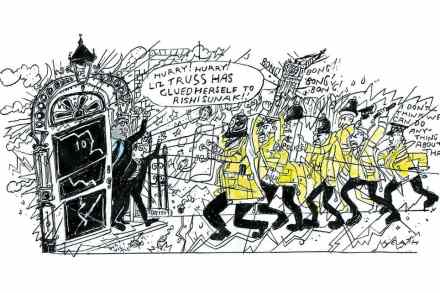
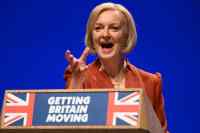
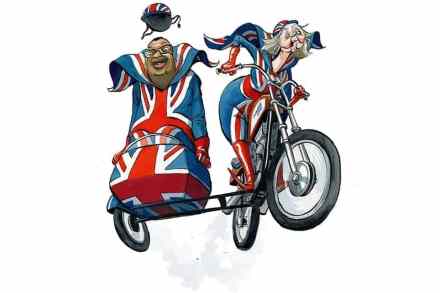
Liz Truss has taken the lead in the Tory leadership race with an agenda that seems radical and ambitious, whereas Rishi Sunak appears to offer only elegantly managed decline. Truss promises instant relief from the rising cost of government; Sunak offers to reverse barely half of his own tax rises – and over the course of the rest of the decade. To promise more, he says, is to sell ‘fairytales’. Truss says a better future is possible with enough vision, ideas and, perhaps most importantly, resolve. Ms Truss came up with a promising idea this week: regional pay boards, so that civil service salaries could be set relative to the local cost of living.

When did ‘best before’ dates begin?

An idea past its sell-by date Waitrose has announced the removal of ‘best before’ dates from many food products. – The idea of printing dates began with Marks & Spencer in the 1950s, but only for use in the stockroom. They first appeared in the company’s shops in 1970 and were named ‘sell-by’ dates from 1973, launched with an advertising campaign saying: ‘The sell-by date means that St Michael foods are fresh.’ There was also a TV advert which featured Twiggy. – The concept was quickly adopted by other supermarkets after evidence that shoppers liked the reassurance of a date.

Portrait of the week: Hosepipe bans, England’s women win the Euros and a strike over dragons

Home BP reported quarterly profits of £6.9 billion, its biggest for 14 years, after oil and gas prices rose steeply. Typical domestic energy bills were forecast by the consultancy Cornwall Insight to go above £3,600 a year in the coming winter. Under the family scheme for visas, 31,300 Ukrainians had arrived in the United Kingdom, and 72,700 under the sponsorship scheme. British Airways suspended new ticket sales for short-haul flights from Heathrow until at least 15 August, to meet the airport’s limit on the number of passengers departing each day of 100,000. On 1 August, 696 migrants crossed the Channel in small boats; in July the total was 3,683, and more than 17,000 so far in 2022.

Germany’s energy crisis is a warning to Britain

During the eurozone crisis, southern European states had to go cap in hand to Germany to stave off national bankruptcy. A decade on and it is Berlin doing the begging. Europe has reluctantly agreed a 15 per cent cut in gas use this winter in the hope that German factories can stay open and German citizens can keep from freezing. Meanwhile, Russia’s state-controlled energy giant Gazprom threatened to reduce the gas flowing through the Nord Stream 1 pipeline yet again so that Germany would receive only a fifth of the amount it did before the Ukrainian invasion. While Berlin has said it plans to wean itself off Russian gas over the next few years, Vladimir Putin is taunting Europe by cutting supplies faster than Germany can cut its dependence.