The Spectator

Portrait of the week: Scotland’s new First Minister, Prince Harry’s day in court and Amsterdam’s campaign against British men

Home Humza Yousaf was elected leader of the Scottish National party, beating Kate Forbes by 52 per cent to 48 per cent after Ash Regan was eliminated; MSPs then elected him First Minister. Of 19 transgender prisoners in custody in Scotland, 12 began their transition ‘after their date of admission’, according to data obtained under Freedom of Information laws. The National Executive Committee of the Labour party voted 22 to 12 to bar Jeremy Corbyn from standing as a Labour candidate at the next election. The terrorism threat level in Northern Ireland was raised from substantial to severe, meaning an attack was highly likely.
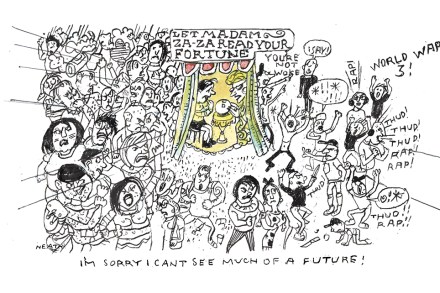
Who was the first April Fool?

Fooling about When did the tradition of 1 April pranks begin? One theory is that it derives from the ancient Roman festival of Hilaria, which involved games and pranks – although that was held on the spring equinox, which falls more than a week earlier than 1 April.  — In Chaucer’s ‘Nun’s Priest’s Tale’, a fox fools a cockerel ‘since March began thirty days and two’. Another explanation is that ‘All Fools’ Day’ referred to backward country folk in 16th-century France who didn’t realise that the adoption of the Julian calendar had moved New Year’s Day from 25 March (a week’s festivities used to end on 1 April) to 1 January. However, the first reference to a ‘poisson d’Avril’ was in a poem from 1508, before the calendar change was made.

Letters: Speak up for our children

Care of children Sir: At last people, namely Harriet Sergeant (‘The ghost children’, 25 March) and Rod Liddle (‘Childcare: an inconvenient truth’), are speaking up for the children. In so many areas of life today we sacrifice our children for the sake of our adult fetishes and fancies. The only people who have no political voice are our children. I am not suggesting that we lower the voting age to five; only that we try to do our best on their behalf. Why not spend the money that is going to provide 30 hours of childcare per week for babies over nine months old simply to pay the mothers to stay at home and look after them themselves? I can tell you which the babies would prefer.

My friend Proudhon

I painted beaches, seasides, shores or waves dashed on a harbour wall, a mackerel sky, a signature, to peddle to the gullible, until the seasons ran aground with darkly varnished fishing smacks or chalk-white gulls soared to astound the cliffs that threw their shadows back. My friend Proudhon said property was theft and so each rock and shell, each stone turned over by the sea, was never mine to lift or sell; as if I’d stumbled on by chance, light-fingered, dawn’s exuberance, pickpocketing, as morning came, sienna, cobalt, cadmium.

Innovator of the Year Awards 2023 – entries close 16 June

The Spectator’s prestigious Economic Innovator of the Year Awards, in partnership with Investec, are now in their sixth year. These Awards, celebrating the shining talents of British entrepreneurship and widely recognised in business and investment communities throughout the UK, have attracted growing numbers of entries year by year. Potential winners are passionate about their innovative products and services, determined to make a positive contribution to society, financially resilient and capable of scaling up nationally and internationally.

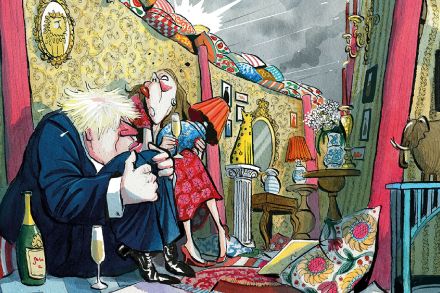
The Boris distraction

Boris Johnson should not be forgiven for his handling of lockdown. He needlessly criminalised everyday behaviour when voluntary guidelines would have sufficed. Nannies were prosecuted for delivering birthday cards to children; friends were apprehended for meeting up in the park. Meanwhile, the officials who had created these rules flouted them regularly. Johnson wrongly denied that his staff were having parties. But compared with everything else that went wrong during that period, his false denial is trivial. It is surprising, then, that the House of Commons seems obsessed by it, rather than by the collapse of the democratic apparatus during lockdown, or the fact that the government was allowed to deploy emergency powers long after the crisis had passed.

How healthy do we think we are?

Beyond a joke Is it time to rewrite an old joke? A letter published in Time in 1963 suggested that heaven would consist of French chefs, British police, German engineers, Italian lovers and Swiss bankers, while hell would consist of English chefs, German police, French engineers, Swiss lovers and Italian bankers. British police, however, have sunk in the world’s estimation – a poll last year revealed that only 44% of people trust them, which puts us behind France and Germany. The most trusted police are in Denmark and the Netherlands, where they are trusted by 58%. The good news is that British chefs are no longer staffing hell’s kitchens. According to a YouGov survey of 24 countries in 2019, British food came mid-table, with Scandinavian countries filling the bottom places.

Letters: The dangers of certainty

Uncertain times Sir: Kate Andrews’s article on the era of economic certainty (‘Crash test’, 18 March) is not the first article I have read – especially in the financial press – telling us that we live in uncertain times, as though at some stage in the past everyone knew exactly what was going to happen. I am unable to recall such a time. I would argue that what we really should worry about is certainty. When people start talking about the end of history, claiming that there is a certain fortune to be made in buying cryptocurrencies or when ‘everybody’ knows the most important thing is to achieve net zero, that is the time to be worried. ‘Why did we not see it coming?’ the late Queen is reported to have asked about the 2008 banking crisis.

Unemployment and Britain’s missing million

There was plenty of miserable economic news in this week’s Budget: the highest taxes imposed by any peacetime government, the worst post-pandemic recovery in the G7, the most painful cost-of-living squeeze since records began. But there was also a statistic which, on the face of it, seems to herald a remarkable success. The official unemployment rate stands at just 3.7 per cent – less than half the rate of a decade ago, as low as it has been in half a century. In his Budget, Jeremy Hunt boasted that ‘Conservatives believe that work is virtue’. Sadly, as this magazine revealed several months ago, there is rather more to the figures than meets the eye. There may be only 1.

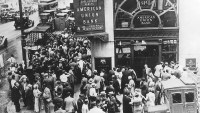
How often do banks fail?

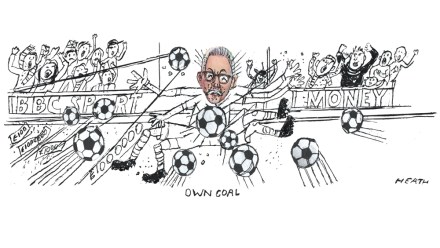
Eyes on the ball Viewing figures for Match of the Day rose by 500,000 when Gary Lineker was suspended from the show for tweeting about the government’s asylum bill and his fellow pundits walked out on strike in support.  – First broadcast on the then new BBC2 on 22 August 1964, the show was initially controversial not because of the views of its presenter Kenneth Wolstenholme but because football clubs feared it would discourage fans from attending games.  – They need not have worried: the first episode, featuring highlights of Liverpool vs Arsenal, attracted just 20,000 viewers.  – Viewing figures rose sharply, however, after England won the World Cup in 1966 and the programme was moved to BBC1.

Letters: The problem with celebrity TV presenters

Channel anger Sir: I fear that in your leading article (‘Our duty to refugees’, 11 March) you find yourself in the same bind as the Labour party and at odds with majority opinion in the country. While people in the UK are vexed by the Channel crossers, this is only because it is the most obvious example of the failure of the political class to control immigration as a whole. The population of the UK is increasing fast: this is almost wholly as a result of immigration. Despite government propaganda about the necessity of migration to ensure an adequate supply of labour to support an ageing population, it remains very unpopular. Migrants are going to get old too: are we to expand our population endlessly?

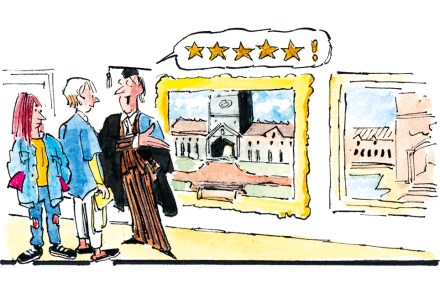
School portraits: snapshots of four notable schools

Roundhay School, Leeds ‘While we were taught about racism and sexism, there was too little time spent making sure everyone could read and write,’ said Liz Truss of her alma mater three years ago when she was minister for women and equalities. Roundhay School’s record begs to differ – it has been ranked ‘outstanding’ by Ofsted for more than a decade now. In 2020, the same year as Truss’s speech, the school received a World Class Schools Quality Mark. Roundhay is based in Leeds, and educates 2,600 pupils across a gorgeous 22-acre site on the outskirts of the city.

Our duty to refugees

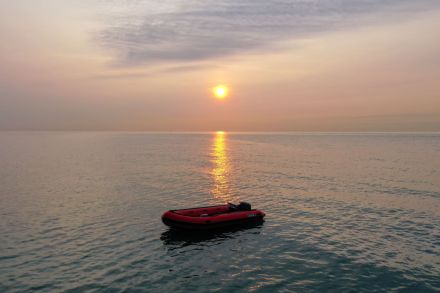
It is hard to deny that the government must take tough action on the issue of migrants arriving in Britain by small boats. A large proportion of those entering the country are not refugees fleeing danger but young men in search of better economic opportunities. Indeed, the largest increase in arrivals comes from Albania, an EU accession state that is neither at war nor under malign dictatorship. Ferrying such people to Britain is a criminal racket that should not be tolerated. If all ‘irregular’ arrivals are to be classed as illegal, genuine refugees will be unable to apply for asylum But under Home Secretary Suella Braverman’s plan, the Illegal Migration Bill will deport every person who enters the country by what the Home Office used to call ‘irregular’ methods.

Portrait of the week: Small boats, stamp price hike and a new job for Sue Gray

Home Suella Braverman, the Home Secretary, introduced the Illegal Migration Bill, intended to stop people crossing the Channel on small boats. It would ban those who entered Britain illegally from claiming asylum or re-entering in future, and would place a duty on the Home Secretary to deport them ‘as soon as reasonably practicable’. Writing to MPs, the Home Secretary said there was a ‘more than 50 per cent chance’ that it was incompatible with the European Convention on Human Rights. She also said she had ‘pushed the boundaries of international law’. Rishi Sunak, the Prime Minister, rang the President of Rwanda to tell him to expect deliveries. The price of a first-class stamp is to go up from 95p to £1.10 on 3 April.

Solution to 2592: Uncle Victor

The unclued Across lights were some of the radio communications alphabet and the unclued Down lights are part of the current Nato alphabet, all listed under ROGER (solution at 16 Across) in Brewer. ‘Uncle’ and ‘Victor’ are two further examples from the respective alphabets. First prize Revd John Thackray, Ipswich, Suffolk  Runners-up Paul Harrison, Wilpshire, Blackburn, Lancs; R.B.