The Spectator

Smile, you’re on camera

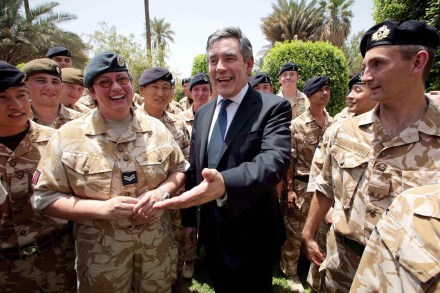
This titbit from The Sun is too good not to pass on: One of Jack Straw’s aides currently assigned to make Gordon Brown personable has come up with a rather novel way to make GB remember to smile more. He has stickered all of Brown’s notes, his briefcase and even his car with bright yellow “smileys” to jog his memory.

He’ll keep the Red Flag flying high

Gordon Brown’s retro opponent will be John McDonnell as Michael Meacher has dropped out. So Gordon will get to spend the next few months explaining why Labour’s 1983 manifesto is not a platform for a fourth election victory. Seeing as McDonnell has always been against the war his candidacy will at least give us a window into how much of a deal breaker Iraq is for the Labour grassroots.  No word yet on whether Benn junior can scrape together the required 44 nominations to enter the deputy leadership contest.

Understanding the lives of others

The New York Review of Books has a fantastic piece by Tim Garton Ash on the Stasi, pegged to The Lives of Others, which is one of the best explorations of Germany’s “paradoxical achievement” I have ever read.

Rudy’s rock

If you want to understand Rudy Giuliani do read this gripping piece from New York magazine on his relationship with his third wife, Judith. Considering how much of a vulnerability his personal life is among socially conservative Republicans, it is bizarre how keen Giuliani is push her forward—volunteering that she’d be allowed to attend cabinet meetings and the like—when the best strategy for him would be to campaign on his competence, track record and tough-on-terror image. But as Lloyd Grove, one of the best gossip columnists in the business, explains, Giuliani is like a love-sick teen around her: his speaking contract even requires that she is sat next to him at any meal that he has to to attend.

Breakfast with Brown

On Sunday-AM this morning Helena Kennedy and I were the warm up act for Rufus Wainwright and Gordon Brown. Both men are on tour at the moment so it was interesting to compare their respective acts. Gordon mustered the best performance of his campaign so far, not least because he had a good story to tell: the promise of eco-towns  has the merit of addressing the housing shortage while also issuing a direct challenge to Cameron's greenery. The Chancellor was also good-humoured on the sofa afterwards during a classic skit by Rory Bremner - especially, it must be said, when Rory did Mandelson, and then Blair saying he had only promised to resign on June 27, but had not specified a year. Is the Brown ice beginning to thaw? We'll see.

Letters to the Editor | 12 May 2007

From our US edition

Britain should come first Sir: Reading Clemency Burton-Hill’s ‘Cameron is taking on Brown — in Rwanda’ (5 May) I felt my blood boil. I have every sympathy with the people of Rwanda but surely Conservative MPs’ time would be much better spent grappling with the issues facing ordinary people in Britain? As Andrew Mitchell, Hugo Swire and David Mundell have some time on their hands this summer, perhaps they would like to help out at my daughter’s ‘bog-standard’ comprehensive where, while she works hard to achieve her ambition of studying Law, other pupils smoke cannabis in the toilets and routinely disrupt classes.

Harry Potter and the amazing royalties

Simon Hoggart’s always excellent Saturday column in the Guardian has this great snippet about the publishing phenomenon that is Harry Potter:The other day a friend of mine signed up with a new literary agency, which also handles the author of Harry Potter. The chap who looks after him took him on a tour round the offices. At one point they looked into a room where eight busy people were sitting in front of computer screens, phones and directories to hand. He asked what they did and was told that they were all engaged, full time, in gathering JK Rowling's royalties from around the world.

Goodbye to all that

It ends, as it began, with a political conjuring trick. The splicing together of Ian Paisley and Martin McGuinness must, by any standards, rank as one of the most extraordinary achievements in recent politics, and reflects, among other things, the sleepless kinetic force that was Tony Blair’s greatest asset. It was the same force that pushed through the Good Friday Agreement in 1998, as Mr Blair promised to reconcile the irreconcilable, square the circle, plot the uncharted ‘Third Way’. In Ulster, he has been rewarded. But the method failed him more often than not. Even before he was elected, the Labour leader swore that he could pump money into Britain’s public services without raising taxes: more than 100 tax increases later, those words seem laughable.

‘I have nothing offer you except sweat, tax credits and child poverty targets’

   I’ve never seen Gordon Brown smile for so long as he did throughout his speech today. Well-groomed, hair under control, red tip swapped for a blue one (shame about the media handling disaster) but he has raised his game. And here are his rules. There will be constitutional reform: a binding vote on going to war, a code of conduct for ministers and independent vetting of public appointments (no more Levys and Chris Evans). We heard again about the moral compass his parents gave him. A change of tack on foreign policy, emphasising economic development. Yes - same old, same old. In his Time interview, he warned he won’t dazzle us. But we’re in a new post-Blair era now. We’d better start getting used to it.

Remembering Frank Johnson

I spent the first half of today at Gordon Brown’s leadership launch and then Frank Johnson’s memorial service. One was a magnificent, vibrant showcasing of a man’s national reach, achievement, intellect and wide support, a glittering gathering. The other was a sombre assembly of the bereft, gloomy and sepulchral. But, then, such events never were Gordon’s strong point. How many journalists in the history of Fleet Street could have inspired such an occasion? The reading by the Leader of the Conservative Party; two splendid addresses by Sir Peregrine Worsthorne and Stephen Glover; and music – what music! – that included a Tchaikovsky aria sung by Sir Willard White.

Coffee House Debate: Round 3

Matthew d'Ancona and Tim Montgomerie of Conservative Home debate what the Tories can--and should--learn from Blair.  Read Matt's opener here, Tim's response here and the second round. Tim The trouble with "tough on crime, tough on the causes of crime" is that it embodies the worst of Blair: the Vickie Pollard aspect of New Labour, which says "Yeah, but no, but yeah, but no", and ends up saying nothing. Nobody sensible would deny that there is a "conveyor belt to crime" or that rehabilitation is desirable. The trouble is that this is not a new thought at all.  Since Roy Jenkins and Reggie Maudling, the orthodox position of the liberal criminal justice industry - egged on by the Treasury!

Coffee House Debate: Round Two

Matthew d'Ancona and Tim Montgomerie of Conservative Home debate what the Tories can--and should--learn from Blair.  Read Matt's opener here. Tim Anarcho-syndicalism? Well, that’s what some of the wilder Tory rhetoric about dismantling the state resembles. But moving swiftly on….  On crime: hug-a-hoodie was a disaster. In my view, no party can be too tough on crime. It is the mods’ greatest error to believe that being cuddly about crime is a necessary part of the “decontamination” strategy. If anything, hug-a-hoodie put rocket boosters under Labour’s claim that the Tory Party is now in the hands of toffs with no concept of real life.

Tony and Clio

Blair has achieved what all successful British Prime Ministers achieve: he has changed both his own party and the opposition. David Cameron would not exist politically without Tony Blair, in the same way that Blair would not without Thatcher. Yet there’s no single achievement of the Blair years that transcends everything else—which is why it is so difficult to work out where history will rank him. (Mary Ann Sieghart, though, had some eloquent first thoughts on the subject in The Times this morning) Blair didn’t, thankfully, succeed in taking us into the Euro. Devolution has never really been a Blair project, it is something he inherited from John Smith. On the economy, the story is what he hasn’t done—radically hike taxes etc.

The showman leaves the stage

Dogs bark, cats miaow, Blair gives superb speeches. His latest farewell remarks were no exception, and there were a few misty eyes here in 22 Old Queen Street. Not mine, I’m afraid to say. Fat lot of good his speeches have done of us over the years. But here’s what I made of his remarks. This was his long-awaited “sorry”. Specifically “I give my thanks to you, the British people, for the times I have succeeded – and my apologies to you for the times where I have fallen short”. Of course, he did qualify this earlier: “I may have been wrong. That’s your call. But believe one thing, if nothing else – I did what I thought was right.” So even when he was wrong, he was kinda right.

The view from across the pond

Richard Perle, neo-con policy intellectual, sends in his thoughts on Blair and British ingratitude: I'm sorry to see him go as I was sorry to see the departures of Thatcher and Reagan before him.  Conviction politicians, all.  It may be a while before you get another--they're rare on both sides of the Atlantic. Its ironic that Blair stands (falsely) charged with misleading when, in fact, he led with strength and purpose.  It is even more ironic that he should be derided as Bush's poodle when, in fact, he led Bush more often than he was led by him.  You Brits have a remarkable habit of political ingratitude that transcends class and party.

Was that the long awaited Iraq apology?

The stage was set for a high-energy celebration this afternoon. There was clapping, music, and a woman in black and white dancing near the podium. But by the standards of this most theatrical of public speakers, the Prime Minister's farewell address today was personal and pensive. Compared to the shouted list of Labour's achievements that has become so familiar at Prime Minister's Questions, punctuated only by whoops of support, this speech seemed like a sombre confessional. Sometimes, he said, decisions had been easy to make, and easy to plan. But "sometimes, as with the completely unexpected, you are alone with your own instinct." With what he conceded might seem like "messianic zeal", Tony Blair described how in the end, each of his decisions has come down to "belief".