55
PollygarchySir: It was with a rising sense of disbelief that I read Polly Toynbee’s review of Ferdinand Mount’s The New Few (Books, 5 May). There’s an oligarchy in this country all right, but what Ms Toynbee fails to realise is that she is a member. For every overpaid plutocrat, there are any number of privileged people like herself who find lucrative employment ‘representing the disadvantaged’. They remind me of nothing so much as the old squirearchy, who used to visit their cottagers to do good works. I would not like to suggest that it is actually in the interest of the socialist elite to keep the masses in their place, though one does wonder why, if they truly care about the working class, they support benefits culture and uncontrolled immigration.
Before the Golden DawnA neo-Nazi party called the Golden Dawn won 7 per cent of the vote in the Greek elections. The party denies being inspired by the Nazis, even though its flag bears a resemblance to the Swastika. Its name, however, may be inspired by the Hermetic Order of the Golden Dawn, an occultist society founded by William Wynn Westcott, a coroner from Leamington Spa. — The society was founded upon rituals and teachings which Westcott claimed to have obtained by deciphering letters from Anne Sprengel, an imaginary illegitimate child of Ludwig I of Bavaria. In 1888 the society opened a temple in London, followed by others in Weston-super-Mare, Bradford and Edinburgh, where members taught astral projection and alchemy. — The movement’s following included W.B.
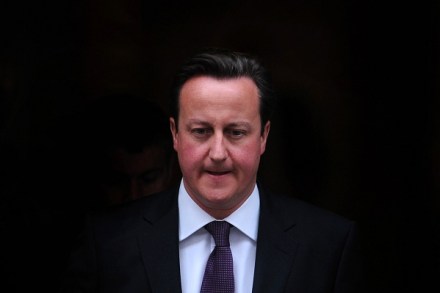
HomeDavid Cameron, the Prime Minister, declared that he would ‘focus on what matters’ after the Conservatives’ poor showing in the local elections brought accusations that pursuit by the coalition of such aims as gay marriage and reform of the House of Lords was alienating voters. On the eve of the Queen’s Speech he appeared at a tractor factory in Essex with Nick Clegg, the deputy prime minister and leader of the Liberal Democrats, who had done disastrously in the local elections. ‘I’m really sad,’ Mr Clegg had said of the results. Labour had gained an extra 823 wards, the Conservatives lost 405 and the Liberal-Democrat party 330, leaving it with the lowest number of council seats since its foundation in 1988.
This government has run out of good ideas; that was what the Queen’s speech told us this week. When the coalition was formed, it united behind a genuinely bold agenda: school reform, welfare reform, health reform and deficit elimination. Where has the boldness gone? The coalition’s courage has vanished, as has its sense of purpose and the ability of the Conservatives and Liberal Democrats to agree on anything sensible. So for the next year, our MPs will be kept busy, not pushing on with important changes, but debating intractable problems like House of Lords reform and long-term care for the elderly. If there’s not much to be said for what was in the speech, we can at least be grateful for what has been left out — in particular, the High Speed Rail Bill.
It is two years to the day since David Cameron first entered 10 Downing Street as Prime Minister. To mark the occasion, here’s James Forsyth’s cover story from the time on the deal that put him there: Can this marriage of convenience work?, James Forsyth, 15 May 2010 ‘It is not the prize. It is a means to the prize.’ This is how one long-time political ally of David Cameron described the Tory leader’s entrance into Downing Street at the head of a coalition government. The deal with the Liberal Democrats which has put Cameron in Downing Street is, as this Cameron ally admits, ‘an arranged marriage not a love match’.
Here is a selection of articles and discussions from this week on Spectator.co.uk... Fraser Nelson looks at what Hollande's win means for Cameron, questions Nick Clegg's economic competence and examines Cameron's gay marriage folly. James Forsyth says the Tories are shaping up for an EU referndum, reports the first blood on Lord's reform and thinks Andy Coulson easily handled his Leveson appearance. Peter Hoskin asks if the Milibands have Hollande fever, thinks Cameron was reassuring backbenchers in the Queen's Speech and asks if Hollande and Merkel can meet in the middle. Jonathan Jones reports on Michael Gove's attempt to take on private schools and trade unions and looks as the Greek tragedy rolls on.
T.S. Eliot once commented that “humankind cannot bear very much reality.” Reality, Reality, Jackie Kay’s latest collection of short-stories, explores the thin line that separates art and the supposed real world. In these 15 stories, 14 of which are written in an intimate first-person voice, Kay brings the reader on a journey with the lonely and dispossessed, as they try and comprehend their own perceived reality.
...here are some of the posts made on Spectator.co.uk over the weekend: Fraser Nelson says that it's about time politcians started lurching towards the public. James Forsyth summarises how each party performed in the local elections, and explains what Francois Hollande's victory means. Peter Hoskin reviews Ed Balls' latest explanation of his fiscal policy, and says that Lords reform will still weigh on politicians' minds. Sebastian has audio from City Hall on the the night of Boris's victory. And Rod Liddle highlights the new 'tough love' approach to healthcare.
Here, for CoffeeHousers, is an extended version of the leader column in this week's magazine. It takes on the green fundamentalism which stupidly aims to put a stop to genetically modified foods: At the end of the month, a group of shrieking protestors are planning to descend upon a field in Hertfordshire and, in their words, ‘decontaminate’ (i.e. destroy) a field of genetically modified wheat. The activists, from an organisation called Take the Flour Back, claim to be saving Britain from a deadly environmental menace.
Here is a selection of articles and discussions from this week on Spectator.co.uk... Fraser Nelson thinks Gus O'Donnell isn't good enough for Threadneadle Street and looks at an emerging tricolour Britain. James Forsyth reports that Leveson is narrowing Cameron's fightback window and looks at the political effects of the hacking talk. Peter Hoskin looks at Obama's political theatre and says that Parliament's drinks are still on us. Jonathan Jones highlights 15 cities to watch and examines what Labour would count as a success today. Sebastian Payne reports on the two Ed's electioneering and looks at the virtues of British men and northern Tories in this week's View from 22.