Rudolphf
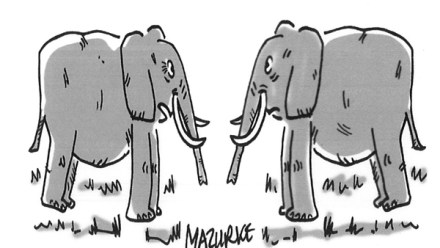
Double trouble The Duchess of Cambridge’s acute morning sickness was said to be associated with twins, raising the prospect of an awkward question of succession, especially if twins were to be born as a result of caesarean section. No monarchy has yet been tested in such a way. —Prince Vincent of Denmark was born before his twin sister Princess Josephine in 2011, but neither is likely to succeed to the throne as they have two older siblings, Prince Christian and Princess Isabella. —The only royal twin to have reached the throne in Britain was James II of Scotland. He was born after his brother, Alexander Stewart, Duke of Rothesay, in 1430, but the elder child failed to reach his first birthday.
Courts to be proud of Sir: Nick Cohen’s article (‘Export-only justice’, 8 December) might leave the reader with the impression that the use of the High Court in London by overseas litigants is a) novel and b) detrimental to the taxpayer. I do not believe either to be the case. Law students have long had drummed into them the fact that in a large number of cases (commercial court cases in particular), it is the norm for neither party to be domiciled in the UK, and I have yet to be informed — when raising inquiry of the listing office — that litigation timescales are lengthening by dint of an influx of foreign litigants. Indeed, my sense is quite the opposite: timescales are shortening as the system becomes more efficient.
The below is from The Spectator, the best-written and most entertaining magazine in the English language. To read the whole magazine on iPad/iPhone, click here for a free trial. Or click here for a Kindle free trial. To listen to politicians is to be given the impression of a dangerous, cruel world where things are bad and getting worse. This, in a way, is the politicians’ job: to highlight problems and to try their best to offer solutions. But the great advances of mankind come about not from statesmen, but from ordinary people. Governments across the world appear stuck in what Michael Lind, on page 30, describes as an era of ‘turboparalysis’ — all motion, no progress. But outside government, progress has been nothing short of spectacular.
January Britain’s public debt rose above £1,000 billion for the first time. Fred Goodwin, the former chief executive of the Royal Bank of Scotland, was stripped of his knighthood. The High Speed 2 rail link between London and Birmingham was given the go-ahead. Police removed protestors’ tents in Parliament Square under a new act. Abu Qatada won an appeal to the European Court of Human Rights against deportation to Jordan. In Syria protestors continued to be killed. In Saudi Arabia 28,000 women applied for jobs in lingerie shops, in which only men could previously serve. February The High Court ruled that prayers said at meetings of Bideford council were unlawful. Police removed tents from a protest camp at St Paul’s, set up on 15 October.
If you're short on ideas for minor Christmas presents, then you can't do better for expert guidance than read Marcus Berkmann's choice of stocking fillers from last week's issue of the Spectator magazine. There can be few phrases in the language more debased than ‘Christmas gift book’. (Well, ‘friendly fire’, maybe, or ‘light entertainment’.) Needless to say, every writer worth his overdraft wants to do one, having already spent in his head all the lovely money he is going to earn from it. But you are essentially writing something for people to buy for other people who would rather have been given something else. Having produced one or two of the things myself, I suspect that most Christmas books aren’t even opened, let alone read.
Craig Brown Which classic work do you think this comes from? ‘Her teeth were white in her brown face and her skin and her eyes were the same golden tawny brown. She had high cheek-bones, merry eyes and a straight mouth with full lips. Her hair was the golden brown of a grain field that has been burned dark in the sun but it was cut short all over her head so that it was but little longer than the fur on a beaver pelt.’ Jeffrey Archer? Jackie Collins? Lee Child? I’ll give you one more clue.
Sir Patrick Moore, the astronomer, died this morning aged 89. He featured on The Spectator's power list of over-80s, published last year. Here are the other scientists listed in the category. Bernard Lovell, by Martin Rees Bernard Lovell ranks as one of the great visionary leaders of science. Along with others of his generation, the war gave him responsibility and opportunity at an early age. He was thereby encouraged to ‘think big’ when he returned to academic science. He had the boldness to conceive a giant radio telescope, and the persistence to see it through to completion, despite the risk of bankruptcy. It was a huge project by the standards of the 1950s.
The Sutton Trust today criticised the system of personal statements for university admissions, as they favour well-connected children from private schools. Spectator readers might not be surprised by that, though: in September Molly Guinness revealed in the magazine that those who can afford to often contract the writing of the statement out to graduates for a generous fee. Guinness wrote: 'They need help, and they’d be crazy not to get it. ‘Why would anyone write their own?’ says my cousin Malachy Guinness, who set up a tutoring agency. He points out that with no interviews, there’s no way of checking the authenticity of the statements. His company fields dozens of calls each month on the personal statement question.