Surgeon

Hamas’s human shields Sir: Unlike the rockets fired at Basra air base by Iraqi fighters (Tom Drife, Letters, 9 August), rockets from Gaza aim to kill Israeli civilians. A more accurate analogy would be if English cities were under attack by thousands of rockets from Scotland. Any country under such attack would try to destroy the aggressor’s rocket launch capability. Since Hamas deliberately sites its rockets amongst Gaza’s civilians, it is impossible to do so without civilian casualties. Israel goes to great lengths to avoid these, but with an enemy determined to sacrifice its own people this is not always achievable. Human shields are not ‘less immoral’ than Israel’s defensive war. Using civilians in this way is a Hamas war crime.
Ministerial needs Home Office minister Mark Simmonds resigned, complaining he couldn’t afford to live in London on his junior minister’s salary of £89,435. His resignation echoes that of Lord Gowrie, who resigned as minister for the arts in September 1985 complaining he couldn’t live in London on £33,000 a year. Are ministers better off now than they were then? — If you uprate Lord Gowrie’s 1985 salary with the Retail Prices Index (which the government now regards as overstating inflation), it would be worth £85,000, less than the sum earned by Simmonds.However, Lord Gowrie’s was a cabinet post and would now carry a salary of £134,565.

Home David Cameron, the Prime Minister, resisted calls for Parliament to be recalled to debate the crisis in Iraq. Philip Hammond, the Foreign Secretary, said that the government was not considering military intervention ‘at the present time’. Mark Simmonds resigned as a Foreign Office minister, but Downing Street hastened to say that his resignation, unlike Lady Warsi’s a week earlier, had nothing to do with government policy on Gaza, since he was complaining he could not afford to rent a flat in London for his family with the £27,000 allowance. A man sought by police investigating the theft of a fish tank from a furniture shop in Leeds hid in a bush and was attacked by a swarm of wasps. Unemployment fell 132,000 to 2.

The old cliché that ‘nothing happens in August’ has again been brutally disproved. From the centenary of the outbreak of the first world war to the Russian invasion of Georgia six years ago, August is a month often packed with violence — but rarely more so than this year. In Syria, Christians are being crucified for refusing to convert to Islam. In northern Iraq, there are reports of mothers throwing their children from mountains rather than leaving them to the jihadis who are parading the severed heads of their victims. Russian convoys are rolling towards the Ukrainian border as Vladimir Putin tests the resolve of the West. Barack Obama has watched this unfold from his holiday spot in Martha’s Vineyard; David Cameron from the Portuguese coast.


[audioplayer src="http://traffic.libsyn.com/spectator/TheViewFrom22_14_August_2014_v4.mp3" title="Iraq War III, the cult of Richard Dawkins and the moaning middle class" fullwidth="yes"] The View from 22 podcast [/audioplayer]The Islamic State of Iraq and Syria has extended its hold from eastern Syria into western and northern Iraq, massacring Shi’ites, Christians and Yazidis wherever it can. But can we afford to let Isis run wild, asks Max Boot in this week's Spectator. Peter Hitchens, a columnist for the Mail on Sunday, discusses this on our podcast, and argues that we have made the most tremendous mess in Iraq, and it’s high time we realised this.
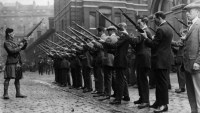
From ‘Rifle clubs and village guards’, The Spectator, 15 August 1914. John St Loe Strachey, in addition to being High Sheriff of Surrey, was the editor and owner of The Spectator: We understand that the High Sherriff of Surrey, Mr. St. Loe Strachey, is this afternoon holding a Conference of the Surrey Rifle Clubs at Brett Reynard’s Restaurant, Guildford, at five o’clock, with the object of making proposals for the formation of Town and Village Guards. It must be obvious to every one that it would be an enormous if every small town and village had such Guards, and if the police and military authorities could, in the case of emergency, could find an organised body, even though roughly organised, ready to co-operate with them.
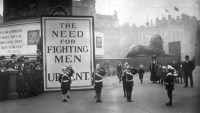
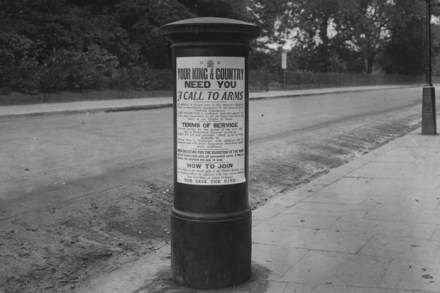
From ‘The Call to Arms’, The Spectator, 15 August 1914: At this moment it is the duty of all employers, rich or poor, to discharge no man but this does not apply to men of military age — i.e., those between 19 and 30, who are sound in wind and limb. In our opinion, employers not only have a moral right to discharge such men if they will not go into the fighting line, but in many cases also have a positive duty to do so. Rich men who are over military age need not to continue keeping soft billets for footmen, under-gardeners, stable boys, or young gamekeepers merely because the occupants of these pleasant places may not care to learn the prime duty of defending their country.
‘A pacifist protest’, a letter from the 15 August 1914 Spectator in response to a piece in the 8 August edition: SIR, - One is willing to believe that your article in last week’s issue called “Keep Your Temper” was not intentionally provocative, but it shows some lack of justice and of courtesy towards the pacifist. You divide pacifists into three classes. The first consists of obstinate fools who refuse to think their own country can do right; the second consists of cowards; and the third, which you are generous enough to admit to be a small one, of knaves. One would like to ask to which class you consign those pacifists par excellence, the members of the Society of Friends.
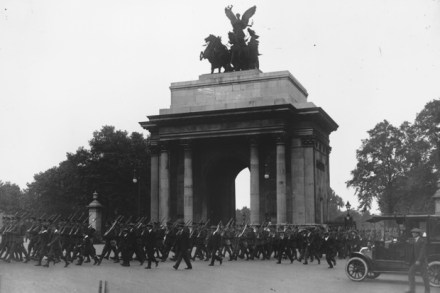

A letter from the 15 August 1914 Spectator: SIR,- As an American, I venture to point out that England’s decision to live up to her implied promises to France, as put forward for so many years, nearly concerns the self-respect of one hundred million Americans and British Colonials, as well as Englishmen. For no English-speaking person could any longer cite the quality of his race, or show his face in Europe, had England taken the course so vigorously urged by her puling intellectuals and certain of her newspapers.
Let us say once more what we said as emphatically as we could last week – that the first thing to do is to get Lord Kitchener the five hundred thousand men who he must have to make the country safe. Till that is done, till we have got the men for the firing line, all philanthropic schemes, however good, nay, however essential in themselves, must wait. Sterilized dressings are absolutely necessary, but they must not get in front of the rifles. Therefore, once again, the first duty of ever man between nineteen and thirty is to join Lord Kitchener’s Second Army. That is his way to help.