The Spectator
Thursday
Spectator letters: who kept us out of the euro, and how to deal with squirrels
The referendum parties Sir: Zac Goldsmith and Sir John Major are each of them both right and wrong on the EU referendum (‘My dad saved Britain’, 28 February; Letters, 21 March). I was an MP interested in Europe, and then a PPS and minister on EU issues in the Foreign Office from 1997 to 2005, and it was pretty clear to all of us that Sir John’s decision to call a referendum on euro entry was motivated by his need to appease the rising Eurosceptic fronde in his party. He may sincerely believe that the creation of the Referendum party by Sir James Goldsmith had nothing to do with the decision.
A censored hymn to motorway misery
Service record The government is to form a design panel to improve motorway services stations. These have not always charmed the British public, not least the very first: Watford Gap services, which opened in 1959 on the same day as the first stretch of the M1. — It quickly became a night-time haunt of rock stars travelling between gigs, but not all were impressed by the food. In 1977 the folk singer Roy Harper recorded a track on his Bullinamingvase album called ‘Watford Gap’ and containing the lyrics: ‘…And the people came to worship on their death-defying wheels,/ fancy-dressed as shovels for their death-defying meals…Watford Gap, Watford Gap, a plate of grease and a load of crap.
How to fix our defence budget mess
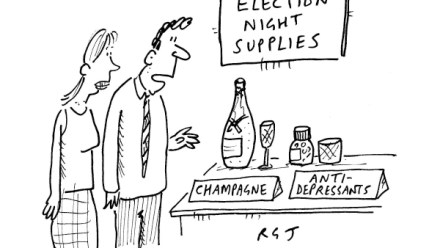
With the exception of 1983, when Michael Foot promised unilateral nuclear disarmament, defence has played little role in modern election campaigns. This is not least because the two main parties appear to have developed a non-aggression pact. They have agreed to heap praise upon the armed forces and commit them to ever more frequent foreign campaigns — while simultaneously nibbling away at the defence budget to fund programmes which offer more instant gratification to the electorate. This week, as the news emerged of Russia’s plan to lease 12 long-range bombers to Argentina, the Defence Secretary, Michael Fallon, announced the results of the latest review into how we protect the Falkland Islands.

Portrait of the week | 26 March 2015
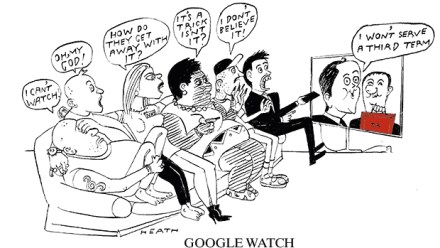
Home David Cameron, who was cutting up lettuce in his kitchen, told James Landale of the BBC that he would not seek a third term as Prime Minister, even if he secured a second. Mr Cameron was heckled the next day by pensioners at an Age UK conference. He had mentioned Theresa May, George Osborne and Boris Johnson as possible successors. Mrs May, the Home Secretary, made a speech promising action against extremists, such as the use of ‘closure orders’ against premises (such as mosques) used by extremists, and a ‘positive campaign to promote British values’.
Books and arts – 26 March 2015

As it happened: TV Q&A with David Cameron and Ed Miliband
Welcome to The Spectator's live coverage of the Q&A session with David Cameron and Ed Miliband on Channel 4 and Sky News. We'll be providing the latest developments and analysis on the programme, starting at 9pm this evening. This page will automatically reload.
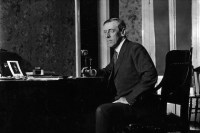
The Spectator at war: President Wilson’s mistake
From ‘President Wilson's Mistake’, The Spectator, 27 March 1915: President Wilson's attitude can only be described as a tragedy. We do not believe that there was a man more determined than he was when he entered office to conduct his administration on moral lines, and to show the world that morality and politics are not incompatible, and that cynicism need not really be the rule for statesmen. Alas for the President that he did not follow his own natural instinct for the right instead of his reason. It would never have betrayed him. Instead, it would have led him on the road which he really wants to travel.
March Wine Club | 26 March 2015
Chateau Musar is one of those delightful oenological quirks – a remarkable wine of great style produced under extraordinarily difficult conditions in the most unlikely of places: Lebanon’s Bekaa Valley. If the success of past offers is anything to go by, Musar has a huge following among Spectator readers and we’re delighted that both Chateau Musar and the Wine Company have decided to offer the latest vintage of the estate’s grand vin – the 2008 – in these pages, before anyone else in the UK has it. Not only that, in this fascinating six-bottle selection we also have two previous fine vintages of the main wine, plus a mid-range and entry-level red and the deliciously exotic Chateau Musar white. Let’s start with that 2007 Chateau Musar White (1).
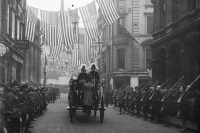
Better off out
From ‘President Wilson’s Mistake’, The Spectator, 27 March 1915: The Americans have a world of their own in which to take sides physically, and are perfectly entitled to say to Europe: ‘You must do your own police work and restrain your own malefactors. Europe must not expect from us more than abstract sympathy in regard to a European struggle.’ On the whole, and in spite of ex-President Roosevelt’s generous and chivalrous attitude, we are strongly inclined to think that this is the right attitude for Americans to adopt. At any rate, it is the attitude that they do adopt.
Wednesday
The Spectator at war: Counting the cost
From ‘News of the Week’, The Spectator, 27 March 1915: The controversy as to what should be our future military policy in the west still goes on, and calculations are made on the basis of the inquiry — If it cost us so many thousand men to advance two miles on a front of four, how many men will it cost the Allies to advance a hundred miles on a front of two hundred? No doubt the losses would be very heavy if we made such an advance, but we must point out that all these arithmetical calculations are quite valueless. If a general advance were ordered, the problem would change not merely in degree but in kind, and no calculations based upon the Neuve Chapelle figures would be of the alighted value for estimating the casualties.

Tuesday
The Spectator at war: The ordinary and the extraordinary
From ‘The Industrial Situation’, The Spectator, 27 March 1915: The present industrial situation shows how completely what we may call the economic pacificists misjudged the probable effects of a great European war. Instead of our industries being brought to a standstill, they are in a condition of abnormal activity. The trouble is not to find work but to find workers. To a certain extent this fact is doubtless due to the favoured position occupied by Great Britain as an island defended by an overwhelmingly powerful Navy. But it must be admitted that, so far as evidence can be obtained, our enemies, in spite of the destruction of their maritime commerce, are still able to carry on many, if not most, of their industries.
Sunday
The Spectator at war: Temperance movement
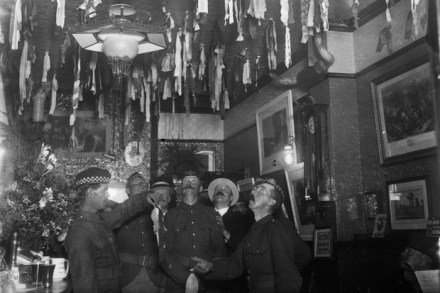
From ‘The Racing Problem’, The Spectator, 20 March 1915: We are not temperance fanatics. We do not suggest the prohibition of the public sate of intoxicants in order to penalize any one or to punish people for having sold alcohol in the past. We do not regard either the sale or the consumption of alcohol as a crime. A moderate consumption of alcohol does no more harm either morally or physically than a moderate indulgence in other unnecessary luxuries like smoking. We know, too, that a permanent temperance, a temperance worth having, can only come by a change in national habits—through freedom, not through interference with liberty. What we are asking for is merely war prohibition in order to produce national efficiency at the moment.
Saturday
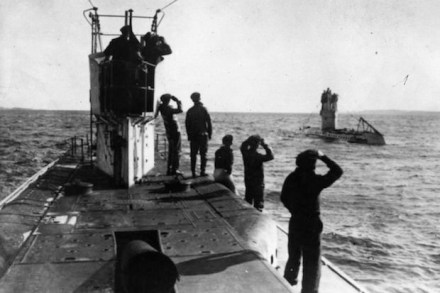
The Spectator at war: Freedom of the seas
From ‘How We Are Blockading Germany’, The Spectator, 20 March 1915: We are, indeed, fighting against a thoroughly unscrupulous enemy, and we have to consider how we can bring the war to an end in the shortest possible time. If we shorten the war, we shall save life—the lives of the non-combatants at sea who are threatened by Germany's diabolical engines—and shall redeliver to the world the seas free and open to traffic. We shall sustain Liberty against despotic dictation, and vindicate the sanctity of national pledges. Beside such objects temporary commercial inconveniences are really small matters. We cannot help feeling strongly that we shall make a great mistake if we try to argue solely on legal grounds.