The Spectator
Thursday

Oil 2

Smartphones
Letters | 23 April 2015
Enemies within Sir: I thought Matthew Parris was typically incisive in his last column, but perhaps not quite as much as the person who wrote its online headline, ‘Scotland knows the power of a common enemy. We English don’t’ (18 April). It is true that ‘the wish to be the underdog’ is a defining urge of our age, even in relatively prosperous polities such as Scotland and Catalonia. But Parris is wrong when he claims that the closest the English come to the ‘Braveheart feeling’ is in their collective memory of the second world war. If only that were true. Would any other country make so little of its crucial role in the defeat of the most evil ideology the world has known?
Barometer | 23 April 2015
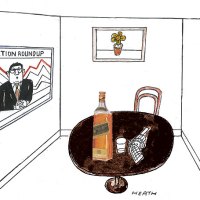
Any answers? Nigel Farage accused the audience in the BBC opposition leaders’ debate of being left-wing. Need insulting an audience destroy a political career? — Former US Vice President Dan Quayle did it on a number of occasions, telling an audience of American Samoans in 1989: ‘You all look like happy campers to me.’ Two years later he upset the American Bar Association by asking: ‘Does America really need 70% of the world’s lawyers?’ — Current US Vice President Joe Biden told a crowd in Wisconsin in 2010: ‘You’re the dullest audience I’ve ever spoken to.’ — Nigel Farage has done it before.
Portrait of the week | 23 April 2015
Home The prospect of a parliamentary alliance between Labour and the Scottish National Party injected an element of fear into the election campaign. The SNP manifesto promised to increase spending and to find a way to stop the renewal of the Trident nuclear deterrent. Nicola Sturgeon, the SNP leader, said she wanted to make Labour in government ‘bolder and better’. Lord Forsyth, a former Conservative Scottish secretary, said that the building up of the SNP, to take seats in Scotland, was a ‘dangerous view which threatens the integrity of our country’. Ed Miliband, the Labour leader, said the Tories should not be ‘talking up’ the SNP. Even the Democratic Unionists began to eye prospects for advantage in a hung parliament.

The other union
The election campaign is becoming increasingly dominated by a small party whose raison d’être is to preach independence from membership of a union it claims is hindering national ambition. But the party is not Ukip, which had been expected to play a big role in this election. It is the Scottish National Party, which seems ever more likely to hold the balance of power after 7 May and is determined to use it ruthlessly to its own advantage and to the furtherance of its sole objective: the dissolution of the United Kingdom. Nicola Sturgeon has been the only party leader talking about the virtues of national self-government, and she has met with reasonable success. No one else seems to be trying it. Nigel Farage is fighting the campaign as if it were a by-election in South Thanet.

Books and arts – 23 April 2015
The Spectator at war: Soldiers of Italy
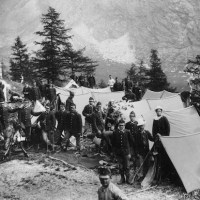
From ‘Soldiers of Italy’, The Spectator, 24 April 1915: It is winter in Florence. The sun shines, but snow lies low on Monte Morello, and the tramontana blows cold as ice, out of a piercingly blue sky. The streets and squares are crowded. Bells are ringing, bands playing, troops marching. The soldiers are coming back from Tripoli. There is to he a reception at the station. A burst of cheering, a scattering of flowers, a blare of music. Here they come. Bronzed, hardy-looking men these, in their war-worn uniforms, swinging along among the crowds and flowers. But the welcome is not altogether joyous. There are wet eyes amongst the onlookers. Wives and mothers whose men are not among the marching soldiers turn away to hide their team.

Florence weeps
From ‘Soldiers of Italy’, The Spectator, 24 April 1915: It is winter in Florence. The sun shines, but snow lies low on Monte Morello, and the tramontana blows cold as ice, out of a piercingly blue sky. The streets and squares are crowded. Bells are ringing, bands playing, troops marching. The soldiers are coming back from Tripoli. There is to be a reception at the station. A burst of cheering, a scattering of flowers, a blare of music. Here they come. Bronzed, hardy-looking men these, in their war-worn uniforms, swinging along among the crowds and flowers. But the welcome is not altogether joyous. There are wet eyes amongst the onlookers. Wives and mothers whose men are not among the marching soldiers turn away to hide their tears.
Wednesday
Watch live: Spectator wealth debate with Owen Jones, Jack Monroe, Toby Young and Fraser Nelson
The Spectator will host a debate at 7.00pm this evening on whether 'Politicians should leave the wealthy alone, because they already contribute more than their fair share'. Fraser Nelson, Toby Young and William Cash will go head-to-head with Owen Jones, Jack Monroe and Molly Scott Cato, with Andrew Neil chairing the debate. The debate has now sold out, but if you were unable to get tickets, we are offering Coffee House readers an exclusive chance to watch the debate live from 7.00pm. You can sign up here prior to the debate, then when the debate begins, you will be able to view the event live, as well as comment and vote on the motion. It's going to get heated... To sign up to watch live, visit debates.spectator.co.uk.
The Spectator at war: The menace of drink
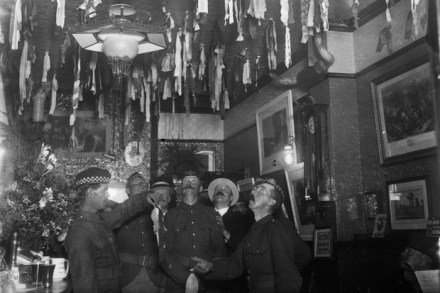
From ‘The Menace of Drink’, The Spectator, 24 April 1915: Some depressing influence is at work among the very poor which is not poverty, something which makes the full effort after the highest civilization attainable to them seem not worth while. That depressing influence is, as we believe, drink. "Oh, hold your tongue!" we hear some one say. "Every fanatic, and tract-writer, and cheap moralist, and goody-goody parson, and old-maidish district visitor has been shouting that word for years. We are sick of hearing it. It may be very true that drink is responsible for a small output of munitions, but to make it responsible for the condition of the urban poor is nonsense. Dealers in that argument are altogether too superficial.
Tuesday
The Spectator at war: Crime and punishment | 21 April 2015
From ‘Criminal Warfare and Retaliation’, The Spectator, 24 April 1915: Although a soldier is supposed to obey his officer unquestioningly, the English soldier has two masters, his officer and the law. An illegal command need not be obeyed by the English soldier. An English soldier who kills by order of his officer is liable to be tried for murder. That obedience to two possibly conflicting authorities is obviously subversive of discipline, for it makes the soldier a judge as to whether he should obey or not. German discipline, on the other hand, makes obedience absolute, considers the soldier merely as a passive instrument executing a higher will, and makes the officer solely responsible for the soldier's action.
Monday
The Spectator at war: Ypres times
From ‘News of the Week’, The Spectator, 24 April 1915: THERE are two very important military events to record during the week. The first is the capture by the British of Hill 60, a part of a ridge which runs close to the south of Ypres. Ypres is on what we may call the dead Flanders plain, and the bill is on the low elope which overlooks it. We captured the bill by a very successful piece of sapping and mining. We tunnelled under the German trenches which held the hill, blew them into the air, and before the enemy could recover from their surprise occupied the trenches with our own troops and immediately prepared them against re- capture by their previous owners.
