Bank 6
From our UK edition
From our UK edition
From our UK edition
From our UK edition
From our UK edition
From our UK edition

From our UK edition
From our UK edition
Party packs Is it possible to form a stable coalition with more than one political party? The Conservative/Lib Dem coalition of 2010– 2015 was in fact unique in being the only British coalition featuring just two parties. — Lord Aberdeen’s coalition on 1852–55 was made up of 11 Whigs, six Peelites and one Radical, Sir William Molesworth, who served as First Commissioner of Works and was later described by Gladstone as ‘perfectly harmless’. He did, however, give us Westminster Bridge. — The wartime coalitions of Asquith (1915–16) and Lloyd George (1916–22) were mostly Liberals and Conservatives but also had three Labour junior ministers and an Irish Nationalist, James O’Connor, who served as solicitor general for Ireland.
From our UK edition
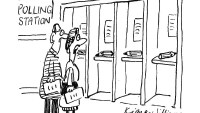
Bees vs Belgians Sir: To answer Rory Sutherland and Glen Weyl’s question: yes, everyone should vote and no, just because someone is more interested in politics, his opinion should not count more heavily (‘Plan Bee’, 2 May). Belgium has had compulsory voting for over a century. The troubles that follow every general election may seem to make it a strange example to follow, but those troubles are a consequence of the fragmented political landscape and not of the polling system. Compulsory voting motivates people to stay informed and care about what is happening to their country. It is, however, only compulsory to show up at the polling station, not to cast a valid vote, so the happily apathetic can draw a chicken or write a poem on their ballot paper if they’d rather.

From our UK edition
After working for Bill Clinton, the political strategist James Carville said he had changed his mind about where power really lies. ‘I used to think that if there was reincarnation, I wanted to come back as the President or the Pope,’ he said. ‘But now I would like to come back as the bond market. You can intimidate everybody.’ By this he meant that every political leader, no matter how powerful or radical, lived in fear of going too far into debt, lest the market hiked up interest rates, tipping the government into collapse. Alas, that’s no longer the case. This magazine ridiculed Gordon Brown for claiming to have ‘put an end to boom and bust’.

From our UK edition
Home The country went to the polls. David Cameron, the Conservative leader, prepared by going around with his sleeves rolled up. Ed Miliband, the Labour leader, said that his pledges had been cut into an eight-foot slab of limestone. Nick Clegg, the Liberal Democrat leader, took a bus for John O’Groats. Stuart Gulliver, the chief executive of HSBC, said it would take ‘a few months, not years’ to decide whether to move its headquarters out of Britain. Sainsbury’s reported a loss of £72 million for the year, after writing down a fall in the value of some of its shops. Three tons of cocaine, worth perhaps £500 million, were recovered from a ship intercepted 100 miles east of Aberdeen; the nine Turkish crew were arrested.
From our UK edition
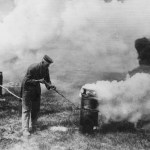
From ‘War by Poison’, The Spectator, 8 May 1915: THE nature of the gases by means of which the Germans have won undoubted local successes is gradually being ascertained, and the more we know of the gases the more brutal does the use of them appear. At first we heard them spoken of simply as asphyxiating gases, a description which suggested that men were overcome by them as men are rendered unconscious by fumes in a mine or a sewer. But the information now coming from the hospitals proves that the Germans have not scrupled to resort to a truly diabolical use of chemical science, and to discharge at their opponents vapours which cause not merely temporary physical incapacity, but agonizing suffering and permanent injury.
From our UK edition
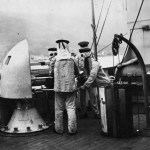
From ‘War by Poison’, The Spectator, 8 May 1915: By the consent of all men who are not savages, the use of poison is ruled out in war, and has been prohibited by custom for centuries. And war by poison is being practised not only in Europe; in German South-West Africa the Union troops, as we are informed by a Colonial Office Paper, have come across many wells poisoned with arsenic… ‘Poisoned wells’! The very phrase calls up visions of warfare with the wildest and most fanatical tribesmen in the world, but not with the inhabitants of the most highly organised country in Europe.
From our UK edition
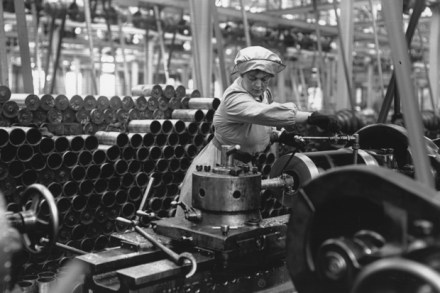
From ‘National Concentration’, The Spectator, 8 May 1915: The two great needs of the hour are more men and more munitions of war. We have got so to organize our forces that while more men are spared for the fighting line, there shall also be more men engaged, and efficiently engaged, in the manufacture of shells and other munitions of war. We have always pleaded in these columns for scientific recruiting, but what we want now is scientific recruiting, not merely for horse, foot, and artillery, but also for the factory and the shipyard. Translated into the world of immediate action, this means that we have got to do two things.
From our UK edition
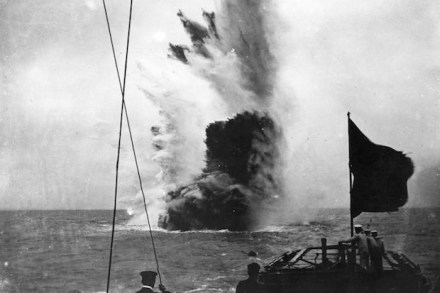
From ‘News of the Week’, The Spectator, 8 May 1915: Last Saturday the American oil-tank vessel ‘Gulflight’ was torpedoed by a German submarine off Bishop’s Lighthouse. The captain died of shock and two seamen were drowned. Thus the critical event which the American Government foresaw has come to pass. On February 4th the American Government despatched a Note to the German Government on the German declaration that the British seas would in future be a war zone in which Allied merchantmen might be sunk without notice, and every neutral ship would run the gravest risk owing to the fact that she might be mistaken for a British vessel flying a foreign flag.
From our UK edition
Carol Ann Duffy, the Poet Laureate, has again refused to write a poem to commemorate the birth of the new royal, Charlotte Elizabeth Diane. Rod Liddle has written his own poem about Duffy, asking why she took the job of Poet Laureate if she doesn't like writing verse about royals. But this still leaves no one around to write a verse befitting the occasion. So we are inviting Spectator readers to do so, and will make this the Spectator Literary Competition: it will be formally announced in next week's magazine. Please email entries of up to 16 lines to lucy@spectator.co.uk by midday on 20 May.

From our UK edition
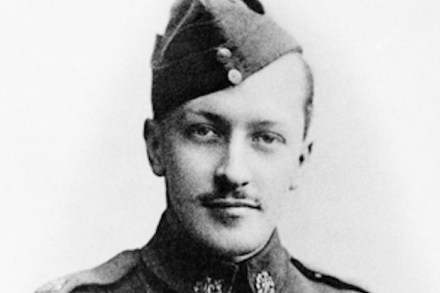
From ‘News of the Week’, The Spectator, 8 May 1915: The papers of last Saturday published a particularly vivid account by the Canadian Record Officer of the stand of Canadians at Ypres. Such heroism as is revealed in this narrative deserves even more than the tribute we paid to the Canadians last week, Their feat of arms will live for ever in military history. It was performed by men offered by lawyers, professors, and business men. We have since learned from a statement by General Hughes, the Canadian Minister of Militia, that the Canadian casualties exceeded six thousand. According to General Hughes's account, late in the battle the Canadian Highlanders were cut of by about sixty thousand Germans.
From our UK edition
From ‘Rupert Brooke’, The Spectator, 1 May 1915: TO all men there is attractiveness in the combination of the soldier and the poet, and perhaps the combination gives a more satisfying pleasure to the countrymen of Sir Philip Sidney than to any other race. This is the reason why thousands of Englishmen mourn for Rupert Brooke who never knew him, and possibly, till a few days ago, never heard of him. They read the brief details of his life and accomplishment, and at once their sorrow was real and, in a sense, personal. Rupert Brooke was distinctly one of the most promising of our poets. He had fire, imagination, a joy in life, a classical taste, an Hellenic eye for beauty and grace.

From our UK edition
From ‘The Khalifate’, The Spectator, 1 May 1915: It seems that the Ottoman Empire is likely to crumble away, and in that event, whether it happens soon or late, the question of the Khalifate will cause many searchings of heart to the Mohammedan world. In an intimate and most important sense Britain is concerned in this matter. The spiritual security and satisfaction of Moslems vitally concern the British Empire.

From our UK edition
From ‘News of the Week’, The Spectator, 1 May 1915: The accounts from the Dardanelles are distinctly encouraging. On Tuesday the British portion of the Expeditionary Force landed on the point of the Gallipoli Peninsula—i.e., on the European side—while the French landed an the Asian side, and have fought a battle on the plain of Troy or its neighbourhood, in which they have taken nearly two thousand prisoners. Our landing on and around the tip of the Gallipoli Peninsula has been supplemented by a landing near Bulair, the narrowest part of the tongue of land which forms the European wall of the Dardanelles. If this landing at Bulair can he made good, we ought to be able to destroy the whole of the Turkish force which lies between it and the tip of the Peninsula.

From our UK edition