2441: To and Fro solution
FRANCIS THOMPSON, born in PRESTON, wrote THE HOUND OF HEAVEN and a poem, AT LORD’S, remembering the run-stealers that flicker to and fro, and his HORNBY and his BARLOW LONG AGO. First prize D.
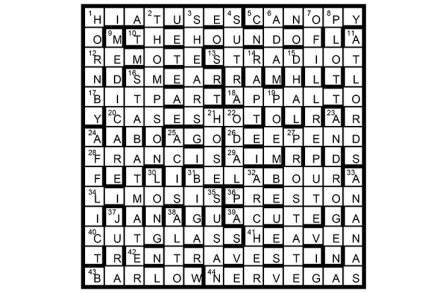
FRANCIS THOMPSON, born in PRESTON, wrote THE HOUND OF HEAVEN and a poem, AT LORD’S, remembering the run-stealers that flicker to and fro, and his HORNBY and his BARLOW LONG AGO. First prize D.
Boris Johnson's much-lauded Cabinet reshuffle has arrived. The sackings are now finished and the new hirings are underway. The biggest news by far is the loss of Sajid Javid.

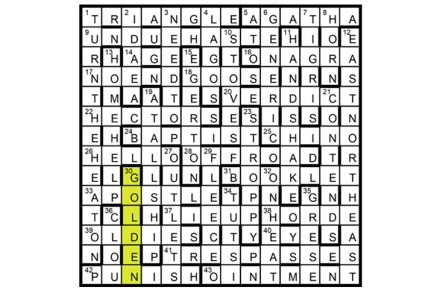
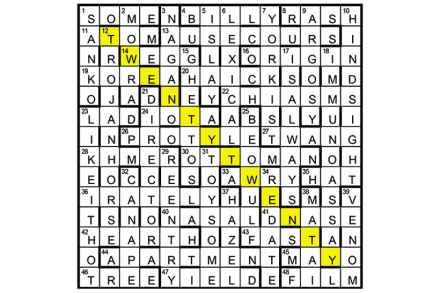
The unclued lights can be linked with GOLDEN, at 30D, which had to be highlighted. The trio is GOLDEN EYE OINTMENT (30/40/43).
The chance to fail Sir: Matt Ridley’s article ‘Risky business’ (1 February) offers a variety of reasons why innovation has been stifled in Britain for too long. As an educator, I would like to add two factors that I encounter on a regular basis: the tremendously suffocating grip of insurance companies, which turns the safest idea into a discouraging risk-assessment exercise, and the desire of parents to protect their child from any failure. There are understandable reasons why insurance companies and parents act like this. However, in schools and at home it prevents necessary opportunities to test and try, fail, learn and improve, and try again.
Home The United Kingdom quietly left the European Union at 11 p.m. GMT on 31 January. Boris Johnson, the Prime Minister, said in a speech about trade negotiations: ‘We have made our choice — we want a free trade agreement, similar to Canada’s but in the very unlikely event that we do not succeed, then our trade will have to be based on our existing withdrawal agreement with the EU.’ Britain would also pursue trade deals with other countries. The government brought forward from 2040 to 2035 a ban on selling new petrol, diesel or hybrid cars. David Cameron, the former prime minister, declined an offer from Boris Johnson to head the UN climate change summit in Glasgow in November.

After being sacked as the chairman of the COP26, the UN climate conference which is to take place in Glasgow later this year, Claire Perry O’Neill did not lose any time in settling scores. Boris Johnson, she said, does not ‘get’ climate change. In a sense she is right — but not in the way she thinks. The once-sceptical Prime Minister has been acting with the zeal of the converted on climate change and is all set to achieve ‘net zero’ UK climate emissions by 2050. Whether he ‘gets’ what this promise will require is another matter. This week, for example, he posed with Sir David Attenborough in the Science Museum to announce plans for the coming COP26 summit, pledging that Britain will take global ‘leadership’ in cutting carbon.

Mumbo jumbo The Prime Minister called opposition to imports of US-produced food ‘mumbo jumbo’. The expression was introduced to the English language in 1795 by Mungo Park in his Travels in the Interior of Africa. It was his way of writing down ‘Maamajomboo’ — the name used by the Mandinka people of West Africa for a pagan god, played by a male dancer, who was sent to intercede in disputes between the multiple wives of local men. Mumbo Jumbo would decide which woman was guilty, then strip her naked and scourge her with a rod. It is a wonder that Boris’s enemies haven’t seized upon his use of the expression as yet one more example of politically incorrect language. Health check Deaths from coronavirus reached the 490 mark.
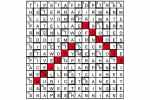
The unclued lights (paired at 5/8, 24/3, 30D/30A and 42/35, and the singleton at 37) are titles of series of books written by ENID BLYTON which is an anagram of TINY BLONDE in the title. First prize John Nutkins, London TW8 Runners-up C.V.

‘Homosexuality without the cant’, by Simon Raven, 14 June 1968: ‘All virile societies,’ writes Mary McCarthy à propos the Florentines, ‘see boys as objects of desire.’ And there you have it in one. Men will find younger men physically pleasing, not because of some terrible occurrence years ago in the woodshed, but because young males, like young females, are physically pleasing… They are a pleasure to look at, as everyone admits; they are also a pleasure to touch, when legitimate occasion presents; presumably, therefore, they are a pleasure to take to bed. The above is a straightforward statement of an attitude that has been common to many young males in many times and places. (It was certainly my own.
To buy tickets, head to the Spectator Shop. Join us in the Spectator boardroom on Friday 28 February for the next in this year’s series of Spectator Winemaker Lunches with Alex Schulz, fifth generation owner and head winemaker of Turkey Flat Vineyards, the cult winery of the Barossa Valley, Australia. First planted with Shiraz in 1847, Turkey Flat Vineyards is one of the oldest producers in Australia, famed not only for the remarkable quality of their sustainably-farmed Rhône-style wines but also their downright accessibility.

As we all know, we live in strange times and to do our part to shield our readers The Spectator has decided to cancel events until further notice. This means that several of our Spectator Winemaker Lunches will need to be cancelled or postponed. If you have already booked for any of these you will, of course, be refunded.Until we meet again, stay safe and make sure you have enough wine to see you through these dark days. Future virtual Wine Club events for which you might like to join us for:September 30 2020 - Online rum tasting October 14 2020 - Online cognac tasting October 28 2020 - Online whisky tasting *We will communicate any further changes to the schedule should the need arise.
The statement, ‘HINDSIGHT IS ALWAYS (10/17) twenty-twenty’ was made by the FILM DIRECTOR (48/21) BILLY (4) Wilder (suggested by the title). His works include SOME LIKE IT HOT (1A/23D) and The APARTMENT (44). TWENTY-TWENTY (diagonally from 12) was to be shaded. First prize C. and A. Snelson, Leyburn, N.
Enemies on the left Sir: James Forsyth’s article ‘Labour must change to win’ (25 January) describes how little appetite the party’s prospective leaders seem to have for arranging this change. Nonetheless, Labour remains a threat to national prosperity. The party was captured by the Trotskyists of Momentum in 2015. Trots never give up. Indeed, they regard politics as a long game. The danger is that the Conservatives have already been in government for nine years, and sooner or later all governing parties become unpopular. Momentum knows this very well and is getting ready. We ducked a bullet at the recent general election, but sensible people, of whatever political stripe, should not yet relax about Britain’s political situation.

In the beginning How did Britain mark its entry into the European Economic Community on 1 January 1973? There were no official celebrations, though George Thomson, one of Britain’s first two European commissioners, led a torchlit procession through London. In Brussels, a Union Flag was raised. Prime Minister Edward Heath was present at neither event: he was flying back from Ottawa, having attended the funeral of former Canadian prime minister Lester Pearson. Already, there were signs that many Britons saw it as nothing to celebrate: a poll for the BBC found 38 per cent were happy about joining — and 39 per cent already wanted to leave.
Home Using a Parker fountain pen (a brand now made in Nantes), Boris Johnson, the Prime Minister, signed the EU withdrawal agreement, which had been signed by Charles Michel, the President of the European Council, and Ursula von der Leyen, the President of the European Commission, in Brussels and sent to London by train. The Queen had given royal assent to the Withdrawal Bill. All that remained was for the agreement to be rubber-stamped by the European Parliament to allow the United Kingdom to leave the European Union at 11 p.m. GMT on 31 January. A 50p coin was minted, inscribed: ‘Peace, prosperity and friendship with all nations’; Lord Adonis declared: ‘I am never using or accepting this coin.

The moment of Britain’s departure from the EU was always likely to be an anticlimax, both for those who expect great things from Brexit and for those who had been braced for disaster. Departure day is not much of an event in itself, merely a moment at which new economic policies become possible. Thanks to the transition period and the Withdrawal Act, there is no cliff edge — at least not for now. Tough negotiations will begin again, but the Prime Minister has a chance to handle all this in a better, less divisive way than his predecessor. After leaving, Britain now takes on a new role: as the European Union’s strongest ally. Although the UK has opted out of the EU’s bureaucratic hierarchy, we remain part of Europe in terms of geography, culture, trade and outlook.
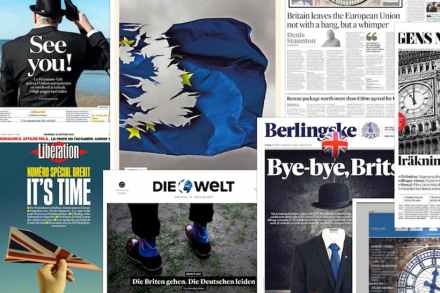
At 11pm tonight, Britain will finally leave the European Union, after 47 years inside the bloc. And, as expected, many European newspapers chose to mark Brexit day on their front pages. Le Figaro: 'L'adieu a l'Europe Liberation: It's time La Croix: See you! Le Monde: Europe enters the unknown Die Welt: The British leave.
The Spectator is the world’s oldest (and Europe’s fastest-growing) magazine and is read by more people than ever. But our podcasts now get over 1.5 million downloads a month: demand is pretty big and we need a podcast producer to help the expansion. We currently have a one-person podcast team, Cindy Yu, who produces nine regular podcasts covering everything from Brexit and Trump to the latest releases in the literary and culinary world. We need someone who, at 8am, can have a decent idea for what to discuss on a Coffee House Shots; who can look at a copy of the magazine and suggests not just three topics for our Edition podcast, but the guests.

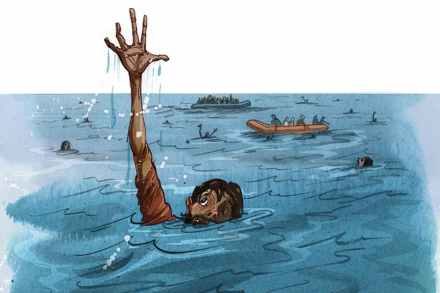
The news this week could easily have led with the deaths of 14 Afghan and Iraqi migrants in the English Channel, drowned as they attempted to reach Britain. In the event this didn’t happen, but only because their boat proved to be so unseaworthy that it capsized before they made it out of sight of the Belgian coast. All were able to swim back to the beach. This is the reality of people-trafficking: it is a callous industry whose operators care little for the lives of the migrants to whom they charge large sums for the promise of a new life. It is only three months since 39 Vietnamese migrants were discovered dead in the back of a refrigerated lorry at Tilbury. It is luck that has so far prevented a seaborne version of that disaster, but luck will not hold.
Parliamentary motions The government floated the idea of moving the House of Lords permanently to York. Until it was found a home in the Palace of Westminster in Henry VIII’s reign, parliaments were regularly held all over the country. A few of them: 1266 Parliament convened at Kenilworth, Warwickshire, while Henry III besieged Simon de Montfort’s followers in the castle. 1283 Parliament met at Shrewsbury so that members could watch the execution of Welsh rebel Dafydd. 1414 ‘Fire and Faggot Parliament’ met at Leicester and passed the Suppression of Heresy Act, allowing Lollards to be burned with bundles of sticks. 1459 ‘Parliament of Devils’ met in Coventry to try Yorkists with High Treason.