Tanya Gold

Tanya Gold

Tanya Gold is The Spectator's motoring critic

High on the hog: The Pig at Bridge Place reviewed

The Pig at Bridge Place is not a pig in possession of a country house, but I would be for it. You cannot have enough pigs, or any edible fauna. It is, rather, a hotel inside a Jacobean mansion — or, rather, part of a Jacobean mansion, the rest burnt down, and is all the better for it — in a pleasingly unkempt part of Kent, just beyond Canterbury. There are ten Pigs, dotted across the south coast as if in homage to Armada beacons. They are the successor to the Soho House brand, which is looking increasingly dusty, and in velvet. My main objection to Babington House is that it is for people with Peter Pan Syndrome: children who cannot grow up. They served fish-finger sandwiches and I think I saw a giant inflatable unicorn in the pool, but I have may have imagined it.
A Damascene moment in London: Imad’s Syrian Kitchen reviewed

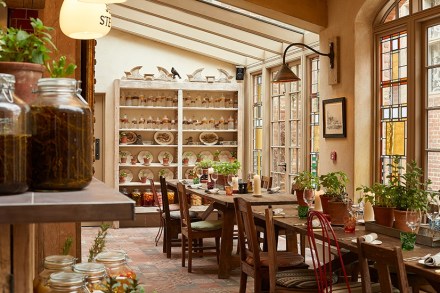
Imad’s Syrian Kitchen is an eyrie off Carnaby Street, a once-famous road which seems to exist nowadays to sell trainers to tourists who have fallen, as if by wormhole, out of the Liberty homeware department with its pathological dependence on florals. No matter. Nearby, in Kingly Court, which is like Covent Garden before it fell to Dior and Apple, more interesting things happen: the sort of things that London, so sunken, needs. Kingly Court is charming because it invokes an ancient coaching inn — London was once filled with them — and it is, due to the presence of independent eating houses, still palpably bright, pleasing and alive. The restaurant is likewise cheerful: wooden floors; pale walls; blue windowsills; blue tiles; a beamed ceiling; photographs of Damascus.

Olivia Potts, Rory Sutherland and Tanya Gold

14 min listen

On this week's episode, Olivia Potts says angry chefs could soon get their comeuppance. (00:56) Then, Rory Sutherland says over-qualification is leading to collective idiocy. (06:28) And finally, Tanya Gold wonders why people eat lobsters.

The politics of eating lobster

Lobsters like to live in gullies on the sea floor, or under sand, and I understand how they feel. But you can’t hide from politics. An amendment to the Animal Welfare (Sentience) Bill will make it illegal to post shrink-wrapped lobsters alive, or boil them alive, which turns them from blue to Father Christmas scarlet. In Switzerland, Norway and New Zealand it is already illegal to boil them. It is considered kinder to freeze them or pierce them or shoot them with an expensive lobster-stunning gun which you can probably buy in Hampstead Village. And then boil them. Lobsters were once food for the destitute near the sea, so plentiful they would wash ashore in piles. Then the trains came, and it was possible to transport them inland. The price shot up.

An utterly convincing dreamworld: The Ritz reviewed

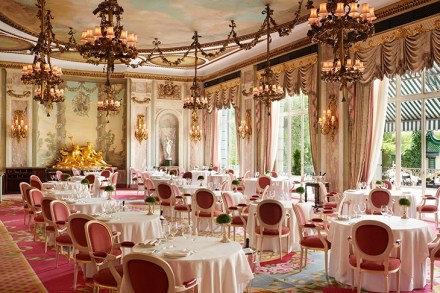
The Ritz is still here, and still gaudy. No grand hotel in London feels quite so complete, if pink; as if it landed like a Tardis on Green Park. There is no real life here, and there shouldn’t be. Each guest travels with their own novella. There are jewels in the window and brides on the stairs. Lady Thatcher died here, in a corner suite. Don’t ask which one. They won’t say, to discourage ghouls, party hacks and perverts. You cannot know if you are sleeping in her bed, and that is not even the oddest thing about the Ritz. The staff, who dress like toy soldiers, are charming in that way you don’t find outside Judith Krantz novels. That is, you believe them, and that is rare. The Ritz is a myth, and it is dedicated to itself.

Wally Funk: meet the 82-year-old jetting into space with Jeff Bezos

The moon would be more interesting with Wally Funk on it, and clearly Jeff Bezos agrees: the entrepreneur has just invited the 82-year-old female aerospace pioneer to join him on his inaugural space flight later this month.  In 1961, when she was 22, Wally took the physical tests to become an astronaut. They were grisly - ice-cream was dripped in her ears and she stayed in a floatation tank for almost eleven hours. She performed better than John Glenn - the vainest of the original Mercury 7 astronauts - but the tests were cancelled. No American woman entered space until Sally Ride in 1983. But Funk is too interesting to reduce to a fable about misogyny. Spacemen were sexist - who knew?

Harry Potter meets Ikea: Backlot Cafe reviewed

Harry Potter is a fictional orphan locked in a cupboard by his aunt and uncle, after which he discovers a magical world and a better class of nemesis than his ugly suburban relatives. It seethes with class. The Dursleys are lower-middle-class, golf-club-haunting gammons. I suspect their MP is Dominic Raab, and I suspect they vote for him. The improved nemesis ‘Lord’ Voldemort is half landed gentry and heir to a Jacobean manor house on a hill. Harry Potter is world famous, and so people want to join him in suburban misery (we are near Watford), though in a slightly larger cupboard: the vast prop room in a former sound stage off the M1 called the Warner Bros Studio Tour London — the Making of Harry Potter. Harry is a boiler-plated mythical hero.

A careful parody: Noble Rot Soho reviewed

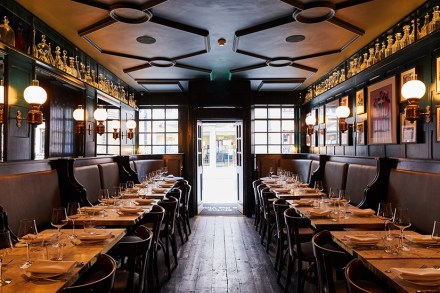
Noble Rot sits in Greek Street, Soho, on the site of the old Gay Hussar, which squatted here from 1953 like a rebuke. Some people loved this Hungarian ‘left-wing’ restaurant, with its terrible food, its library of Labour-themed political biographies, its raging cartoons and fond memories of Harold Wilson. But you can’t eat political biographies — not if you have taste. An attempt to save it by a ‘Goulash Collective’ failed, because the Gay Hussar was a themed restaurant whose theme — a sort of politicised London Dungeon — ran out. In an exquisite metaphor, it closed in 2018, at the height of Jeremy Corbyn’s self-hating — and self-thwarted — grasp for power.

The Lexus LC is why I’ll always love petrol

The only car I have felt unsafe in is a Morgan. It was a sort of pink leather bath on wheels that screamed down the road while men over sixty waved at it. I was right to be nervous. The delivery man crashed it on the way home. A photograph of the crushed Morgan – it was distinctive when formed, and even more so when broken – was circulated on Facebook by the man who recovered it. I initially thought the delivery driver was dead. (He wasn’t. 'Road conditions,' he said, when I telephoned him in hospital. It had rained).  I don’t mind telling you this, because I will never drive another Morgan because I want to live. The Morgan cannot be made safe; if it were invented now, as part of a motoring branch of cottage core, it would not be allowed on the road.

Bird-brained: Brood, by Jackie Polzin, reviewed

This is not a novel about four chickens of various character — Gloria, Miss Hennepin County, Gam Gam and Darkness — that belong to the nameless narrator of Brood. That is incidental. It is a novel about a miscarriage — ‘our baby had been a girl’ — and, because it is a novel about the loss of a child pretending to be a novel about chickens, it is a brilliant novel about chickens. They have a biographer now, but they can’t be grateful, and that is why she loves them. ‘By the time a snowflake has landed, snowflakes are all a chicken has ever known.’ Or: ‘Gloria is wedded to the egg, not the idea of the egg. If the egg is removed, her memory of the egg goes with it.’ Or: ‘A chicken speaks of the moment.

Bad food is back: The Roof Garden at Pantechnicon reviewed

The Roof Garden is a pale, Nordic-style restaurant at the top of the glorious Pantechnicon in Belgravia — formerly a bazaar — opposite a Waitrose I didn’t know existed. (Waitrose seems too human for Belgravia. Food seems too human for Belgravia.) This thrilling building, which should be a library — it has Doric columns — is instead a collection of restaurants, shops and what I think are called ‘outlets’ (a Japanese café; something called, gnomically, ‘Kiosk’), all celebrating the ‘playful’ intersection — I mean meeting, but marketing jargon is addictive if you are an idiot — between Nordic and Japanese food. It is a wealth mall from hell, then, in the style of Terminal 5’s main street.

Richard Dobbs, Tanya Gold and Rory Sutherland

17 min listen

In this episode, Richard Dobbs reads his piece on why he's considering giving up his second vaccine for people more in need (00:55); Tanya Gold reports from her Kent road trip in a Ferrari (07:50); and Rory Sutherland on the unexpected joys of lockdown and why we may miss it when it's gone.

My road trip notebook: castles, Charles Darwin and Churchill’s cuddly toys

Before pandemic I thought I might drive across America, or even France. Now — what about Kent, the garden of England? Why treat English Heritage and the National Trust like guardians of the graveyard: you must be old or possessing a dog to enter? I need a car and so I borrow a Ferrari. The car and I are both nervous. It has a peculiar consciousness; no car feels as responsive, or as human. It feels like driving an Italian man. It is infinitely stylish, it beeps when it is anxious or cross, and it is credulous and ambitious about London traffic, which is touching: how can it take an hour to go eight miles? Me, I just don’t want to break it.

Where I love to eat

We can enter restaurants on Monday, and I wondered if I should tell you where to eat if you want the most fantastical or expensive or original food in London, or where I will eat in the early days of re-opening. What have you missed? A ball of ice on wheels containing champagne bottles at angles, trundling along like a mad hedgehog? (This was in Monaco). Foam? Hamburgers amid velvets at Louie, a newish supper-club near the Ivy named for Louis Armstrong and Louis XIV both? (Sometimes in life you have to choose, but not in Louie). Balthazar in the over-polished wasteland of Covent Garden, the latest central London district to be ruined by depopulation and money? Anything with Gordon Ramsay’s name falling off it, like Humpty-Dumpty and dust?

Pretty food with a side order of pollution: 28-50 reviewed

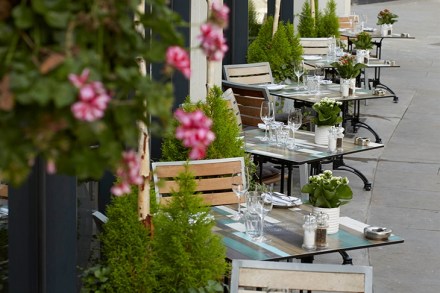
You cannot have cars and dining tables in the same dreamscape: it doesn’t work, unless you think carbon monoxide is a herb, or are wearing full Hazmat, like some teachers. London is in much denial about its air pollution; in the East End child asthmatics are choking. But we must embrace it for a few days more; others have lost more in pandemic than an attachment to the convention that if we dine outside it should be in a flower-filled garden. Perhaps there are enchanted restaurant gardens in London, but I have never found one. I conclude that, outside fiction or aristocracy, they do not exist. Instead, we have modish kerbside dining.

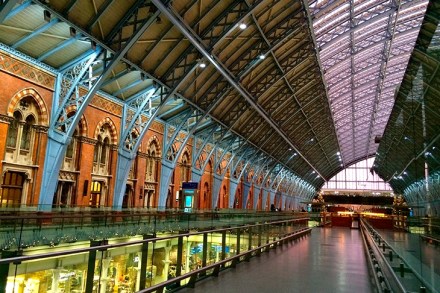
Pleasing perversity: St Pancras Brasserie and Champagne Bar by Searcys reviewed

The St Pancras Brasserie and Champagne Bar by Searcys is as expansive as its name, but ghostly. It is an immense Art Deco restaurant spilling on to an empty platform at the station. When restaurants opened their patios and gardens, I fretted that they would be too busy to be enjoyed: a diner would cling to a square of Astroturf, fearing to sink. But not here: the people have been removed, and they have not returned. Inside, it is empty if not shuttered: a great, golden brasserie with dark wood, dark leather and pale globes of light. The door to the loo is so tall I imagine they stole the idea from Mr Greedy (and the giant who loved peas).

The strange allure of off-road vehicles

The Duke of Edinburgh was carried to his tomb in a modified Land Rover, and this is apt. He walked away from a highspeed collision in Norfolk a few years ago because – and probably only because - he was driving a Land Rover Freelander. The Land Rover, which was intially the off-road Rover, is the original British SUV. It is beloved by farmers, who need them, and dukes, who like them because they are both grand and useful, a metaphor in metal – at least from their perspective - for feudalism itself. Few cars are as evocative of an ancient chariot, or as versatile: motorways do not daunt them, and nor do potholes.

Back to the future: Bentley’s Oyster Bar & Grill reviewed

From our US edition

The west end of London is still pale and necrotic, but there are points of light. Hatchards the bookseller is open and its memorial to the Duke of Edinburgh is relatively, blissfully, restrained: a portrait in the window, with minimal text for a writer to trip up on his own sycophancy. People are buying whisky on Jermyn Street. The greasy spoon Piggy’s in Air Street survives and if before you merely loitered outside restaurants and ate your food from a bucket you can now sit down, though a strange sort of duck marshal lurks in St James’s Park, and I do not trust him. I do not think he is really watching the ducks. I celebrate the end of this lockdown at Bentley’s Oyster Bar & Grill in Swallow Street.

Anti-Semitism and the far left

The comic David Baddiel has written a book which explains that much of the far left hates Jews. There are exceptions. They are OK with dead Jews (the Holocaust gets a sad face emoji if it isn’t ‘exploited’ by living Jews, in which case it gets an angry face emoji), and penitent Jews (the ones who hate Israel in any form). They will deny it and call me an anti-Semite and a Nazi writing for a Nazi magazine with my Nazi fingers because they don’t understand Nazism, anti-Semitism or themselves. They are not really progressives; they are religious maniacs — and that is sometimes funny. These penitent Jews should include Baddiel, who is not a Zionist.

Spring lamb and the bread of affliction: our Zoom seder

This week my son came home from school and asked me if it was true that the Jews killed Jesus. Um, I said. Read the Gospels. Read Hyam Maccoby. Ask your father. My husband is a religious maniac, though Christian. Any patriarchy will do. He insists I pretend to be an ultra-Orthodox Jew for festivals, and finds recipes for weird ceremonial breads. ‘Can’t we make Judaism fun?’ he asks. I reply, aghast: ‘It isn’t supposed to be fun.’ My Judaism is rather Holocaust--centric. I told a family therapist after my parents’ divorce: ‘I lost a father and gained a Shoah.