Stephen Daisley

Stephen Daisley

Stephen Daisley is a Spectator regular and a columnist for the Scottish Daily Mail

Boris Johnson’s greatest challenge is nothing to do with Brexit

The Scottish papers carry two difficult polls for Downing Street. One, from Survation, puts support for independence at 50/50; another, from Panelbase, has it at 52 per cent in favour and 48 per cent against. The cursed percentages. I say difficult polls for Downing Street rather than Westminster in general because the Union — not Brexit, or terrorism, or northern regeneration — is the number one challenge facing Boris Johnson’s government. I appreciate that I banged on about this as recently as Friday but I intend to keep banging on about it because a) it’s true, and b) I cannot bring myself to care about Nish Kumar.

Labour’s Richard Burgon problem

Richard Burgon is an idiot. Yes, I know you subscribe to The Spectator expecting more high-brow invective but I believe in being direct. Now, ordinarily I’d be in favour of leaving such a simple creature to his own devices, but this is the Labour Party we’re talking about, so Daisley’s First Law applies: The worst candidate in any Labour election is the one most likely to win. Elections for the deputy leader of the Labour party are generally to be filed under ‘private grief’, but Burgon is bent on spreading the misery around. He wants to be ‘campaigner in chief’ and pledges that, ‘within the first month of being deputy leader I will visit every single seat we lost’.

Boris Johnson must start taking Scexit seriously

Polls come and go and the YouGov survey showing support for Scottish independence at 51 per cent should be read with that in mind. The Nationalists have been ahead before and have fallen behind again. What Downing Street cannot take in its stride is this: five years since the Scottish referendum, and with the SNP government in Edinburgh plagued by crises in health and education, support for secession has not fallen away. The separatists still enjoy a solid base of support, around 45 per cent, which delivered them 47 of Scotland’s 59 seats in the general election. They lost the 2014 referendum 55 per cent to 45 per cent and have been inching forwards ever since.

British universities are a modern-day racket

One of the great myths of Scottish higher education is that it’s free. Outside observers can be forgiven for making this error because Nicola Sturgeon asserts it so very often. She has boasted that ‘one of this government’s proudest achievements is the restoration of free higher education’, claimed to ‘stand for universal services, such as... free education’, and argued, naturally, that independence is ‘the only way to protect the advances that Scotland has made with devolution through the social contract, which has delivered vital universal benefits such as free university education’.

Taking the Lords out of London should be just the start

The proposal to relocate the House of Lords to York is harmless enough, though residents of York might disagree. The idea of an upper chamber of philosopher kings to check democratic excitability is sound in principle but when your definition of a philosopher king extends to John Prescott, you begin to question the merits of philosophy. If immediate abolition is too radical for the Tories, let’s punt the peers to the north east, note the inevitable drop-off in attendance and go in for the kill at a later date. But just as important as the de-Londonisation of the state (and the economy) is the de-Londonisation of the intellectual life of the UK.

The necessary case for Ian Murray as Labour’s deputy leader

Ian Murray is standing for a post last won by a Scot 88 years ago. Since its creation in 1922, the deputy leadership of the Labour Party has been filled by five Londoners, four Welshmen, three Yorkshiremen, two Lancastrians, one Cumbrian, one Plymothian and William Graham, the solitary Scot. Graham was also an Edinburgh MP, though having died in office after just four months, he may not be Murray’s desired role model. The case for ending nine decades of Scottish exile from Labour’s number two position seems particularly strong in light of the General Election. Murray was left, as he was in 2015, the only Labour MP in Scotland; his colleagues swept away in another SNP yellow wave.

Boris must correct the mistakes of Scottish devolution

Boris Johnson’s refusal to grant a second independence referendum is a source of relief rather than joy for Scottish unionists. Unionists won decisively in 2014 but their opponents’ failure to accept the referendum result has held Scotland in constitutional limbo ever since. Five years on a permanent campaign has been as healthy for the body politic as one might imagine, and while the discord over Brexit last year was unfortunate, it was hard to watch as a Scot without channelling Crocodile Dundee: That’s not bitter constitutional division. This is bitter constitutional division. Nicola Sturgeon has held Scotland hostage in pursuit of her constitutional agenda and allowed its health service and education system to deteriorate through neglect.

The gloriously unhinged progressive pushback against the Babylon Bee

From our US edition

Going viral is ordinarily pay-dirt for a small website: new readers, more subscribers, and a bigger slice of that sweet, sweet Google Ads revenue pie. Unfortunately for satirical Christian news-site the Babylon Bee, it went viral in the wrong way: it made fun of Democrats. Last week, its spoof story 'Democrats Call For Flags To Be Flown At Half-Mast To Grieve Death Of Soleimani' attracted 750,000 shares on social media. The headline and the body of the text are patently absurd and obviously satirical. Of course Democrats didn’t call for the flag to be flown at half-mast for Soleimani. It’s not like he was Osama bin Laden or anything. Donie O’Sullivan, who covers ‘disinformation, politics and technology’ for CNN, saw darker forces at work.

babylon bee

Can anyone stop the SNP’s drive for independence?

Nicola Sturgeon’s reshuffle of her Westminster team is more than a post-election shake-up of the Nationalist front bench. For one thing, it represents a shift to the next generation. Mhairi Black (25), who became something of a political superstar upon her election in 2015, has been promoted to Scotland spokeswoman; freshly elected Stephen Flynn (31) is suddenly shadowing the chief secretary to the Treasury; David Linden (29) will head up housing and local government policy; and Amy Callaghan, the 27-year-old who unseated Jo Swinson in East Dunbartonshire, will lead on pensions. The SNP has a wealth of talent coming up and is giving them their first step on the ladder. The SNP’s front bench line-up is markedly more impressive than Labour’s.

Boris Johnson’s dismal response to Qasem Soleimani’s assassination

Two weeks ago, I asked what kind of prime minister Boris Johnson might be and whether he could be ‘the great disruptor’ on foreign policy, defying standard practices and elite assumptions as Donald Trump has. I think I might have my answer. On Trump’s decision to take out Iranian terrorist-in-chief Qasem Soleimani, the Prime Minister was silent for two days. When he finally spoke, it was hardly worth it. Of course Johnson was right to say, given the Quds Force head’s role in the killing of thousands of civilians, ‘we will not lament his death’. He was right too to warn Tehran against escalation.

Labour’s defeat has not ended anti-Semitism

The defeat of Jeremy Corbyn and the Labour Party has afforded little respite to British Jews. Residents of Hampstead and Belsize Park woke on Sunday to storefronts and a synagogue daubed in the Star of David and ‘9/11’, apparently invoking the conspiracy theory that Jews were behind the September 11 attacks. December has been sweeps month for anti-Semitism across Europe. Two teenagers were charged after allegedly beating a rabbi in Stamford Hill while shouting ‘kill Jews’. A man was arrested on suspicion of racially or religiously aggravated assault after a United Synagogue official was attacked near his east London home. An Israeli student was assaulted on the Paris Metro for speaking Hebrew.

On foreign policy, Boris can be the great disruptor

Much of the post-election attention has gone on the next stage of Brexit and the government’s attempts to set down a domestic reform agenda that works for the Tories’ new northern constituencies. As such, the Integrated Security, Defence and Foreign Policy Review, briefed as ‘the deepest review of Britain's security, defence, and foreign policy since the end of the Cold War’, has so far been somewhat overlooked. Yet, as the terms of both the Queen’s Speech and Downing Street’s briefing underscore, this review will ‘reassess the nation’s place in the world’, a pretty significant remit. The Sovereign committed her ministers to ‘promot[ing] the United Kingdom’s interests...

Corbyn couldn’t have done it without ‘moderates’ like Jess Phillips

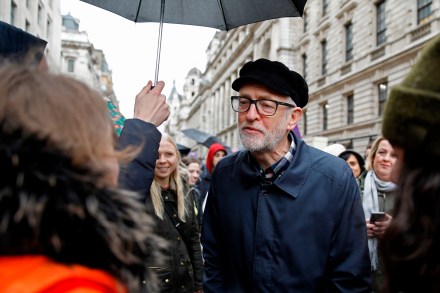
Thursday was a routing for Labour but the reckoning is still to come. Four years into the Corbyn project, and two years after it should have happened, the country crushed the Labour party for embracing the most extreme and dangerous figure in mainstream British politics since Oswald Mosley. For British Jews, who have been put through intolerable torment since 2015, this past weekend marked the first Shabbat dinner at which Jeremy Corbyn’s name could be raised in something other than anger or exasperation or dread. In a break with much of Jewish history, Gentiles were on the right side for once. And while it is naive to assume anti-Semitism was the decisive factor for most voters, for some it was and for others it was swimming around in the broth.

Has Nicola Sturgeon pulled off a second historic victory?

It’s just an exit poll. They can be wrong. They were, substantially, in 1992 and lowballed the Tory result in 2015. Those caveats stated, we have to address that number for the SNP. Fifty-five seats, every seat but four north of the border, would represent the Nationalists’ best result since 2015. Before polls closed, SNP insiders were nervous they might lose some marginal seats to a combination of the Tories and Labour. If the exit poll is broadly accurate, Nicola Sturgeon has pulled off a second historic victory. Since she placed Brexit and Scexit at the centre of her campaign — stopping the former and securing a second referendum on the latter — we can expect her to say the result establishes a mandate for just that.

‘Progressive’ Britain is no more if Jeremy Corbyn comes to power

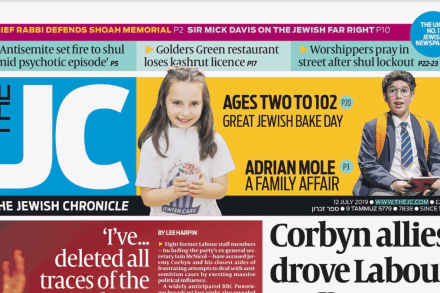
At the outbreak of World War I, the Jewish Chronicle, which had been wary of conflict with Germany, threw its support behind the war effort in a leader proclaiming: ‘England has been all she could be to Jews, Jews will be all they can be to England.’ A banner reading the same and urging Jews to enlist, was hoist outside the newspaper’s London offices. The Jewish World published a full-page poster insisting ‘There must be no Jewish slackers’ and urging ‘young Jewish men’ to ‘do your duty to your faith and your country’. Naturalised British Jews urged Russian emigres to sign up, even though as foreign nationals they were initially exempt.

Nicola Sturgeon’s failings are catching up with her

Nicola Sturgeon has had a change of heart. Gone are the ultimatums, the stridency and the self-righteous rhetoric. In an interview with today’s Daily Record, we see Sturgeon the Introspective: ‘Brexit gave me an insight, maybe that I didn’t have before, of how No voters would have felt had the referendum on independence gone the other way.’ We see Sturgeon the Pluralist: ‘Scotland belongs to those who oppose independence just as much as it belongs to those who support independence.’ There is even Sturgeon the Collegial.

Take it from this expert: Jeremy Corbyn is an anti-Semite

‘Racists are racists are racists and Jeremy Corbyn is a racist.’  Yair Lapid is not mincing his words. One of the leaders of Israel’s main centre-left party broke with protocol this morning at a conference in Jerusalem to urge British voters not to elect Jeremy Corbyn.  He said the Labour leader was an anti-Semite, but that his anti-Semitism was not the ‘new anti-Semitism’ seen in recent decades as a result of the ‘black and red coalition’ of traditional fascists and leftists. ‘This is old-school, plain anti-Semitism,’ he said. Lapid, a former television presenter, entered politics in 2012 with a new liberal party, Yesh Atid.

The 15 Scottish seats that could decide the general election

For at least a generation — something we define loosely up here — Scottish hacks have been trying to interest London newsdesks in Scotland’s role in general elections. Then, in 2015, we had the good fortune of Scotland deciding to up and turn into a one-party state overnight. Then, in 2017, we revised our arrangements to a one-and-a-bit-party state when Ruth Davidson’s Conservatives liberated 12 seats from Nationalist control. Scotland may end up being the main story of this election too, if, as Eeyore types like me have been warning, the Tories do not romp home on December 12.

Boris should threaten to back Corbyn’s ridiculous Brexit plan

The decline of the Liberal Democrats continues to give Labour a boost and rattle Tory nerves. Middle class Remainers who dislike Jeremy Corbyn are nonetheless deciding that he is their last best chance to thwart Brexit. Electing an anti-Semitic government so you don’t need to show a passport at Paris Charles de Gaulle is quite the ethical choice but there you go. It’s also a pretty big gamble. We know that Corbyn is a Brexiteer who believes freedom of movement drives down workers’ wages because he has told us as much. Voting for him to stop a hard Brexit isn’t so much holding your nose as poking your own eye, but Remainers know Labour backbenchers will hold him to his promises on a second referendum. Right?

Jo Swinson’s Andrew Neil interview exposed her party’s Brexit extremism

Jo Swinson’s ordeal at the hands of Andrew Neil dramatised (painfully) the anguish of being a liberal in an age of populism. The Liberal Democrats are the ultimate fence-sitters, the men too broadminded to take their own side in a quarrel, per Robert Frost’s aphorism. But in this election they have tried to represent the centre while advocating the most extreme position on Brexit. As Neil pointed out to Swinson on tonight’s BBC One interview, her policy of revoking Brexit without a vote (in the event of a Lib Dem majority government) was so fundamentalist it has proved off-putting even to some Remainers. He suggested this might have contributed to Swinson’s ever-declining favourability ratings, and he’s probably onto something there.