Ross Clark

Ross Clark

Ross Clark is a leader writer and columnist who has written for The Spectator for three decades. He writes on Substack, at Ross on Why?

George Osborne’s stamp duty hike is starting to bite the Treasury

The existence of the Laffer Curve can be proved by thought-experiment alone. If a government levies an income tax rate of 0 per cent it will raise zero revenue. If it levies a rate of 100 per cent it will also raise zero revenue, as no-one will bother to earn any money – or at least declare any earnings. Somewhere between those extremes lies an optimum point at which the tax-take reaches a maximum value. Trouble is, no-one really knows where the peak of the Laffer Curve lies for income tax, or for any other tax for that matter. George Osborne asserted that – at least for income tax in Britain – it lies some way below 50 per cent.

A view of St Paul’s is the least of London’s housing problems

Richmond Park has been in the news a bit lately. It is portrayed as a bastion of wealth and privilege, whose residents stand accused of trying to lord it over ordinary voters. But never mind blocking Brexit, do the people who live there deserve the right to an uninterrupted view of St Paul's? Outrage has greeted the construction of a 42-storey tower in Stratford, East London, which is accused of compromising the view of Wren’s great cathedral from a mound in Richmond Park. Planning permission for Manhattan Loft Gardens, which will incorporate 250 flats as well as a 145-bed hotel, was granted back in 2011. Yet no-one seemed to notice at the time that the block would stand directly behind St Paul’s when viewed from Richmond Park. The cathedral says it was not consulted.

Is support for Brexit growing in Richmond Park?

'The people of Richmond Park and North Kingston have sent a shockwave through this Conservative Brexit government,' said Sarah Olney, the victorious Liberal Democrat candidate in the Richmond Park by-election. She went on to announce that she would interpret the result as a personal mandate to vote against the triggering of article 50 if it comes down to a Commons vote. The LibDems were perfectly entitled to try to turn the Richmond Park by-election into a protest against Brexit – in spite of Zac Goldsmith’s protests that it was all about Heathrow’s third runway. If you resign your seat and cause a by-election, opposition parties are entitled to fight on whatever issues they like.

The Booker prize has triggered a bout of literary protectionism

Whatever happened to all those great liberal internationalists who damned the vote for Brexit as a case of isolationist Britain turning its back on the outside world? Julian Barnes, for example, is so pro-EU that not only was he against Brexit, he recently told the FT that he would still like Britain to join the Euro. It is a somewhat different story, though, when the literary establishment sees a threat to its cosy little world. Then, they come over all protectionist. Barnes is now bleating about the Booker prize being opened up to US writers. 'The Americans have got enough prizes of their own,' he complains. Novelist Amanda Craig was quick to play the internationalist over Brexit.

Global temperatures have fallen – so why isn’t it being reported?

Remember how rises in global temperatures were reported earlier in the year? Here is a taste from the Guardian in July. Funny thing is, though, global temperatures are now falling equally sharply – and no-one, with the exception of the Mail on Sunday last weekend, seems to be bothered about reporting it. Not even Nasa seems interested in reporting its own data for global temperatures. Instead, Nasa last week put out a press release about a study which claimed to have found a reason to explain the hiatus in global temperatures between 1998 and 2013 – the conclusion of which was, in as many words: it was all an illusion. The oceans were still warming up, but they were storing much of the Earth’s increased heat, which will be spewed out into the atmosphere in due course.

Like Donald Trump, Francois Fillon is a Russian realist

One of the bonuses of a Trump presidency – of which there will be many negatives – is the prospect of a distinct lowering of temperature in relations between Russia and the West. Now, it seems that Vladimir Putin is destined to have a friend in Western Europe, too. The new favourite for next year’s French presidential election, Francois Fillon, is just as keen on forging relations with the Russian president. Asked recently whether he worried about Trump’s closeness to Putin he replied: 'I don’t only not worry about it, I wish for it.' He went on to demand that Russia be treated as 'a great nation' and not made a pariah over its annexation of the Crimea. Putin has returned the compliment, calling Fillon an ‘upstanding person’.

The IFS forecast should be taken with a pinch of salt

Under Robert Chote, the Institute of Fiscal Studies (IFS) was meticulous about positioning itself as politically neutral. Since he left to run the Office of Budgetary Responsibility (OBR) and Paul Johnson took over it has been far more relaxed about its political position. Increasingly it comes across as yet another centre-left think tank attacking the government’s ‘austerity’ policies. Today, the IFS put out a projection of wage growth over the next four years, taking into account yesterday’s autumn statement. The eye-catching headline is that real earnings will be lower in 2020/21 than they were in 2007/08, at the beginning of the financial crash.

The government’s latest growth forecast isn’t worth the paper it’s written on

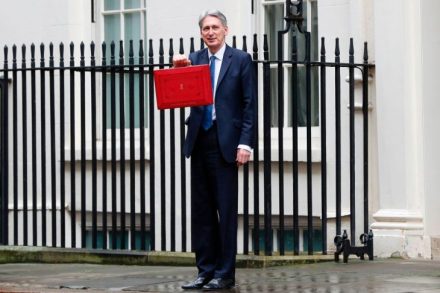
Facebook and Barack Obama have said they both want to tackle ‘fake news’ on the internet. The battle should start with government economic forecasts. Does anyone really believe the figures for economic growth up to 2020 made by the Office for Budgetary Responsibility (OBR) and pumped out by Philip Hammond in his Autumn Statement? Growth for next year, claims the OBR, will be 1.4 per cent, down from 2.2 per cent. In 2018 it will be 1.7 per cent, followed by 2.1 per cent in 2019 and 2020 and two per cent in 2021. How very precise. And how utterly improbable. What is the point in making these forecasts when they have proved so wide of the mark in the past? A year ago, the OBR forecast growth in 2016 at 2.4 per cent.

Will Philip Hammond be arrested after the Autumn Statement?

So, austerity is to end. Or that is what the briefings for Wednesday’s Autumn Statement seem to indicate: Philip Hammond will loosen the purse strings, relax his fiscal targets and give the economy a big public spending-induced buzz – if indeed buzz is quite the right word for what happens when governments spend money. There is just one problem with what Hammond appears to be proposing. No, not that it almost certainly won’t be enough to please Ed Balls, Yanis Varoufakis, the unions, the Guardian and everyone else on the left who accused George Osborne of trashing the economy by making ‘cuts’ – or, more accurately, by refusing to grow public spending in line with what they think it ought to grow by.

Cryonics isn’t the route to immortality – but there might be another way

However tempting it would be to think otherwise, I don’t think we will be seeing ‘JS’ on Earth again. She is the 14 year old girl who died of cancer and whose mother has won in the high court the right to have her body cryogenically-preserved in the US – against the wishes of her estranged father. There are moral issues involved in this case, but the question of which parents’ wishes should be taken into account in such cases seems rather secondary. Far more to the point is how moral is it for a company to charge £37,000 to preserve your body in ice when nobody has the faintest idea of how it could ever be brought back to life.

Oxford Dictionaries is playing politics by picking ‘post-truth’ as its ‘word of the year’

The BBC was recently exposed for buying more copies of the Guardian than of any other paper. I imagine they must get through quote a pile of Guardians at Oxford Dictionaries, too. How else could they have come up with the idea of making ‘post-truth’ their word of the year? The trouble with the concept of ‘post-truth’ is that it is itself untrue. It implies that there was a golden age of scientific reason which has now passed. There wasn’t. People have always been prone to superstition, prejudice and to making emotional judgements. They still are, but if anything, scientific evidence is treated with far more reverence than it ever has been.

Falling inflation marks another nail in the coffin for Project Fear

So, another post-Brexit horror story fails to materialise. When the stock market failed to crash and the economy failed to slump, the continuing Remain campaign hit on another fear: inflation. When the CPI rose in September to one per cent, it was predicted to be merely the beginning of a trend which would see prices surge as a result of the fall in the pound. Instead, the CPI fell back slightly last month to 0.9 per cent. It may well rise again in the coming months, but it is already clear that it is going to be hard to maintain the narrative of a Brexit-inspired inflationary spiral. At 0.9 per cent, CPI remains below the nadir it reached in the midst of the 2008/09 crisis – a time when many economists were warning of the spectre of deflation.

Why doesn’t the Guardian’s fevered hate crime coverage mention Christian victims?

One searches in vain on the Guardian website for the name Nissar Hussain. This is odd because the newspaper seems to have spent the past few months engaged in a campaign against hate. Virtually every day there is a column or leader grimly claiming that the vote for Brexit has unleashed a spate of hate. Its archives brim with news stories trying to infer a causal link between Brexit and a reported rise in hate crime – even to the point of absurdity. Last month, the paper carried a story claiming that there had been a 147 per cent rise in homophobic attacks since Brexit.

The unfair attacks on Liz Truss prove that Parliament has too many lawyers

If there were any doubt that there are too many lawyers in Parliament it has been removed by the meeting, on Monday evening, between backbench Conservative MPs and the justice secretary Liz Truss. The subject was Truss’s alleged failure to defend the judiciary from criticism of last week’s High Court judgement on the enactment of Article 50. One MP was reported as saying: 'Her job is to defend the judiciary from attack.' No it isn’t. Liz Truss has special duties as Lord Chancellor – but she is the government's justice secretary, not CEO of a judges' trade association. Her duty as Lord Chancellor is to uphold the continued independence (from the government) of the judiciary - not to protect it from public criticism.

Theresa May will only regret it if she doesn’t call an early election

Is there anything more absurd than hearing a bunch of Remainers claiming that they have achieved a great victory for Parliamentary democracy in today’s High Court ruling that Parliament should vote on the exercise of Article 50, beginning Britain’s exit from the EU? Parliament voted for a referendum, in which the British people voted to leave the EU. All that today’s judgement does is frustrate that process. As I wrote last week over Heathrow, the judicial review system is fast-turning Britain into a Krytocracy, in which judges wield the real power. All that said, why is the government bothering to fight the judgement? If the Remainers want more Parliamentary democracy, Theresa May should give it to them.

Why I’m boycotting Waitrose

Right, that’s it. No more paying through the nose for sun-dried tomatoes. I am boycotting Waitrose and I urge others to do the same. I am not buying my groceries from a company which has caved into the unscientific balderdash coming from the anti-GM lobby. Waitrose has just announced that it will no longer use GM feed on its farms. I am not usually one for boycotts, but the only way anyone is going to defeat the anti-GM brigade is to play it at its own game. Britain should have been a world leader in GM technology. In the late 1990s we had the minds to develop and grow it. Instead, it was squashed by scare stories spread by environmentalists, who claimed that GM food was going to give us cancer and lead to the countryside being gobbled up by cross-pollinated superweeds.

Amber Rudd is right, Orgreave is best consigned to the history books

So, there will be no public inquiry into the Battle of Orgreave in 1984, and no left-wing lawyers making a fortune. Maybe Andy Burnham, who seems to have appointed himself as Shadow Minister for Ancient Grievances, would have got further had he demanded an inquiry that was less overtly political, and looked at the violence of striking miners as well as misconduct by the police, but do we really have to trawl back through all of that? No-one died at Orgreave, unlike in South Wales where taxi driver David Wilkie was killed when a concrete block was dropped on his car while taking a ‘scab’ to work. The striking miners responsible ended up serving just four years in jail, their murder sentence reduced to manslaughter on appeal.

The Uber ruling will change little

So the GMB and the two Uber drivers who thought they ought to receive holiday pay and be guaranteed the national living wage have won their case. An employment tribunal has ruled that Uber was wrong to classify them as self-employed as their contracts placed too much demand on them to work at particular times – a condition which indicates employment rather than self-employment. What the other 40,000 Uber drivers think of the case is not clear. On the one hand, having status as employees would offer them a guaranteed £7.20 an hour and paid holidays. On the other hand, it would mean paying higher National Insurance contributions and less flexibility to work when they want to. It would make it much more difficult for them to combine driving a cab with doing other work.

Today’s GDP figures show the ‘inevitable’ Brexit recession wasn’t so inevitable after all

So now we know. The recession that we were told would be ‘inevitable’ if we voted to leave the EU was not quite so inevitable after all. In fact, it hasn’t happened at all. The Office of National Statistics’ first estimate of economic growth for the third quarter has the economy growing by 0.5 per cent. Though this is just an early estimate and could well be revised – revision upwards or downwards of 0.1 to 0.2 per cent are perfectly normal – it is certainly not indicating a recession, which would be two quarters of negative growth. It is pretty much in line with how the economy was growing prior to the vote – a healthy annualised growth of around two per cent.

The Project Fear backtracking isn’t over yet

Another day, another backtracking in the doom-laden predictions of what would happen as a result of a vote for Brexit. Back in May, World Trade Organisation (WTO) chief Roberto Azevedo told the Financial Times that Britain would not simply be allowed to ‘cut and paste’ its terms of membership with the WTO. We would, he suggested, effectively have to negotiate from scratch – a process which could take years, as it did when Liberia joined. Today he has recanted, somewhat. 'The UK is a member of the WTO today, it will continue to be a member tomorrow,' he told Sky News. 'There will be no discontinuity in membership. They have to renegotiate but that doesn't mean they are not members.