Ross Clark

Ross Clark

Ross Clark is a leader writer and columnist who has written for The Spectator for three decades. He writes on Substack, at Ross on Why?

Theresa May must still be prepared to call the EU’s Brexit bluff

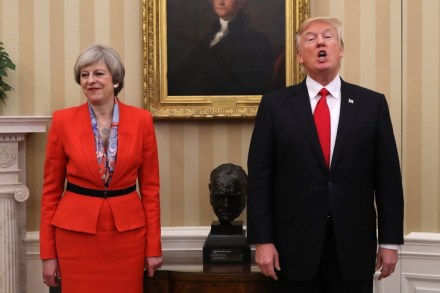
As the Brexit ‘war cabinet’ meets this morning to discuss what future trading relationship Britain would like with the EU there is a grim inevitability about the next few months. We know what we want – free trade with the EU, in services as well as goods, as well as free trade with the rest of the world. The EU, as it has made clear in recent days, has other ideas. Its plan is to allow us a Canada-style deal – a free trade deal in goods but not services, something which will be completely unacceptable to Britain, with our financial services-dominated economy. Moreover, it is going to try to impose punitive tariffs on British imports wherever it feels that UK regulation is unhelpful to EU industries.

Theresa May should have backed down in her Brexit battle with Parliament

This morning has brought predictable outrage about Tory ‘traitors’. The Prime Minister has been undermined, Guy Verhofstadt has had his fun describing it as a ‘good day for democracy’. The government has been reduced to damage-limitation, suggesting that last night’s defeat – which means that Parliament will now have the final say on a Brexit deal – won’t derail its plans. That is true. Allowing Parliament the final judgement on the deal almost certainly won’t alter the outcome: Britain will leave the EU on 29 March 2019 with whatever deal the government is able to cut with Michel Barnier and his team.

Nick Clegg is right: we need a second Brexit referendum

I didn’t think I would ever see myself write this, but I think Nick Clegg is right: we need a second referendum on the EU. I come to this conclusion not because – like some Remainers seem to do – I think 52 per cent of the British population are too thick to make decisions affecting the future of the country and need to be made to vote again so that they can come up with the correct answer. I have come to it because it is the only way that Theresa May and her government are going to survive the next 15 months. As is clear from polls at the weekend there is a lot of public anger, as well as disquiet on the Tory backbenches, at the size of the £40 billion leaving bill.

The government must learn its lesson from Alan Milburn’s resignation

There is a simple lesson the government needs to learn from Alan Milburn’s resignation as social mobility czar: employ a GOAT at your peril. A ‘GOAT’  – the acronym derives from Gordon Brown’s phrase ‘Government Of All Talents – is a figure appointed to a government job, either as a minister or an adviser, even though he or she has a political persuasion. Presumably, what was going through David Cameron’s mind in 2012 when he appointed Milburn to the job driving Tory social mobility policy was that it would make his government look broad-minded and caring. That was, after all, what Cameron was all about – he was above all else a one-man PR operation to ‘detoxify’, as he saw it, the Conservative brand.

Immigration figures show that ‘Brexodus’ is still a myth

Government figures today show a sharp fall in net migration – 230,000 over the year to June, compared with 336,000 in the previous 12 months. If it keeps falling at that rate for another 18 months, Theresa May will have fulfilled David Cameron’s rash promise to reduce net migration to tens of thousands – if that, indeed, is an achievement worth trumpeting. For many it isn’t. The fall has reignited claims that the NHS, business and other employers are suffering a Brexit-induced drought of qualified staff, as EU workers desert ‘xenophobic’ Britain and are not replaced.

The focus on ‘deprived’ areas has failed Britain’s forgotten poor

Can anyone really be surprised that among the worst districts for social mobility identified by Alan Milburn’s Social Mobility Commission are some of the wealthiest areas in Britain? Ranked out of 324 districts in England West Berkshire comes in at 265, Cotswold at 268, Herefordshire 271, Chichester 287 and West Somerset bottom at 324. Surely it can’t really come as that much of a shock given how governments of both colours have thrown educational resources at ‘deprived’ areas. It might look good politically to sprinkle extra resources on places which the public associates with deprivation, but it rather overlooks the fact that while some areas of the country have high overall wealth there are plenty of low-income families who inhabit them.

Cashing out

What could be more terrifying than a return to the 15 per cent interest rates with which homebuyers had to contend in the early 1990s? Possibly the vision presented last week in UBS’s Global Economic Outlook: interest rates at minus 5 per cent. It would take us to an unknown world where savers who deposited £100 in a bank would return a year later to find only £95 left. This month’s small rise in interest rates has rekindled fears that the era of ultra-low rates could be at an end and that millions of borrowers, enticed into loans thinking rates of virtual zero are normal, could be left with debts they could not repay. But there is an alternative scenario. UBS notes that during the last crisis the Bank of England slashed rates from a peak of 5.

Philip Hammond’s fiscal fix? A tax on cheap cider, fags and diesel cars

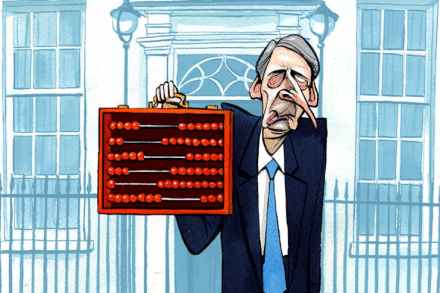
So where are the nasties? Philip Hammond’s Budget speech can be summed up as follows:  £2.8 billion for the NHS, £44 billion of capital funding and loan guarantees for housing, £400 million for a new charging infrastructure for electric cars, £2.3 billion investment in research and development, £1.5 billion worth of changes to Universal Credit, an extra £2 billion for Scotland – all to be paid for, apparently, with higher taxes on super-strength cider, fags, a few of the smokiest diesel cars and the end of indexation for allowances on corporate capital gains tax.

For real political chaos, take a look at Germany

The female leader of a prominent European country fails to win a majority in an election and then struggles to form a coalition. Meanwhile, her government limps from crisis to crisis and finally negotiations break down, leading to another general election just weeks later. Not Theresa May, obviously, because she had little difficulty in forming a workable coalition with the DUP. But it is the situation in Germany where today Angela Merkel said that she has given up on trying to create a workable government with the Free Democratic Party, the Christian Social Union and the Greens. There will now almost inevitably have to be another general election, with Angela Merkel – rather than Theresa May – likely to be out on her ear by Christmas.

The hidden danger of electric cars

Wasn’t the whole point of electric vehicles supposed to be to civilise our cities, making them safer and less-polluted places to live? I just wonder what the mung bean-eaters who act as cheerleaders for the industry are making of the latest performance by Elon Musk, the founder of Tesla. Launching his latest vehicle, a £150,000 ($200,000) roadster which apparently does 0-60 mph in 1.9 seconds, he was asked what the point of the vehicle was. He replied: “to deliver a hardcore smackdown to gasoline cars”.   A hardcore smackdown, eh? I am not sure that is quite what environment secretary Michael Gove had in mind in July when he announced that, as of 2040, no new conventional petrol or diesel cars would be sold in Britain.

Whatever happened to the Brexodus?

Vegetables are rotting in the fields for want of Eastern European pickers, patients are being left untreated thanks to a haemorrhaging of EU nurses, our universities are in peril as European academics flee from a xenophobic Britain which no longer wants them. That, at least, is the picture that is continually presented to us by the rearguard Remain lobby, which wants us to think that the EU nationals who make our economy go round have had enough and, as the Guardian says of nurses and midwives, are ‘leaving in droves’. There is one problem with this analysis: it is directly contradicted by the facts. Figures released by the Office of National Statistics yesterday show that in the third quarter of this year there were 2.

James Dyson is right about the benefits of walking away from Brexit talks

I don’t hold much faith in forecasts by the IMF. They have been so wrong in the past as to be worthless. A week before referendum day in 2016, for example, the IMF predicted that a Leave vote would take 5.5 per cent off UK GDP by 2019, tipping us into recession in 2017. We’re still waiting. However, it is interesting to note that if the Remain lobby does want to continue quoting IMF forecasts at us, there is an inconvenient little statement in its latest World Economic Outlook, published today. It claims that in the event of a ‘disruptive Brexit’ – i.e.

It’s time for the Tories to admit rail privatisation has been a disaster

Buried in yesterday’s drama over Priti Patel was the news that train drivers represented by Aslef have voted to end their industrial action on Southern Rail by accepting a pay deal which will give them a 28.5 per cent rise over five years. It will take their basic pay – for a four day week – to £63,000. With overtime, some could find themselves dragged into Jeremy Corbyn’s supertax bracket, aimed at those earning more than £80,000. It won’t even mean the end of the misery on Southern Rail, because the Rail, Maritime and Transport Union (RMT), which has also been striking, has not accepted a deal. Wasn’t this sort of thing – unions holding railways to ransom for outrageous pay demands – supposed to be ended by privatisation?

Has Brexit really made us all happier?

Apparently we’re all getting a little happier – if a little more anxious. The government’s official happiness index shows that we rate our overall life satisfaction at an average of 7.7 out of 10. We think our lives are 7.9 out of 10 worthwhile. We rate our happiness yesterday at 7.5 out of 10 and our anxiety rating at 2.9 out of 10 – a slight rise on early 2015 when national anxiety reached a low but still much less than when the index started in 2011.  Does it mean anything though?

Why is the Government so scared of giving all prisoners the vote?

David Cameron will presumably be spending today retching into a bucket at his Oxfordshire home. Having said that the thought of prisoners voting made him ‘physically sick’, he will not be pleased by the Government’s proposal to grant the vote to the hundred or so prisoners who are out of jail at any one time – this in reaction to the European Court of Human Rights (ECHR), which ruled that a blanket ban on prisoners’ voting is a breach of human rights. It is pretty par for the course for the ECHR – standing up for criminals while failing to do much to ensure free speech in Russia and so on. But why the Government’s drawn-out battle to  resist what would be a pretty small and unimportant change to the prison regime?

Why can’t the Bank of England admit it was wrong to cut interest rates?

It took all of five minutes for news of the Bank of England’s first rise in base rate for over a decade to be blamed on Brexit. The Guardian’s live blog, for example, suggested that the rise was 'to prevent the cost of goods bought in the UK from spiralling further', following the fall in sterling. Well no, actually. The explanatory notes from the Monetary Policy Committee (MPC) explain that it voted 7-2 to raise rates because the slack in the UK economy has fallen. With unemployment at a 40 year low, it fears that inflation could run ahead of itself unless dampened by an interest rate rise. The inflationary effects of low sterling, it adds, are falling away, but 'net trade is bolstered by the strong global expansion and the past depreciation of sterling.

Climate change campaigners are crying wolf

When will the climate change lobby finally realise that it is undermining its own arguments through hyperbole? Yesterday, the Lancet published its latest climate change ‘indicators’, accompanied by a comment piece in the Guardian by Christiana Figueres, former Executive Secretary of the UN Framework Convention on Climate Change and now chair of the Lancet Countdown advisory board.  The piece, headed 'Climate change isn’t just hurting the planet – it’s a public health emergency' makes the assertion that climate change is affecting 'the health of you, your family, your neighbours – each and every one of us.

Britain isn’t short of jobs. It’s short of skills

Amid the attention given to the ‘Three Brexiteers’ in their efforts to establish post-Brexit trade with the rest of the world, the work of business secretary Greg Clark often gets overlooked. But in conversation with James Forsyth at the Conservative party conference in Manchester, this is what we learned about the government’s business strategy. The event was sponsored by the Nuclear Industry Association. With unemployment at a 40-year low, Britain can claim to be the ‘jobs capital of the world’, but we can’t claim to be the earnings capital of the world. The productivity gap has been puzzling economists for years, with little improvement since the economic crisis of 2008/09.

The New Frontier: Freedom, security and responsibility in the internet age

The Spectator, in association with Sky, brought together the Home Secretary, Amber Rudd, David Anderson QC, the former independent reviewer of terrorism legislation, Michael Beckerman of the Internet Association, which represents the internet giants, and Andrew Griffith of Sky for a panel event at Conservative party conference. This is a summary of the discussion which took place. How do you tackle the Isis propaganda machine as it pumps out 2000 items a week? Notionally, the power lies with the West to stop the ceaseless incitement to violence. The internet and social media are, after all, largely under the control of large corporations. Yet the internet is also a powerful tool of freedom with which few democratic governments want to meddle without good reason.

Economic forecasts are almost always wrong – so why do we take them seriously?

There is a weird psychology behind economic forecasts. We know they are going to be wrong, because they always are. Yet such is our appetite for information – any information – that nevertheless we can’t stop ourselves taking them seriously. The Sunday Times this morning has gone big on a report by serial doomsayers the EY Item Club claiming that the government needs to move quickly to obtain a transitional deal on Brexit or face a collapse in business investment. Even with a deal it predicts that the growth in business investment next year will fall to 1.5 per cent, from 2.1 per cent this year. Maybe. But then again, maybe not. There is absolutely no evidence from previous EY Item Club forecasts to suggest that this is better than a figure plucked out of the sky.