Ross Clark

Ross Clark

Ross Clark is a leader writer and columnist who has written for The Spectator for three decades. He writes on Substack, at Ross on Why?

Is the demise of polar bears being exaggerated?

Wouldn’t it be nice if we could debate climate change for five minutes without hearing about polar bears or being subjected to footage of them perched precariously on a melting ice floe? But that is a little too much to expect. Polar bears have become the pin-ups of climate change, the poor creatures who are supposed to jolt us out of thinking about abstract concepts and make us weep that our own selfishness is condemning these magnificent animals to a painful and hungry end. Needless to say, the Guardian and BBC jumped on the opportunity for more polar bear coverage when a paper appeared in the journal Nature Climate Change, predicting that a high carbon emissions scenario ‘will jeopardise the persistence of all but a few high-Arctic subpopulations by 2100.

What we don’t (yet) know about the Oxford vaccine

How excited should we be about the latest news of the Oxford vaccine? At least this time – in contrast to previous updates, which have tended to come via Downing Street briefings – we have a paper in a scientific journal, the Lancet, to go by. The paper reports that 1,077 people took part in the trial and that 90 per cent developed antibodies to the SARS-CoV-2 virus after a single dose of the vaccine. All developed antibodies after a second dose. The trial also tested for adverse side-effects – which were widespread, but all of which were described as ‘mild’ or ‘moderate’. Some patients were given paracetamol along with the vaccine, but of those who were not, 70 per cent reported a sense of fatigue and 68 per cent reported a headache.

Labour’s wealth tax proposal is deeply flawed

Will Labour ever stop pushing for punitive taxation? Not content with gifting the Conservatives an 80 seat majority in December, the supposedly more moderate Labour party under Keir Starmer is already dreaming up ways it can extract large sums from our pockets. Shadow Chancellor Anneliese Dodds floated a ‘wealth tax’ at the weekend, so that the burden of paying for the Covid 19 crisis might fall upon the ‘very best off people’. Except it won’t be the very best-off people who get whacked by a wealth tax, as she should surely know. The highly mobile global super rich wouldn’t hang around for five minutes after a Labour government announced a wealth tax – any more than they did in France when Francoise Hollande introduced the same thing.

The next culture war will be over climate change

It is steadily becoming clear where the woke brigade will go once the current moral panic over racism has run its course (which can’t be long, following the news that London estate agents have stopped using the term ‘master bedroom’ to avoid its connotations with slavery). A week ago Andrew Willshire wrote here of how the activist group Hope Not Hate has now decided that climate change ‘denialism’ is now a hate crime. Now comes another sign that climate change is becoming the next woke battleground. Earlier this week, an environmental campaigner, Michael Shellenberger wrote a mea culpa on the website of Forbes.com.

Did Harry and Meghan’s wedding really raise £1bn in revenue?

Without going into the ins and outs of the Duke and Duchess of Sussex’s withdrawal from royal life, still less the merits of the Duchess’s privacy case against the Mail on Sunday, a claim made by her lawyers this morning cannot be allowed to pass without comment. They claim: ‘This contribution of public funds towards crowd security was far outweighed by the tourism revenue of over £1 billion that was generated from the royal wedding of the Duke and Duchess of Sussex which went directly into the public purse.’ Should we really be thankful to the Duke of Duchess of Sussex for stuffing the UK’s coffers as a result of tourists flocking here for the pair’s wedding or being inspired to come here after watching the event on TV?

What we still don’t know about Covid in Leicester

Just why has Leicester been locked down, its economy placed back in the deep freeze and many more of its citizens condemned to lose their jobs? Since the announcement, the country has gone back into panic mode. Leicester, according to much reporting, is in the midst of a second spike – and is surely just the first of many towns and cities that will have to be placed back in lockdown. Listeners to the Today programme on Wednesday morning, in particular, will have been left in no two minds: we are in the foothills of a resurgence which could overwhelm the whole country. Finally, on Wednesday evening, Public Health England published the full data for Leicester – along with a preliminary report from its rapid investigation team. And what does it conclude?

A Huawei U-turn must now be inevitable

The declaration by US authorities that Huawei and fellow Chinese comms firm ZTE are national security threats is likely to have a clear outcome. It will knock the UK government further down the path it already seemed to be travelling: reversing its decision to allow Huawei to play a role in Britain’s 5G communications network.  Boris Johnson’s government surprised many earlier this year by approving Huawei to build what it called ‘non-core’ parts of the network, in spite of US threats to withhold the exchange of intelligence if Huawei was allowed to be involved. He made the decision in spite of warnings from Britain’s own security services.

Should we be afraid of this new swine flu?

Imagine if a vaccine for Covid-19 was approved tomorrow, and that within weeks we had all been vaccinated. Would life be able to go quickly back more or less to normal? Don’t bet on it. The long shadow of Covid-19 will mean mass panic every time another novel virus comes to light. Indeed, news of such a virus comes today in a paper by a team from China’s Agricultural University published in the Proceedings of the National Academy of Sciences. They say they have identified a flu virus with pandemic potential, which is circulating in the pig population and has already infected significant numbers of humans who work with pigs. Crucially, however, it has not yet demonstrated any ability to be passed from human to human.

Is Covid immunity more common than we think?

Antibody tests on random samples of the population have so far shown much lower levels of general infection than the government’s scientific advisers claimed would be necessary to attain ‘herd immunity’. In London, for example, tests have shown that 17 per cent of the population have antibodies to Sars-CoV-2, the virus that causes Covid-19. In New York, the figure is 21 per cent. At the beginning of this crisis, on the other hand, Sir Patrick Vallance, the chief scientific adviser, suggested that at least 60 per cent of the population would have to be infected in order to achieve herd immunity. It provides a possible explanation for why the Covid-19 epidemic seems to have died away in many places But are antibodies the whole story?

Was Covid with us long before anyone realised?

One of the mysteries of the Covid-19 crisis is how the disease seemed to bubble up out of nowhere in Italy at the end of February – at a time when it seemed to be under control in China. In spite of local quarantines and the isolation of individual patients, the epidemic quickly took hold. We have subsequently had reports of patients infected all over Europe who were possibly infected in mid-January.  The earliest sample appears a fortnight before the disease was even identified in China But now a study has emerged that suggests the disease was already circulating in Northern Italy before Christmas.

Isn’t it time Sacha Baron Cohen got cancelled?

How helpful of the comedian Sacha Baron Cohen to reveal that there are two or three people in America who are happy to join in a sing-along containing the line 'Liberals, what we gonna do? Inject them with the Wuhan flu.' Trouble is, it really only was two or three people. If Baron Cohen really was trying to expose the American right as a violent mob, his infiltration of a rally by the Washington Three Percenters, described as a Trump-supporting, pro-gun group, was a miserable failure. Baron Cohen’s wheeze was to pose as a bluegrass singer and to take to the stage and try to whip up the crowd by duping them into singing songs with lyrics that would identify them as hate-filled right-wing lunatics.

The European Space Agency has just chosen Leicester to host its startup hub. Why has no one reported that?

Imagine if a European agency had just announced that it was to close a site in the Midlands, withdrawing from Britain and taking jobs of scientists with it. It isn’t hard to work out where that would feature on BBC news – up top. It would be presented as another cost of Brexit, another result of the foolish decision the country made in 2016 to leave the EU. Interviewees would be dredged up to tell us we had condemned ourselves us to become a deskilled economy. News outlets seem so obsessed with woke and culture war issues that we don’t get to learn about important pieces of investment Now imagine that a European agency had actually just announced that it is to open a new base in the Midlands.

The outrage over Bournemouth beach contains a grain of deceit

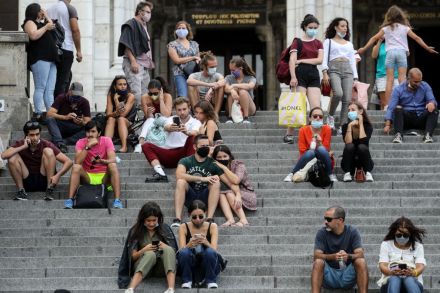
The Covidiots are at it again – crowding onto beaches in flagrant breach of lockdown rules, treating the pandemic as if it were an extended bank holiday. Pictures of crowded beaches on Thursday inspired Chris Whitty to tweet that Covid-19 is ‘still in general circulation’, and worked Matt Hancock into such a froth that he threatened to close the beaches. But are we really suffering a mass outbreak of irresponsibility or just the tyranny of the telephoto lens? Take a quick look at these two photos – and then take a more careful look.

Are we heading for hyper-inflation or deflation?

Will Britain turn into Zimbabwe or Japan? In other words, will the fallout from the economic crisis precipitated by Covid 19 lead to hyper-inflation or to deflation? Are we going back to the 1970s – or to a strange world of which no living Briton has any recollection? Or, more graphically, will it be savers and bond-holders who get ripped off to pay to bills of the crisis – or do borrowers face being buried by their debts? In May, the Consumer Prices Index (CPI) fell to an annualised 0.5 per cent. A fall was expected thanks to plunging oil prices. But many people fear it will only be temporary as the economy begins a fraught recovery.

The limits of Covid death statistics

As is often said, choose your statistics carefully and you can use them make just about any point you want to. But rarely does the Office for National Statistics put out two releases on the same day whose statistics point in totally opposite directions. If you listened to the BBC midday news, you may have heard that overall deaths in England and Wales, while they have fallen, are still running at 5.9 per cent above the average for the time of year. This was based on an ONS release entitled Deaths Registered Weekly in England and Wales. However, poke your nose in another release put out an hour or so earlier, entitled Deaths Involving Covid-19, and you would have come to exactly the opposite conclusion: that overall deaths in England and Wales are running at 5.

Why hasn’t the US second spike led to more deaths?

Infections up 15 per cent in a fortnight, with 37,000 recorded in a day. For those who are inclined to see it that way, the graph of US Covid-19 cases is confirmation of the folly of reopening society far too soon, and ‘throwing away’ all that hard work during lockdown, as Matt Hancock likes to put it.  But there is a little problem with this analysis: while the graph of cases in the US shows something which could be described as a second spike, the graph of deaths has stubbornly refused to follow suit. Quite the reverse: having peaked at over 2,000 deaths a day in April it is now down to around 600 a day and falling steadily. Until the middle of May, the two graphs seemed to be coupled.

The case for the two metre rule is falling apart

With the Covid alert level being reduced from 4 to 3 it is surely only a matter of days before the government announces that it is relaxing the two metre rule – a move for which the hospitality industry has been lobbying for heavily, warning that pubs and restaurants will not be able to reopen until it happens. Another sign of impending change came from Professor Calum Semple of the University of Liverpool, a member of the Sage committee, who told the Today programme this morning that he had changed his mind on the two metre rule and now believes that infection levels are low enough to make it safe. But was there ever any scientific justification for the two metre rule?

Is the Covid alert level still too high?

Cynics might wonder whether the timing of Matt Hancock’s announcement this morning that the Covid alert level is to be reduced from four to three is an attempt to deflect the government’s embarrassment from the failed test and trace app. The cynics may well be right with the timing (although the decision is ultimately in the hands of the Chief Medical Officer, Chris Whitty, and his counterparts in Scotland, Wales and Northern Ireland). But more to the point: why was the alert level still at four when, by the government’s own definition, it should have been at three, and why is it now not being reduced to two? These are the Covid alert levels as described by the government: 5. As level 4 and there is a material risk of healthcare services being overwhelmed4.

Was Baden-Powell a Nazi sympathiser?

Police were no match for the Black Lives Matter mob that pulled down a statue of Edward Colston last week and threw it in Bristol harbour. But the Scouts are evidently a force to be reckoned with. No sooner had Bournemouth, Christchurch and Poole Council announced that it was planning to take down a statue of Lord Robert Baden-Powell on the harbour front at Poole than the Scouts had mobilised themselves to defend it, setting up camp at its base. The council decided to board it up instead, to protect it from protestors. The ‘Topple the racists’ website had identified Baden-Powell among its targets, claiming that the creator of the Scout movement had ‘committed atrocities against the Zulus in his military career and was a Nazi sympathiser’.

Is Boris brave enough to break his triple lock pension pledge?

It would not have been obvious to those drafting the Conservative manifesto last autumn that they were planting a very large bomb beneath the government. After all, the triple lock had already featured in three general election campaigns and had yet to cause the public finances a problem. But the very special circumstances of the Covid-19 crisis have lit the fuse. The inevitable explosion is either going to cost dearly the Conservatives’ reputation in the eyes of pensioners – or else widen an already gaping public deficit, as well as offend millions of younger people who might already be seething at what they see as intergenerational unfairness. The problem is that furloughed workers are going to cause havoc with the calculation of average incomes.