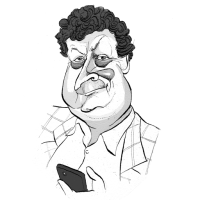
Rory Sutherland

Rory Sutherland

The Wiki Man: Let the road-train take the strain

Only two things matter when choosing a car. What is it like to drive fast? And what is it like to drive very, very slowly? Forget about cornering and acceleration. Very little of our time in cars is spent negotiating hairpin bends or revving chavvishly at a junction. Most motoring falls into two distinct categories. 1) Superb driving conditions: driving at night, or best of all in France (whose admirable policy of motorway pricing leaves their best roads free for the enjoyment of British tourists — since paying to use a motorway twice a year is much less painful than paying twice a day).

The Wiki Man: In with the old

I have noticed Britons in France or Italy cringe with embarrassment, and mutter apologies to waiters when ordering a cappuccino after dinner — or at any time after noon. ‘Look, you needn’t apologise,’ I say. ‘The reason foreigners drink their coffee black isn’t because they’re sophisticated: it’s because their milk tastes like crap.’ It has always surprised me that two countries which take great pride in food can produce such dismal milk. One theory is that many Mediterranean people have not evolved the ability to digest milk after childhood. So Brits should not feel ashamed at any lack of savoir-faire; if anything, our hosts should feel uncomfortable about their failure to make any genetic headway over the past 20,000 years.

The Wiki Man: The best thing since wheeled suitcases

I had a Land Rover Discovery once. It was expensive to run, largely on account of the rear visibility. The blind spot was so large that, when reversing, you had to worry not only about lurking cats, shrubs and bollards but also bungalows. I felt proud whenever I went for six months without needing to replace one of the rear lights. My present car, when reversing, beeps if it detects any obstruction, the frequency of beeps increasing as the object gets closer. This is a godsend when parking. (The only problem is that I sometimes expect these beeps when driving cars not similarly equipped: when I borrow my wife’s car I park like a Neapolitan.) The parking sensor is a simple idea which should have been invented earlier than it was. Why so late?

The Wiki Man: Class system

1) Imagine you have the choice of living in two worlds. In World A you have a five-bedroom house and everyone you know has a six-bedroom house. In World B you have a four-bedroom house and all your friends have three-bedroom houses. Which world would you prefer? 2) You can live in World C, where you get five weeks’ holiday a year and your friends get six. Or you can choose World D where you get four weeks’ holiday a year and everyone else gets three. Which do you choose? ••• Most people, when asked these questions, chose worlds B and C. In other words, with property (at least above a certain size), it is the relative size of a house that matters more: with holiday time, it is the absolute amount that appeals.

Even dogs prefer democracy

Recent research has shown a robust and positive correlation between the amount of democracy we enjoy and how happy we are. This is true for the Swiss, at any rate, for it was among the cantons of Switzerland that the research was conducted. If you believe the Swiss are a peculiarly unrepresentative group, you may be interested to know that the same rule holds true not only for melted-cheese-­eating neutrality monkeys, but also for dogs. Dogs prefer democracy? How can we possibly know?

The Wiki Man: Speaking to Siri

Why am I typing this article rather than dictating it via some wonderful voice recognition software? It’s a question worth asking. Twenty years ago, all Spectator writers would have written every article by hand (only two or three still do). In my office in the 1980s, it was frowned on to type your own letters, since typing was seen as secretarial work. Are we due another revolution in how our thoughts are transmitted from brain to machine? Science fiction has always assumed that computers will converse — HAL-9000, C-3PO, Marvin the Paranoid Android and Thermostellar Bomb #20 (from the 1974 comedy Dark Star) have provided some of the most memorable dialogue in film.

The Wiki Man: In times of crisis, use your head

A few years ago in Malaysia I found myself reading the national paper, the New Straits Times. There was a headline on the front page that caught my eye. It read something like ‘New road to the airport will make it easier to get to the airport’. I’m sure those weren’t the exact words, but that was pretty much the import of the thing. I read the whole of the ensuing article, which effectively confirmed at length what I already had been led to believe — that the new road to the airport would indeed make it much, much easier to get to the airport. I read it again. Something seemed wrong, but I couldn’t quite put my finger on it. It felt altogether different from any newspaper article I had come across before. And then I spotted what was odd.

The Wiki Man: App happy

If you are a Spectator subscriber, the plastic wrapper in which your magazine arrived this morning is probably already in the bin in the kitchen. By now it has been joined by two sodden teabags, four strips of bacon rind and a couple of eggshells. Try to steel yourself now, pull on a pair of Marigolds and retrieve it. Because printed above your name and address on the slip of paper inside is something called your subscriber number. Write this down on a piece of paper and keep it somewhere safe. In the next few weeks, after many months of development, the Spectator launches its iPad and iPhone application, use of which is completely free to Spectator subscribers.

The Wiki Man: The rigged roulette wheel

I came face to face with the real banking problem a month ago when speaking in Oxford to an audience of undergraduates. ‘Well, I suppose one good thing about the last three years is that you won’t now all be applying to work in banks,’ I joked. It seems I was wrong. At these words, about half the people in the audience stared sheepishly into their laps. I can’t say I blame them. Of my own college contemporaries, leaving aside one or two barristers and a brilliant technology entrepreneur, I think it would be accurate to say that every single person who went to work in banking wound up earning more than every single person who did not. This can’t be good.

The Wiki Man: Next bus

True or not, there is a persistent story about a former Duke of Devonshire who, seeing some silver napkin rings in Asprey’s, asked his companion what they were for. ‘Your grace, in some households they roll napkins inside these rings so that they can be used for a subsequent meal, rather than being laundered every time.’ ‘Good heavens. I never knew such poverty existed in England.’ Later, when the duke decided to board a bus for the first time in his life, it is claimed he beckoned to the conductor: ‘27 Eaton Square, please.’ Not such a ridiculous request, in fact. In many countries you will find ‘jitney’ services halfway between buses and taxis.

The Wiki Man: Better than a ride on a banana

A friend of mine once spent a week on a vast luxury yacht cruising the Mediterranean. It was all jolly pleasant, he remembered, except for a strange thing: throughout the entire trip, the only time the shipboard party had experienced what you might call ‘fun’ was when somebody discovered in a locker some kind of giant inflatable banana which could be towed behind the ship’s speedboat while everyone clung on. The yacht was OK, but the inflatable banana was utterly brilliant. It confirmed a suspicion I have always had about yachts — that there is more joy to be had pootling around a harbour in the tender than there is to be had from crossing an ocean in the ship itself. Self-aggrandisement aside, small boats seem a lot more fun than big ones.

The Wiki Man: Evolution and the airline seat

How can something as complicated as a human eye possibly arise through a process of natural selection — through trial and error? Most people will have asked themselves this question at some point in their lives, but without bothering to find out the answer. A pity, since the stage-by-stage explanation of how the eye might have evolved is fascinating. The story begins when organisms develop cells that are sensitive to sunlight. In time, these may develop to a level of sensitivity where they can detect movement. The next stage is for these cells to form themselves into a convex or concave shape to add an extra degree of directional information (with sensors arrayed in a bowl or on a mound, you can better detect in which direction any movement is happening).

The Wiki Man: Bring back the madcaps

I recently watched another one of those delightfully obscure BBC4 archive documentaries. This one was called Bristol on Film. I like archival film footage for what it reveals unintentionally: the incidental details which have nothing to do with the film-maker’s original intent, but which 60 years later reveal how profoundly the world has changed. Like the sign once glimpsed in 1950s Ramsgate: ‘Lift to the seafront 2d — perambulators and wheelchairs 4d’. There was one such moment in the Bristol programme. It was footage of the Queen inspecting the first Concorde prototype at Filton. What astonished me was that it was filmed in black and white.

The Wiki Man: The billionaires who no one seems to hate

Two interesting news items coincided the other week Two interesting news items coincided the other week. The growing debate about the relatively light tax burden shouldered by the massively rich and the partial retirement of Steve Jobs. One dog failed to bark in the night. No one, as far as I can see, dared name Mr Jobs as one of the people who should pay more tax. In fact, for a billionaire head of a vast, powerful US multinational, Jobs has enjoyed a special indulgence: to some people his is almost the only acceptable face of capitalism. Will Wilkinson, blogging for the Economist, suggests people are dazzled by the beauty he has created. An urban liberal consensus has no trouble loving an egotistical, wholly unphilanthropic billionaire capitalist, provided he has great design sense.

The Wiki Man: Technology and the riots

It was the biggest technological story of the month and I missed it. Instead it was my much cooler friend, Jonathan Akwue, who first mentioned Blackberry Messenger and its possible connection with the riots (at urbanmashup.wordpress.com). He spent the next two weeks fielding inquiries from the media. Blackberry Messenger (or BBM, as its users call it) is an application unique to Blackberry handsets, which allows users to message each other in a way similar to text messaging, yet to larger groups and at lower cost. On its own, it has earned the Blackberry, once exclusively a businessman’s handset, a huge following among the young. (Blackberry has in the process become one of those interesting brands with two entirely disparate groups of customers, like Burberry a few years ago.

The Wiki Man: My other car is an iPad

A fortnight ago, I wrote about the arbitrary metrics applied to train travel — and how a trivial reduction in journey time, a measure with little relationship to human pleasure or productivity, has been used to justify the insane cost of a new rail link to Birmingham A fortnight ago, I wrote about the arbitrary metrics applied to train travel — and how a trivial reduction in journey time, a measure with little relationship to human pleasure or productivity, has been used to justify the insane cost of a new rail link to Birmingham. In the interests of balance, I should point out that our decision-making involving cars may be little better than with rail.

The Wiki Man When the rules change, government targets stay the same

I recently stumbled on a Wikipedia page on American diner lingo: ‘sunny side up’, ‘pigs in a blanket’, ‘peel it off the wall’ and so on. I recently stumbled on a Wikipedia page on American diner lingo: ‘sunny side up’, ‘pigs in a blanket’, ‘peel it off the wall’ and so on. Whether or not these phrases were all commonly used (did anyone really ask for ‘shit on a shingle’ when requesting minced beef with gravy on toast?), the list’s length hints at the remarkable breadth of 1930s American street food. Then McDonald’s came along.

The Wiki Man: Needled by PINs

The phone-hacking scandal may bring restraint to Britain’s redtop journalists and relief to a few thousand minor celebrities but, for the country’s 59.99 million unfamous people, it will merely make technology a little more irritating. The phone-hacking scandal may bring restraint to Britain’s redtop journalists and relief to a few thousand minor celebrities but, for the country’s 59.99 million unfamous people, it will merely make technology a little more irritating. Setting the default password for your mobile voicemail as either 0000 or 1234 wasn’t particularly secure, I know, but for the 99.99 per cent of us not being tailed by stalkers or tabloid journalists, it was at least easy to remember.

The Wiki Man: Stuff and nonsense

I would have more sympathy for criticism of consumer culture were it not for the people who voice it — usually the type who owns a second home in Tuscany but is horrified that their cleaner has two televisions. I would have more sympathy for criticism of consumer culture were it not for the people who voice it — usually the type who owns a second home in Tuscany but is horrified that their cleaner has two televisions. As for the anti-materialist stance of Lord Layard, who believes your iPad creates unhappiness in those who cannot afford one, this may be true. But then the same logic must also apply to owning a peerage, which may arouse feelings of inadequacy in humbler social scientists styled ‘Professor’ or ‘Dr’.

The Wiki Man: Engineering solutions

This is from a 2007 blog, listing the Chinese politburo: Hu Jintao, 62, President of the People’s Republic of China, graduate of Tsinghua University, Beijing, Department of Water Conservancy Engineering. This is from a 2007 blog, listing the Chinese politburo: Hu Jintao, 62, President of the People’s Republic of China, graduate of Tsinghua University, Beijing, Department of Water Conservancy Engineering. Huang Ju, 66, graduate of Tsinghua University, Department of Electrical Engineering. Jia Qinglin, 65, graduate of Hebei Engineering College, Department of Electric Power. Li Changchun, 61, graduate of Harbin Institute of Technology, Department of Electric Machinery. Luo Gan, 69, graduate of Freiberg University of Mining and Technology, Germany.