Robin Oakley

The turf | 13 December 2018

The Scudamores are one of the bedrock families of jump racing. After being shot down and spending two years as a PoW, Geoffrey Scudamore trained racehorses in Herefordshire, including a Cheltenham Festival winner ridden by son Michael. Michael, one of the great horsemen of his day, won the 1957 Gold Cup on Linwell and the 1959 Grand National on Oxo. But in November 1966 a horse slipped up: a punctured lung, a broken jaw and cheekbone, a cracked skull and an eye injury forced him, too, to turn to training. Michael’s son Peter was initially nervous of approaching the wired-up Martian-like figure who emerged from hospital.
The turf | 6 December 2018

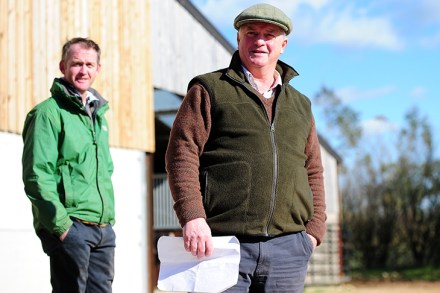
It may yet turn out that the most significant development in racing this year was the sale of some 250 dairy cows. Back in 1995 Colin Tizzard, a dairy farmer on the edge of the Blackmore Vale, started training point-to-pointers for his son Joe to ride. Joe Tizzard, one-time stable jockey to Paul Nicholls, went on to become a leading rider. Colin steadily progressed from being a farmer who trained to becoming a trainer who farmed, though often with a stockman’s shrewdness, preferring to take a third prize of £14,000 in a Graded race rather than the headline glory of victory in a £6,000 handicap. Now, with Joe and his sister Kim as his assistants, he handled Cue Card, the public’s favourite jumper of recent years, to win a King George.

The turf | 22 November 2018

Trainer Dan Skelton and his jockey brother Harry have 100 winners on the board already but for most of us the jumping season proper has only just begun. It wasn’t long, though, before I was reminded of one essential difference between the Flat and jumping codes: the sheer fun element of the winter game. In the Agetur novices’ hurdle at Newbury, the 40-year-old owner-rider David Maxwell looked like being beaten to the line on his French import Ecu De La Noverie when he was headed as the post loomed by the 13–8 favourite Mister Fisher, ridden by the teenage wunderkind James Bowen. Instead the determined amateur conjured one last thrust from his mount and regained the lead to win by a short head at 33–1.

The turf | 8 November 2018

Fairy tales can happen. On Sunday the filly God Given won Italy’s only Group One race of the season, the Premio Lydia Tesio, providing Newmarket trainer Luca Cumani with his 50th Group One winner. Just days before he had moved many of his staff to tears by announcing that on 1 December he will retire and sell the Bedford House Stables where he has operated for 43 years, sending out two Derby winners in Kahyasi (1988) and High Rise (1998) and winning a host of big races around the world. Only Sir Mark Prescott and Sir Michael Stoute have run Newmarket yards for longer and there has been no doubting the genuineness of the tributes paid by the whole racing community to the elegant and highly astute English-domiciled Italian. Sometimes his style has seemed more English than the English.

The turf | 25 October 2018

Watching whip-thin jockey George Baker, just short of six feet, greeting his mounts used to make me think of the weight-reducing regime described by the 1920s rider Jack Leach. The elegant Leach always dined well. Next day he would go jogging in three sets of underwear, four sweaters and a rubber suit before taking a Turkish bath. He took off extra weight so that at the track he could have a sandwich and a glass of champagne. ‘This made me feel like a new man, and if I had a few ounces to spare the new man got a glass too.’ Not quite how modern riders do it in these breath-testing days. George Baker suffered a growth spurt and in a matter of months moved from riding comfortably at 8st 1lb to ‘having to waste my arse off to do 8st 9lb’.

The turf | 11 October 2018

Racing is full of risk-takers, not least those who fork out hefty sums to buy yearlings or unraced two-year-olds. Back at the Keene-land Sales in 1983 Sheikh Mohammed paid a record $10.2 million for Snaafi Dancer, a colt by the great Northern Dancer. Snaafi Dancer alas proved so slow that he never made it to the racecourse. Retired to stud, he had fertility problems and only ever sired four foals. In 2006 a frantic bidding war at Fasig-Tipton between two great racing empires — Sheikh Mohammed’s John Ferguson bidding against Coolmore’s John Magnier — saw Coolmore pay a new world record price of $16 million for The Green Monkey.

The turf | 27 September 2018

Mill Reef, who won the Derby, the Prix de l’Arc de Triomphe, the Eclipse and the King George by far enough for jockey Geoff Lewis to declare ‘daylight was second’, was one of my first equine heroes. One image has always stuck in my mind. Trainer Ian Balding sent Mill Reef and a companion out on a watered gallop at Lamorlaye for a final pipe-opener before the Arc. Afterwards the trainer walked over the ground and noted that on the firmer patches, while the companion’s hoof prints were clearly visible, there was no trace of where Mill Reef had run. On the softer patches, the other horse had cut in deep and turned over the turf; Mill Reef’s feet had barely left a mark. ‘It was,’ he said, ‘as if a ghost had galloped by.

The turf | 13 September 2018

An American trainer was once asked to name the greatest quality of the legendary jockey Willie Shoemaker. He replied: ‘The way he meets me in the Winner’s Circle.’ British racehorse owners would probably give the same answer about the Middleham-based trainer Mark Johnston. When Poet’s Society passed the post first in the Clipper Logistics Handicap during York’s Ebor Festival last month, Johnston became the winningmost trainer in British racing history, passing Richard Hannon Snr’s total of 4,193. The athlete Jesse Owens once declared: ‘In the end it’s extra effort that separates a winner from second place. But winning takes a lot more than that, too. It starts with complete command of the fundamentals.

The turf | 30 August 2018

Having spent most of my life among politicians I guess I have become unaccustomed to candour. The only example I remember was the Danish prime minister I interviewed for CNN before his country’s referendum on joining the euro. ‘Prime Minister, the trouble with referendums is that people often don’t answer the question. They vote on the popularity of the person asking it. Are you popular enough to win this referendum?’ ‘Probably not’, Poul Nyrup Rasmussen replied — and was proved correct when the Danes voted to stay out. In racing too we have all grown used to jockeys and trainers making excuses. ‘The ground didn’t suit him’, ‘He was short of a gallop’, ‘I was cut up round the bend’.

The turf | 16 August 2018

Making racing profitable depends on getting information at the right time. In the Stewards’ Cup at Goodwood two Saturdays ago I had a fancy for trainer Clive Cox’s Tis Marvellous and plunged accordingly. He finished 25th of the 25 finishers. Last Saturday he was racing again at Ascot where I spotted a friend with connections to his stable. ‘Any chance?’ I asked. ‘Good horse but I won’t be having a bet,’ he replied — so neither did I. After the diminutive but determined Hollie Doyle had brought home Tis Marvellous to win the opening race of the Shergar Cup competition at 6–1, Cox explained the sprinter’s contrasting performances: ‘You can take a horse to water but you cannot make them drink.

The turf | 2 August 2018

On a foggy November day in 1965 the young son of a Barbadian police chief was one of six contestants tried out in the commentary box at Newbury to find a new BBC television racing correspondent. Peter O’Sullevan had put in a good word for Michael Stoute but on his first sight of jump racing that day he finished runner-up to Julian Wilson, the only one of the applicants who had travelled first class from Paddington. Sir Michael, as he is today (the knighthood awarded for services to Barbados tourism), would have made a fine commentator with his rich voice, knowing smile and appealing chuckle, but it has been to racing’s immense benefit that he then went off instead to Pat Rohan to start training racehorses instead of talking about them.

Two days in New York

In Britain I never drink cocktails, but on arrival in New York it has become a ritual that my first drink is a Manhattan. Sipping this year’s drink, I realised that my regular two-day forays to the Big Apple have become one long ritual. We stay on Fifth Avenue to allow for a saunter among the brown baggers in Central Park, with delicatessen lunches from Zabar’s. Day one starts in Barnes & Noble to browse the latest US political biographies and pick up the new Alan Furst espionage paperback — after a diversion for Mrs Oakley to update her holiday wardrobe at Tommy Bahama.

The turf | 19 July 2018

For Coleridge, ‘…the light which experience gives is a lantern on the stern, which shines only on the waves behind us’. Not in racing it isn’t. However sharp the instincts of bright young apprentices on the way up, however exciting the pace shown by a novice horse on the home gallops, there is simply no substitute for racecourse experience. Odd, then, that English trainers have mostly been slow to make use of one of the world’s most battle-hardened front-line jockeys, who has chosen this season to base himself in Britain.

The turf | 5 July 2018

Let’s get the crowing over first. The returns from our Twelve to Follow over jumps last season were somewhere well south of disappointing but for those who kept faith the Flat season is bringing handsome recompense. Almost immediately, Hugo Palmer’s Labrega won at Haydock at 9–2. Then, in the very first race at Royal Ascot, the Queen Anne Stakes, Eve Johnson-Houghton’s Accidental Agent flew home under Charles Bishop, named as the jockey to follow this season at a whopping 33–1. ‘Stand by for a shower,’ said the emotional trainer after landing not only her first Royal Ascot winner but also her first Group One.

The turf | 21 June 2018

On the famed Whitsbury gallops, as corn buntings and stonechats fluttered from the fence posts, a dozen of Marcus Tregoning’s team were stretching nicely. The sun reflected from the chestnut flanks of the filly Viva Bella. The handsome head of Moghram, a muscular Sir Percy colt owned by Hamdan Al Maktoum, stood out against the blue sky above the lush downland where horses have galloped since the 1880s. It called for poetry, not prose. But at Whitsbury you are never very far away from history either. In the spacious main yard, with its thatched roof, riders used to get their orders from Sir Gordon Richards. In Major’s Yard, further down the hill, is the box that Desert Orchid occupied when the spectacular grey was collecting King Georges like postage stamps for David Elsworth.

The turf | 7 June 2018

In the previous 17 runnings of the Derby this century no fewer than nine had been won by horses trained in Ireland. The Ballydoyle genius Aidan O’Brien had won four out of the last six for ‘the lads’ behind the Coolmore operation, and with his Saxon Warrior (already the winner of this season’s 2,000 Guineas) the odds-on favourite at Epsom, and four more O’Brien horses in the field of 12, bookies and punters alike were expecting this year to be ‘déjà vu all over again’. The day before, O’Brien and the lads had won the Oaks, the fillies’ equivalent, with Forever Together, sired like so many of their winners by the 2001 Derby winner Galileo and ridden by Aidan’s youngest son Donnacha.

The turf | 24 May 2018

In his days as a novice jockey in the West Country, Bob Davies, who was to ride more than 900 winners, asked the trainer of the horse he was about to partner over 24 fences: ‘How does he jump?’ ‘No idea,’ came the reply. ‘That’s for you to find out.’ The pair survived the experience and Bob Davies has just retired after 35 years as the clerk of the course, company secretary and general manager who put Ludlow on the map. Having at one stage simultaneously held similar roles at Hereford and Bangor, he was a one-man demonstration of changing times. In times past, it did not occur to the powers that were that former jockeys might hold official posts in racing.

In praise of fixed-odds betting terminals

Racing is an expensive sport to stage. Courses and grandstands have to be maintained, health and safety regulations have to be observed. Human and horse ambulances have to be provided, turnstiles have to be manned and, to maintain the ‘integrity’ of a much gambled-on sport, stables have to be guarded, and photo-finish and race-patrol cameras have to be provided. Recognising this, as they sought to clean up gambling laws in the 1960s, our politicians introduced a rare example of ring-fenced taxation: they sanctioned a levy system on bookmakers to make them responsible for producing a significant contribution to racing’s costs. By 1978 the Gambling Commission was complaining that racing had become ‘addicted to subsidy’.

How do you solve a problem like FOBTs?

This is an extract from Robin Oakley's racing column of 3 March, 2018.  You can tell by the tone of the jokes how most occupations are regarded and we’ve all heard the traditional ones about the old enemy. ‘Why don’t sharks attack bookies?’ ‘Professional courtesy’. ‘Why did God invent bookmakers?’ ‘To make used-car salesmen look good.’ ‘Why are bookmakers buried an extra six feet down?’ ‘Because deep down they are very nice people.’ OK, such stories are applied to lawyers too. And journalists. But as a Racing Post headline confirmed last week, bookmakers are under heavy pressure. William Hill has been fined £6.

The turf | 10 May 2018

I suppose, given the income and the opportunity to indulge, you could eventually tire of even Meursault, Mauritius and Mrs Oakley’s sublime chicken pudding. Guiltily, because racing means nothing if it is not a celebration of the best, I notice a fleeting thought going through my mind as I slalom through Swinley Bottom and approach Newmarket for the first of the season’s Flat racing Classics: ‘Please can somebody other than Aidan O’Brien win the 2,000 Guineas this year.’ Before this year’s race, the genius who prepares the horses for John Magnier’s Coolmore operation at Ballydoyle Stables in Co.