Raymond Keene

Puzzle No. 257

From our UK edition

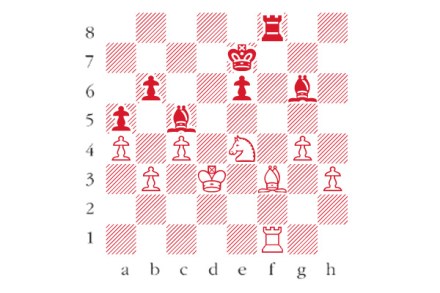
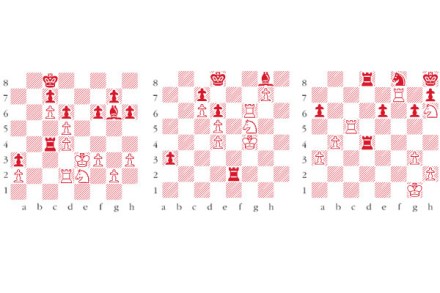
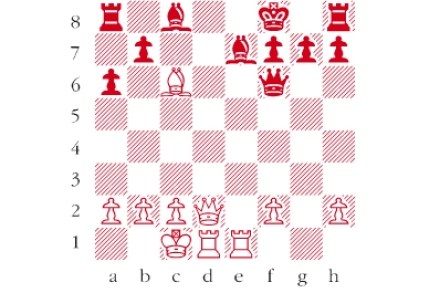
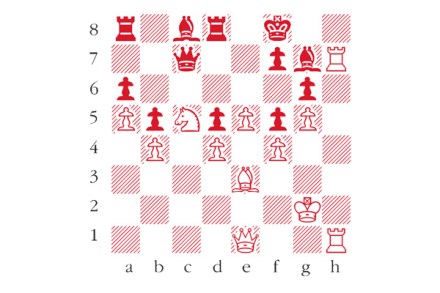
White to play. This position is from Fischer-Benko, US Championship 1963. One of Fischer’s classic attacking finishes. What is the winning move? Answers to me at The Spectator by Tuesday 19 March or via email to victoria@spectator.co.uk or by fax on 020 7681 3773. The winner will be the first correct answer out of a hat, and each week I shall be offering a prize of £20. Please include a postal address and allow six weeks for prize delivery.
Witschcraft | 7 March 2013

From our UK edition

There are two new books about Aron Nimzowitsch, chess strategist and author of My System. Aron Nimzowitsch on the Road to Chess Mastery 1886-1924 by Per Skjoldager and Jorn Erik Nielsen is published by McFarland, while Aron Nimzowitsch 1928-1935 by Rudolf Reinhardt (on which the notes to today’s game are based) is shortly to be published. This week, a game and puzzle by the crown prince of chess, as he was sometimes known. Nimzowitsch-Asztalos: Bled 1931; English Opening 1 c4 Nf6 2 Nc3 c5 3 g3 Nc6 4 Bg2 e6 5 Nh3 Nimzowitsch tries something unusual instead of the normal 5 Nf3. 5 ... Be7 6 d3 d6 7 0-0 0-0 8 Nf4 a6 9 b3 Qc7 10 e3 Rb8 11 a4 b6 12 d4 White has expanded in the centre whilst preventing the black freeing moves ... b5 and ... d5. 12 ...

no. 256

From our UK edition

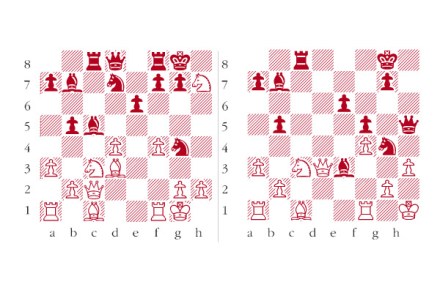
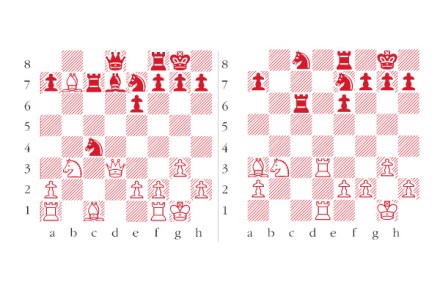
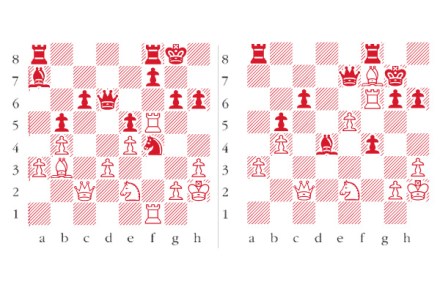
White to play. This position is from Nimzowitsch-Alapin, Vilnius 1912. How did White swiftly conclude his sacrificial attack? Answers to me at The Spectator by Tuesday 12 March or via email to victoria@spectator.co.uk or by fax on 020 7681 3773. The winner will be the first correct answer out of a hat, and each week I shall be offering a prize of £20. Please include a postal address and allow six weeks for prize delivery. Last week’s solution 1 ... Rxg2 Last week’s winner Peter J.
Sacrificial rite

From our UK edition

Rudolph Spielmann, a contemporary of Rubinstein, Reti, Alekhine and Capablanca, can be seen as the Romantic equivalent to a further great master of the 1920s, Aron Nimzowitsch. Whereas Nimzowitsch made his literary reputation with his book of chess strategy, My System, Spielmann entrusted his thoughts on the right way to play chess in his parallel tome, The Art of Sacrifice. The ideal in Spielmann’s eyes was to play the opening like a book, the middlegame like a magician, and the endgame like a machine. Spielmann believed that the power of sacrifice lay not necessarily in its soundness, but in its ability to daze and confuse the opponent.

No. 255

From our UK edition

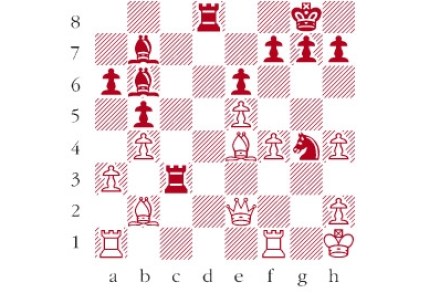
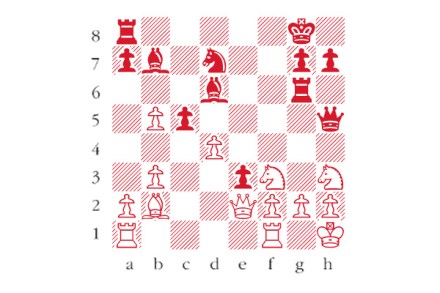
Black to play. This position is from Sjoholm-Spielmann, Kalmar 1941. How did Black swiftly decimate the white kingside?  Answers to me at The Spectator by Tuesday 5 March or via email to victoria@spectator.co.uk or by fax on 020 7681 3773. The winner will be the first correct answer out of a hat, and each week I shall be offering a prize of £20. Please include a postal address and allow six weeks for prize delivery.
Duchamp/Cage

From our UK edition

The Bride and the Bachelors is an impressive exhibition of the work of Marcel Duchamp, John Cage and related artists which is on at London’s Barbican Centre until 9 June. Cage learnt chess in order to communicate with Duchamp without asking crass questions. Other artists, notably Max Ernst, Picabia, Calder and Man Ray also took up chess, impressed by Duchamp’s abilities. Duchamp was a master player at chess whereas the others were mere dabblers in comparison. Marcel Duchamp was arguably the most influential artist of the 20th century, more so than Dalí, Picasso or Matisse. In 1923 he began to concentrate on chess rather than art and he came close to achieving master status. He competed in the French Championships and also in the Olympiads from 1928-1933.

No. 254

From our UK edition

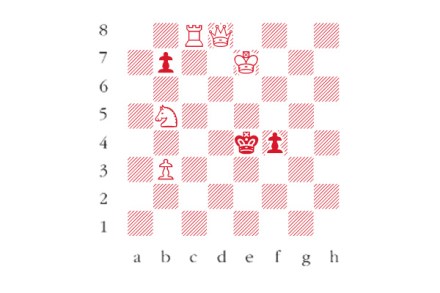
White to play. This position is a variation from Duchamp-Feigins, Folkestone 1933. Can you spot White’s most accurate continuation of the attack? Answers to me at The Spectator by Tuesday 26 February or via email to victoria@spectator.co.uk or by fax on 020 7681 3773. The winner will be the first correct answer out of a hat, and each week I shall be offering a prize of £20. Please include a postal address and allow six weeks for prize delivery.
Francophilia

From our UK edition

Any book by the erudite Steve Giddins is an event and he has now produced a valuable guide to the popular Winawer Variation of the French Defence, championed by the eponymous Simon Winawer, as well as  Nimzowitsch, Botvinnik, Petrosian and Korchnoi. The Winawer gives up the bishop pair early on in most lines, seeking to exploit the doubled white c-file pawns which frequently arise. It is a line for those who prefer the counter attack rather than equalising defence. Interestingly, the computer has proved a great friend to the Winawer, since Black’s strategy often hangs by a complex tactical thread, which computer analysis can justify. This theme comes across strongly in the book, Move by Move: The French Winawer (Everyman Chess).

No. 253

From our UK edition

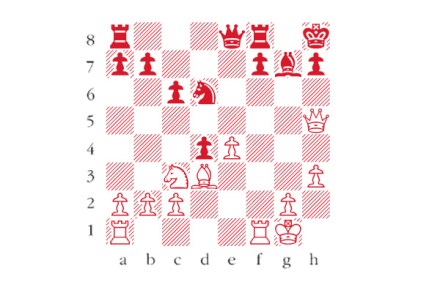
White to play. This position is from  Hartston-Portisch, Nice  1974. Can you spot White’s most accurate continuation of the  attack? Answers to me at The Spectator by Tuesday 19 February or via email to victoria@spectator.co.uk or by fax on 020 7681 3773. The winner will be the first correct answer out of a hat, and each week I shall be offering a prize of £20. Please include a postal address and allow six weeks for prize delivery. Last week’s solution 1 Nxe5 (planning 1 ...
Rock solid | 7 February 2013

From our UK edition

The Gibraltar Masters, where I was last week, has been won by a quartet consisting of Vitiugov, Short, Sandipan and Vachier Lagrave. In the final knockout to determine who would receive the £20,000 first prize, Nigel Short lost out narrowly to Vitiugov. In my opinion, the British grandmaster’s display of fighting spirit after an early loss would have justified his winning top honours for a fourth time. Here is a sample of his uncompromising play.   Short-Nieto: Gibraltar Masters, Caleta 2013; Ruy Lopez   1 e4 e5 2 Nf3 Nc6 3 Bb5 Nd4 Named after the 19th-century English master Henry Bird, this knight sortie is strategically suspect but rich in tactical tricks.

No. 252

From our UK edition

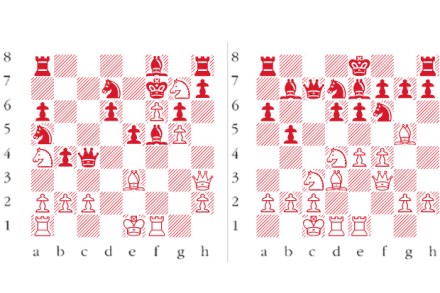
White to play. This position is from Adams-Ehlvest, Gibraltar 2013. White’s next essentially destroyed the black position. What was it? Answers to me at The Spectator by Tuesday 12 February or via email to victoria@spectator.co.uk or by fax on 020 7681 3773. The winner will be the first correct answer out of a hat, and each week I shall be offering a prize of £20. Please include a postal address and allow six weeks for prize delivery.   Last week’s solution 1 ... Rf4 (planning ...
Opposite bishops

From our UK edition

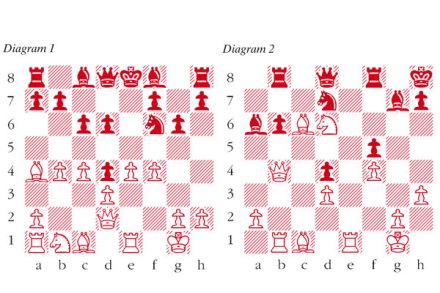
No, not the Church of England and its troubles with the question of whether women should be allowed to be bishops, but chess endgames, with rival bishops moving respectively on black and white squares. Traditionally, the fact that the bishops can play, as it were, past each other increases the possibility of a draw, as indeed do the enhanced possibilities of mutual blockades.   Nevertheless, great masters such as Nimzowitsch, Capablanca, Botvinnik, Smyslov and Karpov have been able to demonstrate that skilful handling of such situations may in fact lead to one side having, in effect, an extra piece if the enemy opposite bishop can be sidelined.

Puzzle no. 251

From our UK edition

Black to play. This position is a variation from Caruana-Nakamura, Wijk aan Zee 2013. Black is two pawns down but White is badly tied up. How can Black continue? Answers to me at The Spectator by Tuesday 5 February or via email to victoria@spectator.co.uk or by fax on 020 7681 3773. The winner will be the first correct answer out of a hat, and each week I shall be offering a prize of £20. Please include a postal address and allow six weeks for prize delivery. Last week’s solution 1 ...

Anand’s Immortal

From our UK edition

There is a scene in Monty Python and the Holy Grail where Sir Lancelot’s servant, Patsy, is shot in the back by an arrow and seems to expire. As Lancelot ( John Cleese) brusquely proceeds on his mission, Patsy (Eric Idle) protests that contrary to appearances he is not dead yet. The world champion Vishy Anand has put me in mind of this. He defended his title last year, but his performance was fairly lacklustre, and he has generally seemed uninspired in his tournament games. His loss to the up-and-coming star Magnus Carlsen towards the end of last year more or less confirmed Anand as a write-off, a roi fainéant, keeping the throne warm for his next challenger.

No. 230 | 24 January 2013

From our UK edition

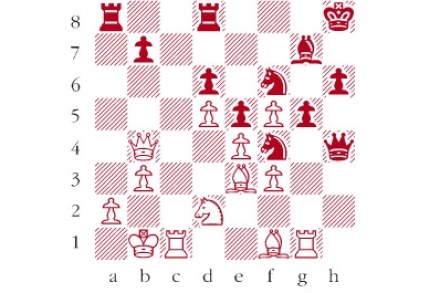
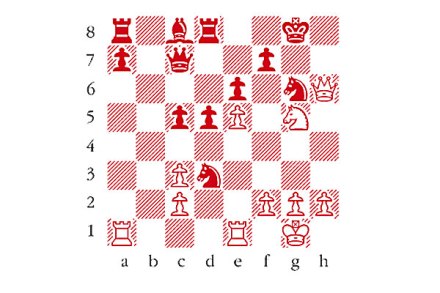
Black to play. This is from Rotlewi-Rubinstein, Lodz 1907. Black has already given up his queen and now concluded with a blow that rendered this game immortal. What did he play? Answers to me at The Spectator by Tuesday 29 January or via email to victoria@spectator.co.uk or by fax on 020 7681 3773. The winner will be the first correct answer out of a hat, and each week I shall be offering a prize of £20. Please include a postal address and allow six weeks for prize delivery. Last week’s solution 1 ...
Gran Fiesta

From our UK edition

Just before the London Classic, Magnus Carlsen and Judith Polgar contested a four-game match under speed and blindfold conditions as part of the Gran Fiesta of chess at UNAM (Universidad Nacional Autonoma de Mexico) in Mexico City. Supported by the enterprising Mexican Chess Federation, the festival’s highlight was this clash between the top-ranked player and the highest-rated female player of all time. This week, a game and puzzle from the encounter. Polgar-Carlsen: Second Gran Fiesta, Mexico City (blindfold game) 2012; Pirc Defence 1 e4 d6 2 d4 Nf6 3 Nc3 g6 4 f4 Bg7 5 Bd3  White chooses an unusual move order which Carlsen swiftly seeks to exploit. 5 ...

No. 249

From our UK edition

Black to play. This is from Carlsen-Polgar, Mexico City 2012. Black’s minor pieces seem to be locked out of the game but Polgar’s next move showed that this was not the case and it led to an easily winning position. What did she play? Answers to me at The Spectator by Tuesday 22 January or via email to victoria@spectator.co.uk or by fax on 020 7681 3773. The winner will be the first correct answer out of a hat, and each week I shall be offering a prize of £20. Please include a postal address and allow six weeks for prize delivery.
London Classic | 10 January 2013

From our UK edition

The fourth London Classic at Olympia, organised by the indefatigable Malcolm Pein, was the strongest of the series including, as it did, the reigning world champion, a former world champion and the current world ranked no. 1. In addition, the contest was graced by the strongest ever female player, Judith Polgar. Final scores, based on three points for a win, one for a draw and nothing for a loss, were as follows: Carlsen 18, Kramnik 16, Nakamura and Adams 13, Anand 9, Aronian 8, Polgar 6, McShane 5 and Jones 3. Carlsen’s success was rewarded by his breaking of Kasparov’s all-time rating record of 2851.

No. 248

From our UK edition

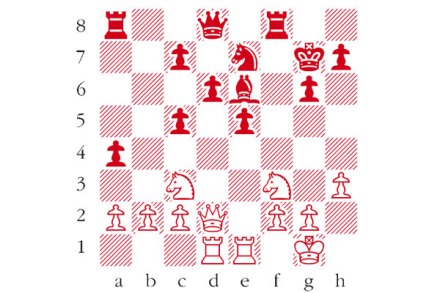
White to play. This position is a variation from Kramnik-McShane, London Chess Classic 2012. How can Kramnik finish off the badly exposed black king? Answers to me at The Spectator by Tuesday 15 January or via email to victoria@spectator.co.uk or by fax on 020 7681 3773. The winner will be the first correct answer out of a hat, and each week I shall be offering a prize of £20. Please include a postal address and allow six weeks for prize delivery.
Special Ks

From our UK edition

London has seen three World Championship matches in the post-war period, Kasparov-Karpov 1986, Kasparov-Short 1993 and Kasparov-Kramnik 2000. The game I have chosen to start the new year is Kasparov’s most convincing win from his 1986 title defence at the Park Lane Hotel, a match opened by the then Prime Minister, Margaret Thatcher, and closed by her predecessor, former Prime Minister James Callaghan. The position is taken from the historic encounter 14 years later, when Kasparov lost his title to the up-and-coming Vladimir Kramnik. Next week I shall focus on games, results and critical positions from the 4th London Classic, which concluded last month.