Raymond Keene

No. 286

From our UK edition

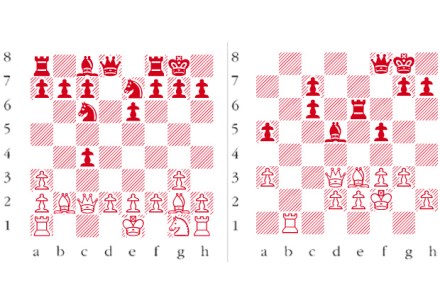
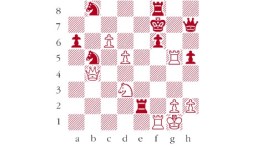
White to play. This position is from Alekhine-Bogolyubov, World Championship (Game 4), Germany 1934. The black king has been driven out into the open. How can White conclude? Answers to me at The Spectator by Tuesday 8 October or via email to victoria@spectator.co.uk or by fax on 020 7681 3773. The winner will be the first correct answer out of a hat, and each week I shall be offering a prize of £20. Please include a postal address and allow six weeks for prize delivery.

Max Fuller

From our UK edition

I am sorry to hear that the Australian master Max Fuller has died in Sydney at the age of 68. For about a decade Max was a fixture on the British chess scene and the high point of his career came when he was within just one move of tying for first prize in the British Championship, instead of sharing second. I was instrumental in the final outcome, since I was playing Black against Max in the last round. Had Max won, and my notes will reveal how this would have been possible, he would have shared first prize with fellow Antipodean, Bob Wade OBE. As it was, Wade won the championship outright. In 1975 Max also shared second place; he represented Australia many times in the Chess Olympiads, shared first prize in the Australian Championship and was appointed captain of their team in 1986.

No. 285

From our UK edition

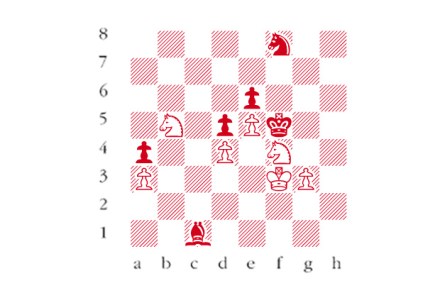
White to play. This position is from Fuller-Sorensen, Copenhagen 1980. The Black king has been driven out into the open. How can White conclude? Answers to me at The Spectator by Tuesday 2 October or via email to victoria@spectator.co.uk or by fax on 020 7681 3773. The winner will be the first correct answer out of a hat, and each week I shall be offering a prize of £20. Please include a postal address and allow six weeks for prize delivery.   Last week’s solution 1...
World Cup

From our UK edition

The recently concluded Fide (World Chess Federation) World Cup held at Tromso in Norway resulted in a triumph for Vladimir Kramnik. The ex-world champion’s form has been variable this year, including shared first place in the London Candidates’ tournament, with Carlsen, but a disastrous last place finish in the Tal Memorial in Moscow. Kramnik missed out on the qualifying slot in London, when he crashed to defeat against the ever mercurial Ivanchuck in a tense final round. However, Kramnik gained his revenge in a crucial game against the same opponent in Tromso.

puzzle no. 284

From our UK edition

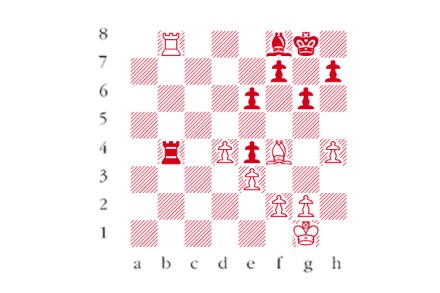
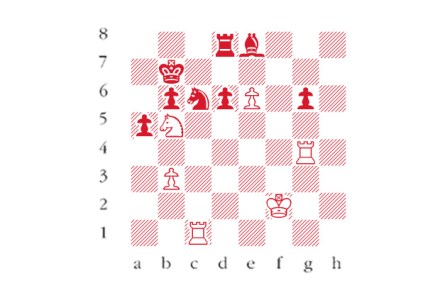
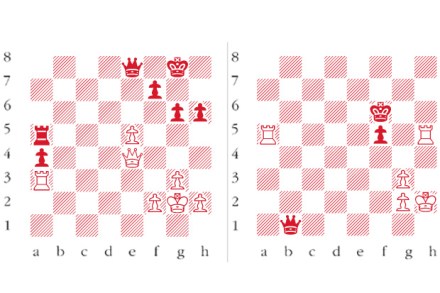
Black to play. This position is from Riazantsev-Felgaer, Tromso 2013. Black’s forces have invaded the white kingside. Can you spot the winning move? Answers to me at The Spectator by Tuesday 24 September or via email to victoria@spectator.co.uk or by fax on 020 7681 3773. The winner will be the first correct answer out of a hat, and each week I shall be offering a prize of £20. Please include a postal address and allow six weeks for prize delivery.   Last week’s solution 1 ...
Lord of the flies

From our UK edition

It is often said that the great chessboard artist, Polish Grandmaster Akiba Rubinstein, was afflicted during tournament play by an imaginary fly, which he sought in vain to swat away. As is the nature of imaginary beings, a case in point is the A Bao A Qu, the first entry in the bible of such entities, The Book of Imaginary Beings by Jorge Luis Borges, they remain undetectable to the uninitiated. The A Bao A Qu, of course, lived invisibly on the stairway of the Tower of Victory in Chittor, Rajasthan, imperceptible to all but those who had attained perfect Nirvana. It was not widely seen.   Similarly, the offending fly was visible only to poor, distracted Rubinstein.

No. 283

From our UK edition

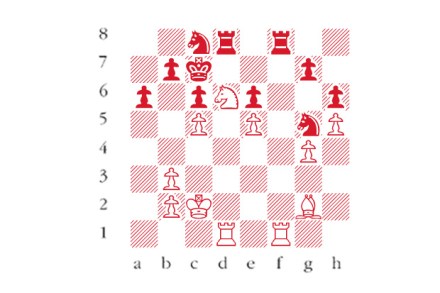
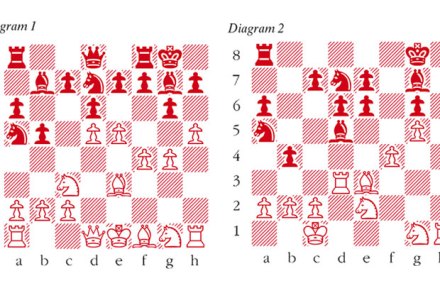
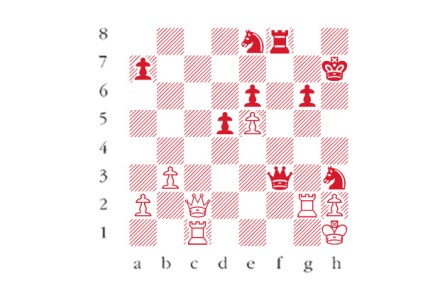
Black to play. This position is from Rotlewi-Rubinstein, Lodz 1907. This is the conclusion of one of Rubinstein’s most famous masterpieces. What is the quickest route to victory? Answers to me at The Spectator by Tuesday 17 September or via email to victoria@spectator.co.uk or by fax on 020 7681 3773. The winner will be the first correct answer out of a hat, and each week I shall be offering a prize of £20. Please include a postal address and allow six weeks for prize delivery.   Last week’s solution 1 Qh5+ Last week’s winner T.
Anon anon sir

From our UK edition

Nowadays it is standard, when publishing a chess game, to give the names of both players. This was not always the case. In the 19th century it was quite common to reveal the winner’s name while leaving the loser identified solely as ‘anon’ for anonymous. Occasionally this was for the perfectly good reason that the loser’s identity had been mislaid in the age before modern communications, though there could also have been the fear in certain cases that the defeated player, insulted at seeing his name in print attached to some chessboard calamity, might challenge the publisher to a duel.

No. 282

From our UK edition

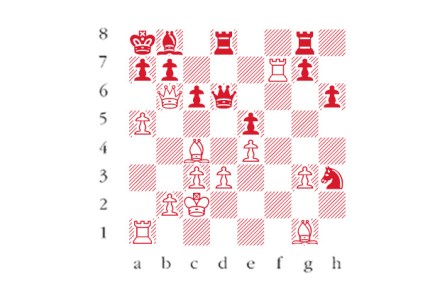
White to play. This is from Johnson-Anon, internet game 2013. Black’s problem is that his king is marooned in the centre with no prospect of finding safety quickly. How did White capitalise with an ingenious tactical blow? Answers to me at The Spectator by Tuesday 10 September or via email to victoria@spectator.co.uk or by fax on 020 7681 3773. The winner will be the first correct answer out of a hat, and I am offering a prize of £20. Please include a postal address and allow six weeks for prize delivery.   Last week’s solution 1 ...
Gligoric

From our UK edition

The great Svetozar Gligoric passed away last week at the age of 89. Gligoric represented Yugoslavia at a time when that nation was second only to the USSR in terms of chess strength. Three times a world title candidate, Gligoric was able to defeat such champions as Fischer, Botvinnik, Tal and Petrosian. Petrosian seemed to bring out the best in him. Petrosian-Gligoric: Rovinj/Zagreb 1970; King’s Indian Defence 1 d4 Nf6 2 c4 g6 3 Nc3 Bg7 4 e4 d6 5 Be2 0-0 6 Nf3 e5 7 0-0 Petrosian avoided his favourite 7 d5 Nbd7 8 Bg5, because his opponent was very confident in his handling of the variation 8 ... h6 9 Bh4 g5 10 Bg3 Nh5. 7 ... Nc6 8 d5 Ne7 9 b4 Nh5 At that time 9 ... Ne8 or 9 ...

Puzzle no. 233

From our UK edition

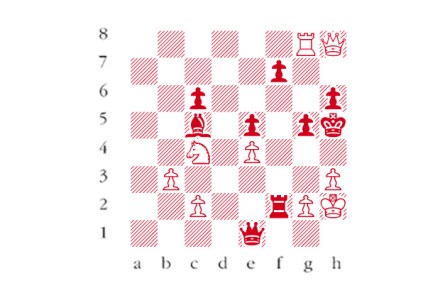
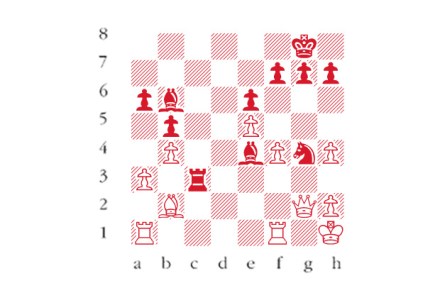
White to play. This position is from Gligoric-Petrosian, Belgrade 1954. How did White blast his way through to the black king in fine style? Answers to me at The Spectator by Tuesday 4 September or via email to victoria@spectator.co.uk or by fax on 020 7681 3773. The winner will be the first correct answer out of a hat, and each week I shall be offering a prize of £20. Please include a postal address and allow six weeks for prize delivery.
Hedgehog fund

From our UK edition

The Hedgehog is a respected chess formation, usually adopted as Black, where the defender crouches behind a wall of pawns on the third rank, spines abristle, fending off any hostile aggression until the time comes to unfurl and deploy the fretful porpentine’s armoury in earnest. Since the Hedgehog is essentially a defensive ploy, it is hardly seen as White, but in the elite Dortmund tournament last month former world champion Vladimir Kramnik demonstrated that it can also be adapted for a White offensive. In the following game White’s 22nd move constitutes one of the most astounding coups I have ever seen on the chessboard. It certainly had the effect of knocking the solid and experienced former world title challenger, grandmaster Peter Leko, entirely off his balance.

Puzzle no. 281

From our UK edition

Black to play. This is from Caruana-Adams, Dortmund 2013. Despite play being in an endgame Adams sacrificed a piece. His adventurous play was rewarded when he reached the following position and won quickly with a tactic. What did he play? Answers to me at The Spectator by Tuesday 3 September or via email to victoria@spectator.co.uk or by fax on 020 7681 3773. The winner will be the first correct answer out of a hat, and each week I am offering a prize of £20. Please include a postal address and allow six weeks for prize delivery.
Dortmund

From our UK edition

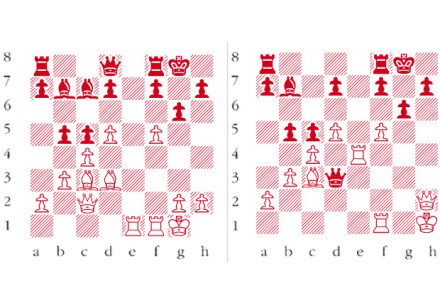
Britain’s top grandmaster Mickey Adams has won clear first prize in the tournament at Dortmund, ahead of former world champion Vladimir Kramnik. The full final scores (out of 9) were as follows: Adams 7; Kramnik 6½; Leko and Naiditsch 4½; Andreikin, Meier, Wang Hao and Caruana 4; Khenkin 3½; Fridman 3.   The last time a British grandmaster won outright at Dortmund was in 1980, when I took first prize, but the field then was far less impressive than the elite group over whom Adams triumphed. This week, some key extracts.   Adams-Andreikin: Dortmund 2013   Although this position features opposite-coloured bishops White’s active pieces and passed g-pawn create too many problems for Black.

No. 280

From our UK edition

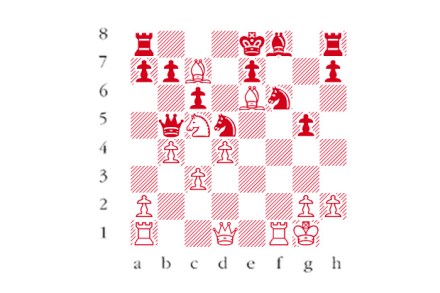
White to play. This position is from Williams-Brown, British Championship, Torquay 2013. What is the most direct route to victory for White? Answers to me at The Spectator by Tuesday 27 August or via email to victoria@spectator.co.uk or by fax on 020 7681 3773. The winner will be the first correct answer out of a hat, and each week I shall be offering a prize of £20. Please include a postal address and allow six weeks for prize delivery. Last week’s solution 1 Nd6+ (1 ...
Fawltless

From our UK edition

David Howell turned in a sparkling performance in the 100th British Chess Championship in Torquay, which finished last week. In 2009 Howell also won at Torquay, so he must be hoping that the English Chess Federation selects the home town of Fawlty Towers as the permanent future venue for the British Championship. Scores at the top (out of 11) were as follows: Howell 9½; Hebden, Jones (the defending champion) and Gordon 8. Grandmaster Mark Hebden, aged 55, was undefeated and this week’s puzzle is a tribute to his continued resilience. Here is an example of Howell’s convincing play during the championship.

No. 279

From our UK edition

White to play. This is from Hebden-Arkell, British Championship, Torquay 2013. White is a pawn ahead in this endgame but his next move eliminated any doubt that this would result in a victory. What did he play? Answers to me at The Spectator by Tuesday 20 August or via email to victoria@spectator.co.uk or by fax on 020 7681 3773. The winner will be the first correct answer out of a hat, and each week I shall be offering a prize of £20. Please include a postal address and allow six weeks for prize delivery.   Last week’s solution 1 Qh5 (meeting 1... gxf4 with 2 Ng4) Last week’s winner P.A.

Miles gloriosus

From our UK edition

England’s leading female player, Jovanka Houska, recently called for a memorial to the late Tony Miles. The timing is fitting. Miles won the British championship in 1982 and the centenary British Championship concludes this weekend in Torquay, the scene of Miles’s victory.   The year after he won the championship, Miles also triumphed in the BBC Mastergame series, defeating the then world champion Karpov in the final. Mastergame is usually regarded as the gold standard for presentation of chess on television. Sadly, however, due to a BBC technicians’ strike, the 1983 series featuring this superb win by Miles was screened in Germany, but not in the UK. Here, then, is Miles’s win against Karpov, which never saw the light of UK television screens.

Puzzle No.278

From our UK edition

White to play, a variation from Speelman-Miles, London 1975. White has two pieces forked. What is the most accurate continuation of the attack? Answers to me at The Spectator by Tuesday 13 August or via email to victoria@spectator.co.uk or by fax on 020 7681 3773. The winner will be the first correct answer out of a hat, and each week I shall be offering a prize of £20. Please include a postal address and allow six weeks for prize delivery.
Il miglior fabbro

From our UK edition

Lothar Schmid, chess grandmaster, the world’s greatest collector of chess books and the only arbiter trusted by Bobby Fischer, died earlier this year, and the chess world lost one of its great characters.   Schmid (born 1928) officiated as arbiter at three of Fischer’s matches, including the 1972 Match of the Century, where Fischer wrested the crown from Boris Spassky. The difficulties and challenges in 1972 would have exhausted the patience of a stylitic anchorite, but he went on to arbit further stormy matches between Karpov, Korchnoi and Kasparov.   Schmid returned as arbiter for Fischer’s 1992 swansong against Spassky in the former Yugoslavia, but this time he faced no problems.