Raymond Keene

Overreach

From our UK edition

Game eight of the World Championship in New York broke the deadlock of hard-fought draws in the first seven games. Carlsen employed a closed variation of the queen’s pawn opening which had, in the past, been popularised both by Johannes Zukertort and Akiba Rubinstein. The opening merged into a level but still fertile middlegame. At this point Carlsen overreached and after a sequence of sub-optimal moves on both sides, doubtless occasioned by time trouble, the black defence emerged victorious. Carlsen-Karjakin: World Championship, New York (Game 8) 2016; Zukertort/Rubinstein 1 d4 Nf6 2 Nf3 d5 3 e3 e6 4 Bd3 c5 5 b3 Be7 6 0-0 0-0 7 Bb2 b6 8 dxc5 A strange choice, relinquishing his full control of e5, which is normally a key plank in the white attack. 8 ...

Chess puzzle | 1 December 2016

From our UK edition

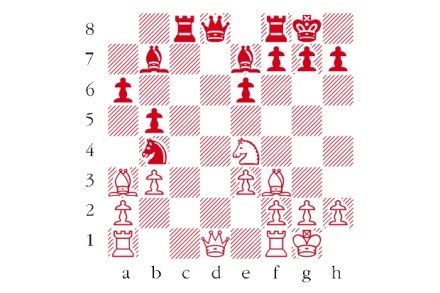
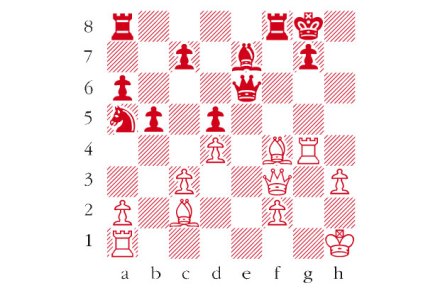
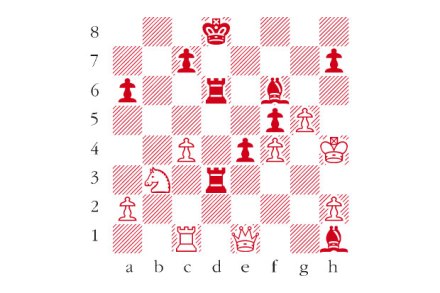
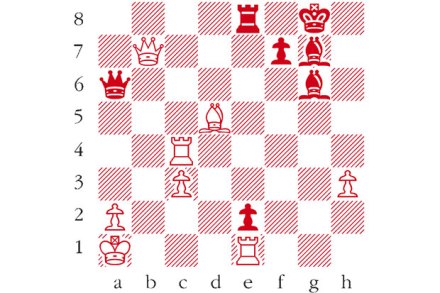
White to play. This position is from Rubinstein-Johner, Carlsbad 1911. How did Rubinstein gain a winning position with a standard tactical device? We regret that because of the Christmas printing schedule, this is not a prize puzzle.

Willing to wound

From our UK edition

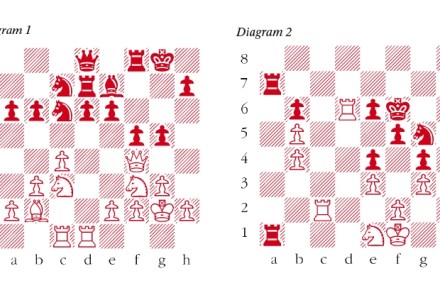
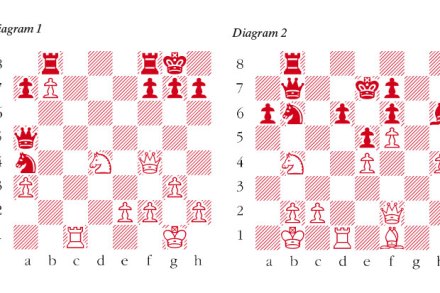
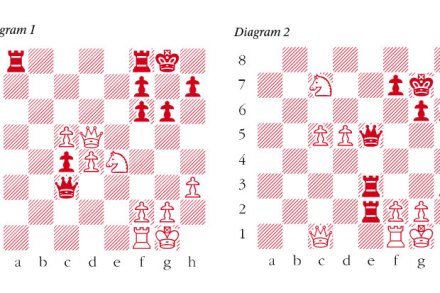
But yet afraid to strike, as Alexander Pope would doubtless have described the first seven games of the World Championship currently in progress in New York. It is not that there has been a dearth of opportunity, just a frustrating lack of realisation. Like Marshall Grouchy at the Battle of Waterloo, no sooner are the players presented with an opportunity for advantage than they march briskly away from the sound of the cannons. Take game five, for example.   Carlsen-Karjakin: World Championship, New York (Game 5) 2016 (see diagram 1)   Here Black has an excellent chance to exploit the windy position of White’s king with 43 ... Rh8, when the following variation is forced: 43 ... Rh8 44 Qe4 Qh6 45 Kf1 Qh1+ 46 Ke2 Bd5 47 Qf5+ Kb8 48 Qd3 Qa1.

no. 436

From our UK edition

White to play. This is from Karjakin-Carlsen, World Championship, New York (Game 7) 2016. This position will be dead equal unless White plays a specific move which offers him a slight advantage. What move? Answers to me at The Spectator by Tuesday 29 November or via email to victoria@spectator.co.uk. There is a prize of £20 for the first correct answer out of a hat. Please include a postal address and allow six weeks for prize delivery.

Chigorin revived

From our UK edition

The early games of the World Championship in New York between Magnus Carlsen and Sergei Karjakin did little to contribute to the gaiety of nations. In the first two games both contestants seemed more anxious to display their ability to avoid loss than to strive heroically for a win. If the two were ‘willing to wound, but yet afraid to strike’, their willingness was of a most muted variety.   Fortunately, there was no lack of entertainment from the parallel Champions Showdown in St Louis, which pits Veselin Topalov, Hikaru Nakamura, Fabiano Caruana and Viswanathan Anand against each other in multifarious formats. Meanwhile, the European Club Cup, from which this week’s extraordinary game is taken, also showed a plethora of exciting clashes.

no. 435

From our UK edition

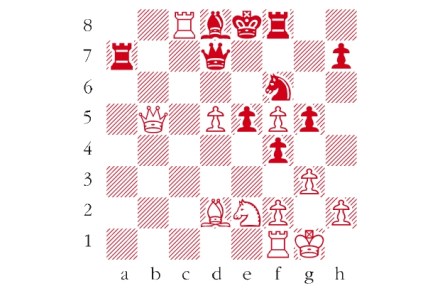
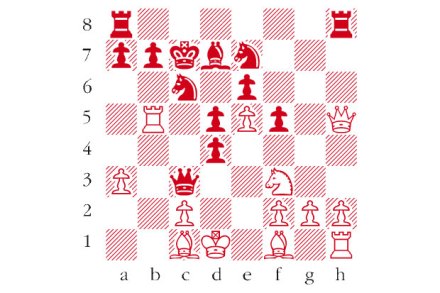
White to play. This is a position from Topalov-Caruana, St Louis 2016. Can you spot White’s crushing blow? Answers to me at The Spectator by Tuesday 22 November or via email to victoria@spectator.co.uk. There is a prize of £20 for the first correct answer out of a hat. Please include a postal address and allow six weeks for prize delivery.

Magnus vs Sergei

From our UK edition

The World Championship in New York begins this week. In the run-up, the defending champion, Magnus Carlsen of Norway, has been the heavy favourite to retain his title against Sergei Karjakin, formerly representing the Ukraine but now playing for Russia. Their lifetime score at classical time limits, under which the New York contest will be conducted, is notably loaded in favour of the incumbent.   As a final preview, here is a win by Carlsen against the former champion Vladimir Kramnik. The notes are based on Cyrus Lakdawala’s in Carlsen: Move by Move (Everyman Chess), a useful compendium for those considering Christmas gifts for chess enthusiasts.

no. 434

From our UK edition

White to play. This is a position from Carlsen-Shirov, Biel 2011. Can you spot Carlsen’s crushing blow? Answers to me at The Spectator by Tuesday 15 November or via email to victoria@spectator.co.uk. There is a prize of £20 for the first correct answer out of a hat. Please include a postal address and allow six weeks for prize delivery.   Last week’s solution 1 ...

no. 433

From our UK edition

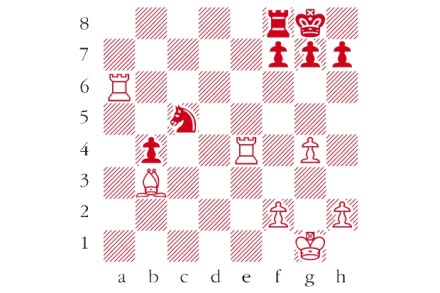
Black to play. This position is from Nakamura-Carlsen, chess.com Blitz Final 2016. The position looks quiet but after Black’s next move White resigned at once. Can you see it? Answers to me at The Spectator by Tuesday 8 November or via email to victoria@spectator.co.uk. There is a prize of £20 for the first correct answer out of a hat. Please include a postal address and allow six weeks for prize delivery.

Lasker’s heir

From our UK edition

Last week I previewed the respective chances of world champion Magnus Carlsen and his challenger Sergey Karjakin for their forthcoming championship bout in New York. Now I take a look at what drives Magnus and what primarily distinguishes his approach to chess from that of his rival. Karjakin has a powerful, conventional style. Well versed in aggressive modern opening theory, he has a forceful, direct and elegant mode of play that owes much to Bobby Fischer. Carlsen, on the other hand, is the spiritual heir of the great Emanuel Lasker, world champion from 1894 to 1921. Lasker was no connoisseur of opening theory, but where he excelled was in juggling options to avoid any kind of clear equality. Faced with such intense psychological pressure, his opponents tended to crack.

no. 432

From our UK edition

White to play. This is from Lasker--Teichmann, St Petersburg 1909. Black had already resigned this game as he could anticipate White’s crushing blow. What had he foreseen? Answers to me at The Spectator by Tuesday 1 November or via email to victoria@spectator.co.uk. There is a prize of £20 for the first correct answer out of a hat. Please include a postal address and allow six weeks for prize delivery.

Psephology

From our UK edition

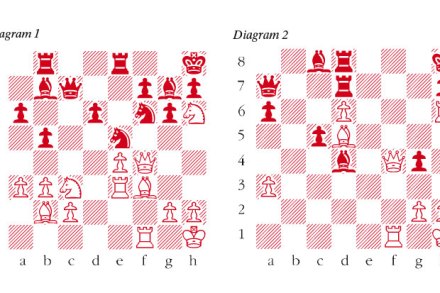
The polls are in for next month’s big event in the USA and Magnus Carlsen has emerged the clear favourite in his world title defence against Sergey Karjakin. Indeed, the Norwegian world champion leads by five wins to one in the classical format used in New York. The match is organised by Agon and the prize fund is ‘at least one million euros’. See worldchess.com/nyc2016 for details of new technology to follow the games online, as well as New York travel packages. This week, extracts of play from previous bouts between the pair.   Karjakin-Carlsen; Norway Chess, Stavanger 2013 (see diagram 1)   White had stood well but Carlsen coordinated his forces impressively and now tears into Karjakin’s kingside. 33 ...

Puzzle no. 431

From our UK edition

White to play. This position is a variation from Carlsen-Karjakin, Monaco 2011. Although White is a rook up he only has one move to ensure ­victory. What is it? Answers to me at The Spectator by Tuesday 25 October or via email to victoria@spectator.co.uk. There is a prize of £20 for the first ­correct answer out of a hat. Please include a postal address and allow six weeks for prize delivery.

Gamesters of Triskelion

From our UK edition

I first encountered the Triskelion, the traditional coat of arms of the Isle of Man, when I saw Laurence Oliver’s film of Shakepeare’s Richard III. At the crucial Battle of Bosworth, Lord Stanley, the Earl of Derby and feudal lord of the Isle of Man switches sides and betrays Richard. His three-legged triskelion banners are seen hurtling down on King Richard’s forces just before the immortal lines, ‘A horse, a horse! My kingdom for a horse!’   The only knights in action on the Isle of Man in the past weeks have been those on the chessboard. Congratulations are due to the organisers and sponsors for attracting a hugely powerful field which included the reigning US and British champions and the better part of the gold-medal-winning US Olympiad team.

No. 430

From our UK edition

White to play. This position is from Mamedyarov-Kramnik, Moscow 2016. White’s next concluded the game. What was it? Answers to me at The Spectator by Tuesday 18 October or via email to victoria@spectator.co.uk. There is a prize of £20 for the first correct answer out of a hat. Please include a postal address and allow six weeks for prize delivery.

no. 429

From our UK edition

White to play. This is from Tal-Botvinnik, World Championship (Game 12), Moscow 1961. Tal’s next move did not force an immediate win but gained sufficient material for him to prevail. What was it? Answers to me at The Spectator by Tuesday 11 October or via email to victoria@spectator.co.uk. There is a prize of £20 for the first correct answer out of a hat. Please include a postal address and allow six weeks for prize delivery.   Last week’s solution 1 ...

Tal order

From our UK edition

As I write, the Mikhail Tal Memorial tournament in Moscow is still underway. The Dutch grandmaster Anish Giri stormed into an early lead, winning three games out of his first five. But he was toppled when coming to grief in the following dramatic situation.   Aronian-Giri: Tal Memorial Moscow 2016 (see diagram 1)   White has sacrificed a rook but can regain material with 31 Nc6 Qb6 32 Nxb8 Qxb7 with an extra pawn. Nevertheless, the Armenian triple olympiad gold medal winner came up with something far more dashing. 31 Qxb8 Rxb8 32 Rc8+ Qd8 Obviously forced. 33 Rxd8+ Rxd8 34 Nc6 Black resigns If 34 ... Re8 35 Ne7+ Kf8 36 Nc8 sheltering the promotion square for White’s passed pawn. Or 34 ...

Rigan wizard

From our UK edition

Mikhail Tal, the Wizard from Riga, was one of the most devastating tacticians in the history of chess. His rise to become world champion was meteoric and included an equally devastating first prize in the 1959 Candidates tournament as well as demolition of the incumbent champion Mikhail Botvinnik in their 1960 title contest.   Tal’s forte was the creation of inexhaustible attacking potential that was almost impossible to refute. Harry Golombek, then the Times chess correspondent, related an anecdote about this week’s game in his book Fourth Candidates Tournament (Hardinge Simpole): ‘Tal sacrificed a piece for an attack that certainly should not have been sufficient.

No. 428

From our UK edition

Black to play. This position is a variation from Gelfand-Mamedyarov, Tal Memorial Blitz 2016. Black has various strong moves but only one forces checkmate. Can you see it? Answers to me at The Spectator by Tuesday 4 October or via email to victoria@spectator.co.uk. There is a prize of £20 for the first correct answer out of a hat. Please include a postal address and allow six weeks for prize delivery.

Olympiad | 22 September 2016

From our UK edition

The 42nd Chess Olympiad in Baku, Azerbaijan, ended in a narrow victory for the USA. Having tied with Ukraine, the American team qualified for the gold medals by virtue of a superior tie-break. The critical factor in the American success, their first gold medals in the Olympiad since 1976, was the acquisition for the team of two superstars, namely Fabiano Caruana, formerly of Italy, and Wesley So, who had represented the Philippines. So, in particular, distinguished himself by winning a second gold medal for best performance on board three.   The top five teams were: 1.USA 2.Ukraine 3.Russia 4.India 5.Norway (England finished a respectable ninth.)   In the parallel Women’s Olympiad the top five teams were: 1.China 2.Poland 3.Ukraine 4.Russia 5.