Peter Jones

Cicero would have agreed with Putin

From our UK edition

Last September Russian President Vladimir Putin warned against a ‘unipolar’ world, saying that the national revival of Russia was in line with its foreign policy objective of a multi-polar world and the prevailing of international law over the rule of brute force. How very Roman of him. Cicero pointed out that if one wanted violence to end, the law must prevail; if it did not, violence would reign supreme. To no avail. Every five years, the Roman censors asked the gods ‘to improve and strengthen the position of the Roman people’. There was nothing unique about this.

What Socrates and Harriet Harman have in common

From our UK edition

Since apologising has recently been all the rage, refusing to apologise, as Harriet Harman has done over the NCCL’s connection with the Paedophile Information Exchange, comes as a very pleasant surprise. Ancient Greeks would have understood exactly what she was doing. Socrates’ Apology (written by Plato) had nothing to do with apologising. Quite the opposite, in fact: apologia in ancient Greek meant ‘defence speech’, and Socrates’ apologia was Plato’s account — there were many others — of Socrates’ defence of his life and conduct against the charge of corrupting the young and introducing strange new gods.

From Caligula to Yanukovych

From our UK edition

Tyrants never learn, do they? From Caligula through Gadaffi to the ex-Ukrainian prime minister Viktor Yanukovych, they rule not to serve the people but themselves — and all in virtually identical ways. The emperor Tiberius populated Capri with palaces and grottos where lovers entwined themselves for the pleasure of his guests, like Yanukovych’s gardens dotted with love-seats and colonnades. Caligula had built a vast barge in the form of a floating palace on a lake, complete with marble, mosaics, and a hot and cold bath system; Yanukovych had a floating restaurant designed as a galleon.

Hadrian on the Somerset levels

From our UK edition

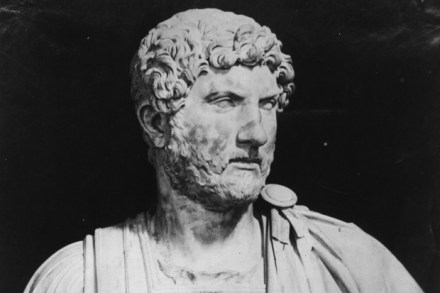
Since the Somerset Levels are a flood plain, nature will flood it. Romans had no problems with that. Much of Rome was low-lying and pretty marshy. The main drain — the cloaca maxima, only incidentally a sewer as well — was constructed early in Rome’s history to make the forum inhabitable. The 250-mile-long Tiber flooded every four or five years, with a big one every 25 years or so, not helped if water backed up from the sea. Flood plains like the Campus Martius were often deep in water. Julius Caesar would have diverted the Tiber away from Rome, behind the Vatican. After a nasty inundation of the city in ad 15, the emperor Tiberius established a quango to consider the matter. It suggested diverting lakes and rivers upstream.

Ancient Rome’s fraudulent foreign students

From our UK edition

Foreign students getting on to courses under false pretences, overstaying their welcome and so on are nothing new. Ask the Romans. In the 4th century AD, the Roman empire was tottering, and Diocletian decided to sort it out. The resulting increase in bureaucracy led to a large rise in taxation. This laid a particularly heavy burden on the wallets of the wealthy who ran local government (the decuriones), because it was their duty not only to collect local taxes but also to make up any shortfall. But there were tax exemptions, one of which was for students — a luxury only the rich could afford. The result was a sudden enthusiasm for education.

Democritus on the 50p rate

From our UK edition

What a song and dance about a tax rise affecting a minuscule proportion of the richest in society! Greeks would have been baffled. Classical Greeks did not have the automatic admiration for self-made millionaires that we do. They felt that only the very lucky or the very wicked could aspire to wealth. ‘No one gets rich quickly by being honest,’ says one character in a play, articulating that sense of the injustice of the good poor man and the evil plutocrat. Riches could also produce bad citizens because it was easy for a man to become ‘enslaved’ by his money (a common image). By contrast, Socrates, rejecting payment for his teaching, preferred ‘looking after his freedom’.

Dieting with Hippocrates

From our UK edition

There is, apparently, an ‘obesity epidemic’ in the UK, such that two million people could benefit from weight-loss surgery. Ancient Greeks would have argued that they would benefit much more from a dose of self-control. The ancients associated fatness with a lazy lifestyle. No change there, then. The doctor Hippocrates, well aware that sudden death was associated with obesity, knew that ‘dieting which causes excessive loss of weight, as well as the feeding-up of the emaciated, is beset with difficulties’. The Roman doctor Celsus (1st C ad) advised thin men to put on weight through rest, constipation and big meals, and the fat to take it off through late nights, worry and exercise.

Sorry, Rory Stewart, but you don’t understand the Greeks

From our UK edition

In last week’s Spectator, Rory Stewart, MP for Penrith, was reported to be proposing that we should create in Britain ‘1,000 little city states, and give power right down to all the bright, energetic people everywhere who just feel superfluous’. What did they teach him at Eton? The ancient Greek city-state (polis, source of our ‘politics’, etc.) was certainly ‘little’. There were at any one time about 1,000 of them dotted round the Mediterranean, most consisting of a city plus its surrounding countryside; and because of the nature of the terrain and the limited resources it could command, the average polis was c. 5,000 strong. The explanation of Athens’ power is that it was the largest of all poleis (pl.

Ancient and modern: Ovid on selfies

From our UK edition

A ‘meme’ is ‘an idea, behaviour, or style that spreads from person to person within a culture, often by mimicry’. If selfies, blogs, Facebook, Instagram, tweets and all the other means of drawing attention to oneself are anything to go by, rampant narcissism (derived from the mythical figure Narcissus) is the current, dominant meme. The Roman poet Ovid’s version of the Narcissus story captures the dark consequences. Narcissus is a beautiful baby, and his mother Liriope asks the prophet Teiresias if he will enjoy a long life. ‘Only if he never knows himself’, comes the paradoxical reply — for such ignorance is usually disastrous (cf. Oedipus).

Why does the year start in January?

From our UK edition

The ancients were an inquisitive lot, a characteristic shown to best effect in works like Aristotle’s Problems (‘Why do sex-maniacs’ eyelashes fall out?’) and Plutarch’s Greek and Roman Questions. Among much else, Plutarch asked, ‘Why do Romans adopt the month of January as the beginning of the new year?’ He began by doing the maths: July used to be called Quintilis, ‘Fifth’ (subsequently named after Julius Caesar) and August Sextilis, ‘Sixth’ (named after Augustus), while September to December covered the Roman numerals seven to ten. So, since the year contained only ten months, March must have been the first. He concluded that, to stay roughly in synch with the solar year, each month must have been lengthened.

While shepherds watched, civilisation was born

From our UK edition

‘And lo, there were shepherds in the fields, watching over their flocks by night...’   Reading recently that it was the 25th anniversary of the invention of the world wide web, I reflected (yet again) on the difficulty of creating in any of our minds that sense of the world as experienced by the Greeks and Romans. So the ancients did not have Xboxes, Y-fronts, or a ‘knowledge’ economy? Or a civil service, a banking industry, or any industry? Or any institutions like universities, the BBC or the FA? Well, well. In his Works and Days (c. 680 bc), the Greek farmer-poet Hesiod gives us some sense of the unrelenting peasant life which was the lot of most ancients — that daily wrestling with nature for simple survival.

Master charlatans at work

From our UK edition

To watch the Revd Paul Flowers being grilled by the Treasury Select Committee on his role in the demise of the Co-op Bank is to watch a master charlatan at work: dignified, polite and supremely self-assured, even as he is stripped to the bone by Andrew Tyrie. The ancient world boasted plenty of such, and they all exhibit identical characteristics. Take one Peregrinus, whose story is told by the Greek satirist Lucian (ad 115–180). He was exiled for killing his father, but saw there was advantage to be gained through the new religion on the block, and became ‘Christian’.

Barometer: How the new ‘third class’ would be worse than the Victorian version

From our UK edition

The grim tales of ‘modern slavery’ that are currently emerging across the UK make one wonder whether ancient Roman slavery was preferable. The fact that it was institutionalised means that it could, if you were lucky, be endurable. There was nothing secretive about slavery in Rome. It was felt to be part of the natural order of things — some people were ‘born’ to be slaves — and that was that. As ‘property’, without any legal status, a slave could be treated in any way his or her master liked: tortured, whipped or executed. Over time, however, some degree of legal protection was permitted.

The age of consent according to Aristotle

From our UK edition

Prime Minister Cameron has rejected the proposal that the age of sexual consent be reduced from 16 to 15, arguing that it was needed to ‘protect children’. In the ancient world, there was no such notion. Girls were to be protected from rape and seduction, but that was because they were destined for marriage, whose purpose was the production of legitimate children. It was fertility that was important, not age. For ancient Greeks, women were reckoned to become fertile at 14. The theory was that in a woman blood and fertility were linked and, by that age, a woman had collected enough blood in her body to have children. If that did not evidence itself in menstruation, sexual activity would bring about the desired result.

What are you doing for ‘Live like a Stoic’ week?

From our UK edition

On 21 November The Spectator is hosting a discussion about addiction — disease or choice? — and how we should best treat it. This neatly coincides with ‘Live like a Stoic’ week (25 November–1 December), which culminates in academics and doctors discussing how far problems of everyday life can be solved by the Stoic practice of thinking rationally about them — in modern parlance ‘cognitive behavioural therapy’ — rather than by expensive medical intervention. Stoicism was invented by Zeno, a Greek from Citium in Cyprus. In about 301 bc, he began teaching in one of Athens’ covered walkways (a stoa, whence ‘stoicism’). His work was to influence two thinkers in particular: Epictetus (c.

Grayson Perry thinks democracy has bad taste. Is that why he sells luxury goods to the rich? 

From our UK edition

‘Democracy has bad taste’, declared potter Grayson Perry in his Reith Lectures on the BBC about art. Tell that to the inventors of democracy. Ancient Greeks would have been appalled at the reverence accorded the views of potters, artists, chefs and other riff-raff about their work, let alone anything else. The satirist Lucian says of the would-be sculptor: ‘You will be nothing but a workman, doing hard physical labour and investing the entire hope of your livelihood in it. You will be obscure, earning a meagre and ignoble wage, a man of low esteem... a workman and one of the common mob...

Why did Athenians resort to arbitration by hedgehog? 

From our UK edition

Since trial by jury is so expensive, government is keen to cut costs on legal aid by ‘alternative dispute resolutions’ (ADR) and settle e.g. family disputes before they ever come to court. The situation in classical Athens was similar. Though jurors were paid by the day, enabling money to be saved by cramming in as many trials as possible in the session, their numbers were very high — 201, 401 or 501 depending on the case in hand — and the cost consequently heavy. So the authorities did all they could to engineer an early settlement. The process was part mediation (persuading both sides to agree a settlement) and part arbitration (a settlement imposed by a third party). Step one would be for the two parties to a dispute to appoint a private citizen to settle it.

Gaddafi and the greatest sex tyrants in classical history

From our UK edition

A new book about Colonel Gaddafi goes into shocking detail about his monstrous sexual appetites. He used rape as a political weapon and instrument of blackmail. Viagra was on constant supply for himself and his soldiers. His harem travelled with him under the guise of ‘delegations’ or ‘journalists’ (‘Hi, girls,’ Tony Blair greeted them). It was ever thus with tyrants. Herodotus (5th century bc) reports a conversation about the best form of rule between three Persians plotting to overthrow the government. Otanes attacks the single ruler, arguing that, being subject to no institutional control, he can indulge his wishes as he sees fit and this makes temptation irresistible.

Livy on Ed Miliband

From our UK edition

What should we make of Ed’s support for his father Ralph against the Daily Mail? Livy’s life of Torquatus suggests two possible responses. Torquatus was the obtuse, inarticulate son of the vicious and overbearing consul Manlius who, wanting to disown him, sent him off to work in the fields. But in 362 bc Manlius was threatened with a court case by the tribune of the plebs, Pomponianus. When Torquatus heard of this, he begged for a private audience with the tribune. The tribune agreed, expecting the abused Torquatus to support his case. Instead Torquatus threatened to kill him on the spot, unless he signed an oath not to proceed. The terrified tribune agreed.

Aristotle on winning the centre ground

From our UK edition

Party conferences always provide the most agreeable spectacle of politicians desperately trying to appeal to both the diehards among the party faithful and the soft underbelly of the general public. Aristotle (384-322 bc) lived at a time when democratic and oligarchic groupings within any polis (city-state) were regularly in conflict to impose their system of government, and was all too aware of the problem. In his Politics, Aristotle began by reflecting on the advantages that these two different systems of government offered to citizens within a polis. Democracy, he concluded, appeals to the many poor, because it gives them a say in the assembly, but oligarchy to the rich few, who use their birth, wealth and influence to run the show.