Peter Jones

Hadrian’s advice for a new Defence Secretary

From our UK edition

Michael Fallon, the new Defence Secretary, is a classicist by training. What lessons, if any, might he take from his study of the ancient world, especially in relation to military adventures in far-off places? Hadrian offered the key insight on the problem when he became emperor in ad 117 and immediately abandoned some Roman provinces in the East: ‘Since we cannot control them, we must give them their freedom.’ Ancient Greeks are an interesting test case. While the city-states were free during the 5th and 4th centuries bc, they were constantly at each other’s throats, almost completely incapable of working together in each other’s interests. Athens itself was at war three years out of four over that period.

Plutarch on smartphone addiction

From our UK edition

Adults, we are told, as much as children, become gibbering wrecks if deprived of their mobiles or iPhones for more than 15 seconds. The 2nd-century ad essayist Plutarch foresaw the problem. In his essay ‘On being a busybody’, Plutarch takes a very strict line on man’s desire to be up to date on every last piece of news and gossip, especially what is ‘hot and fresh’ and, most important of all, scandalous. Joyful occasions — weddings and such like — are of no interest. Country life is even worse, ‘since they find the peace and quiet unendurable’.

Ancient & Modern: the rumour mill

From our UK edition

Geoffrey Dickens’s ancient dossier of (alleged) paedophiles in high places cannot be found among the 138 miles of government files, and rumour immediately takes wing. The ancients knew all about rumour: phêmê in Greek, fama in Latin, both words relating to ‘speech’. In 415 bc, the Athenians sent an expedition to Sicily, and Syracuse was rife with rumours about it. In the Assembly, one speaker said it was all nonsense, stirred up by agitators wishing to create fear and thus gain power. It was a reasonable assumption: in 411 bc a revolution occurred in Athens as a result of rumour. Rumour has not lost its power as a modern political weapon either.

Assisted dying? Ancient religion was all for it

From our UK edition

There is something mildly unexpected about religious groups’ hostility to euthanasia. After all, in the ancient world one of the major differences between e.g. Christians and pagans was that Christians were renowned for welcoming, indeed rejoicing at, death. Pagans found this incomprehensible. Not that pagans feared the afterlife. Although, in the absence of sacred texts, there were no received views on the matter, Greeks reckoned that if the gods were displeased with you, they would demonstrate it in this life rather than the next.

Brussels will treat Britain as Macedonia treated Sparta

From our UK edition

The EU is a federation of states (Latin foedus, ‘treaty’, from the same root as fides, ‘trust, good faith’). But for how long can such a federation endure a recalcitrant member? At some stage the crunch will come, as it came for Sparta. In 338 bc Philip II of Macedon, father of Alexander the Great, completed his conquest of the Greek city-states (poleis) and formed them — for the first time ever — into a political federation. All poleis sent representatives to the Council meetings, but executive power was invested in Philip, and when he was assassinated in 336 bc, in Alexander, it was Macedon that called the shots, and that was the end of it.

Of course fish are smart. Even the Romans knew that

From our UK edition

Dr Culum Brown of Macquarie University, Australia, has been doing some research on fish, and concludes that they are intelligent, live in social communities (etc) and generally display ‘behavioural and cognitive sophistication’. Dr Brown’s research would seem to have consisted of reading the 2nd Century AD essayist Plutarch. In a treatise on the cleverness of animals, Plutarch stages a debate between the pro-animal and pro-fish lobby. Aristotimus, for the animal lobby, states that all living creatures have many human qualities. They demonstrate capacity for purpose, planning for the future, memory, perception, emotion, care for their young, gratitude, courage, sociability, continence, self-control and bigheartedness. He proceeds to prove this with reference to animals.

How ancient Athens beat tax avoidance

From our UK edition

The taxman will soon be ordering those planning dodgy tax avoidance schemes to declare them beforehand and pay the full tax on them up front. Only if HMRC finally decides the scheme is legal will the tax rebate be allowed. This is a very Greek principle, which could help with the problem of bankers’ bonuses. The 4th century bc Athenian tax system was very progressive: only the richest paid any at all. In times of war, those with a certain value of declared property were liable for an emergency tax (eisphora), levied at 1 or 2 per cent. These wealthy Athenians — numbered in the thousands — were grouped into ‘tax partnerships’, and the state assessed what each partnership had to contribute.

The true gods of football (hint: they don’t work for Fifa)

From our UK edition

The World Cup has started, and the gods of football will be in their heaven for a whole month. Not the players, of course: the spectators. Ancient gods, wielding absolute power, expected to have that power acknowledged. This was usually done by their adherents carrying out specific rituals at the right time and the right place. Do that, and the gods would smile favourably upon them, offering them personal benefits and even immortal glory in the eyes of the world. Fail, and that would be an affront, an insult to the gods’ dignity: their wrath would be unconditional.

What Julius Caesar would have done about Nigel Farage

From our UK edition

Our politicians are desperately keen to turn the toast of the people, Nigel Farage, into toast himself. But is that wise? Time to consider the career of the Roman general Marius (157–86 BC). Noble families — i.e. those who had held high office — dominated Roman politics. Marius did not come from a noble family, but it was wealthy, and it did have good connections, which Marius later improved by marrying an aunt of Julius Caesar. Thanks largely to his considerable military prowess, he worked his way up the slippery pole, and made his mark in 107 BC when he became consul on a people’s programme, and six times subsequently. First, he made it clear that he was no toff.

How the Ancient Greeks did wealth taxes

From our UK edition

After 685 tightly argued pages, the ‘superstar’ economist Thomas Piketty unfolds his master-plan for closing the gap between the rich and poor: you take money away from the rich. Novel. Ancient Greeks realised you had to try a little harder. The culture of benefaction was deeply rooted in Greek society, even more so when the Romans made Greece a province in the 2nd century BC and removed their direct power of taxation. The quid pro quo lay in the prospect of eternal honour for the donors. The services which the wealthy provided for the city included paying for baths, gymnasia and food supply. Where harbour facilities and commercial districts needed renewal, they would stump up.

How Plato and Aristotle would have tackled unemployment

From our UK edition

Labour is up in arms because many of the new jobs currently being created are among the self-employed. This seems to them to be cheating. Quite the reverse, ancients would have said. Ancient thinkers knew all about the needs of the poor and were worried about their capacity to cause trouble (as they saw it) by revolution. So in a world where everyone lived off the land (the wealthy by renting it out), Plato thought there should be a law that everyone should have a basic minimum of land to live off, and no one should own property more than five times the size of the smallest allotment; any excess should be surrendered ‘to the city and to the gods’, presumably for redistribution as necessary.

Xenophon’s answer to a budget crisis – more non-doms!

From our UK edition

Nearly half of Britain’s billionaires are foreigners, and government hopes many more will now come in on the government ‘start business — get passport’ scheme. Someone has obviously been reading Xenophon. In the 350s BC Athens was in serious financial trouble. In his Poroi (‘Revenues’), Xenophon, a soldier and essayist, sketched out a plan to restore Athens’ fortunes. The big target was foreign businessmen, or ‘metics’ as the Greeks called them. ‘Metic’ derives from metoikos, literally someone who had ‘changed residence’, i.e. a Greek or non-Greek who was not Athenian. To live in Athens they had to have a citizen sponsor, be registered and pay a monthly tax.

Ukraine vs Sparta

From our UK edition

As rebels, terrorists, fascists, foreign forces, activists, separatists, militants, militias, nationalist groups, Neo-Nazis, Right Sector forces — take your pick — spread civil war across the increasingly lawless cities of eastern Ukraine, a pro-Russian commander helpfully commented ,‘We have God in our hearts, and they have cockroaches in their brains’. In 431 bc the so-called ‘Peloponnesian war’ broke out between Athens and Sparta. In 427 bc, pro-Spartan oligarchs attempted to drive pro-Athenian democrats out of Corcyra (Corfu), as a result of which civil war spread rapidly from city to city.

What Boris and Pericles have in common

From our UK edition

What is Boris’s great secret? Does it lie in the bust of the Athenian statesman Pericles (c. 495–429 bc) that he keeps in the Mayor’s office in London? The key can be found, perhaps, in Pericles’ passionate commitment to the idea of Athens as a ‘living lesson for Greece’. This was the central message of his famous Funeral Speech (430 bc) — not so much the heroism of the dead as the uniqueness of the city for which they had died and the contrast with its bitter rival, the conservative, inward-looking, military-obsessed Sparta. Athens was a model to others, Pericles affirmed, a democracy governed in the interests of the many, not the few. Advancement in public life depended on merit; poverty did not stand in a man’s way.

Ancient and Modern: a war for ‘human rights’

From our UK edition

What a splendidly liberal leader Mr Putin has turned out to be, desiring nothing other for his fellow Russians than their human right to decide their own fate. How the Romans would have applauded! In 215 bc, while Rome was desperately trying to keep Hannibal at bay in Italy, Philip the fifth, king of the powerful northern Greek state of Macedon (Alexander the Great’s territory), decided to ally himself to Carthage. He had in mind putting himself about on the big stage, among the Greek leagues to the south, and north into the Balkans (where Rome was beginning to have interests); and after some success, in 205 bc his gaze turned east, across the Aegean towards Asia Minor.

MPs should be grateful not to be in ancient Athens

From our UK edition

If the continuing rows over the expenses and lifestyles of certain MPs cast all of them in a bad light, it is a mystery why decent members do not take action to hasten the exit of their more shameless colleagues. If they do not, then the press will continue to hound them — but not half as hard as ancient Greeks hounded their officials, and not just officials either. Plato’s ideal republic was ruled by ideal guardians, but as he admitted, man’s nature ensured he would have to settle for second best: decree and law.

Socrates on Maria Miller

From our UK edition

Our former culture secretary, Maria Miller, is still apparently baffled at the fuss created by her fighting to the last to prevent her expenses being examined. It was a mere ‘legalistic’ transgression; that’s what MPs do. So that’s OK, then. Socrates once discussed with the young Euthydemus the question of going into politics. Euthydemus’ assumptions about what it entailed were all too simple, which led Socrates into discussing the importance of examining oneself. ‘Isn’t it obvious,’ said Socrates, ‘that people are successful, when they know themselves, and failures, when they do not? Those who know themselves know what suits them best, because they can distinguish between what they can and what they cannot do.

Is David Cameron trying to imitate the Delphic Oracle?

From our UK edition

Nigel Farage rather missed a trick in his debate over the EU with Nick Clegg. The Prime Minister has promised us an ‘In/Out’ referendum on the EU in 2017, if the Tories are returned to power. But there is a condition: the referendum will be held (his words) ‘When we have negotiated a new settlement...’ (23 January 2013). The problem is that word ‘When’. Does he really mean ‘If’? As it stands, Cameron’s ‘promise’ has all the hallmarks of the Delphic Oracle. Take poor old Croesus, king of Lydia. The historian Herodotus tells us that he asked the oracle what would happen if he fought the Persian king Cyrus. ‘You will destroy a great empire,’ it replied.

Epicurus on particle physics

From our UK edition

According to a top TV scientist, in the beginning there was ‘empty space’ and ‘energy’. After a big bang, the universe started out as a ‘featureless void’. But emerging particles ‘organised themselves into the universe we see today’ by ‘clumping together’ because of ‘deviation’ from perfect smoothness in ‘warped’ space. Meanwhile, cosmic light particles are zooming along in straight lines and still going strong, creating billions of other universes. This ‘astonishing idea’ is the ‘cornerstone of modern cosmology’. Ancient, too.

On teaching, St Jerome is with Daisy Christodoulou

From our UK edition

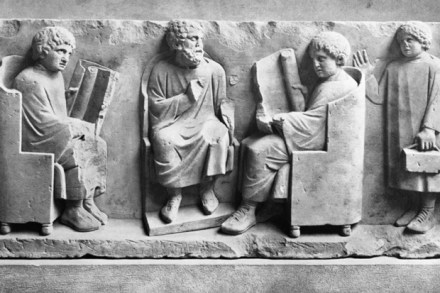
Last week in The Spectator, Daisy Christodoulou argued that, contrary to current educational theory, children learned best via direct instruction and drills under the guidance of a good teacher, which might be hard work but was satisfying and good for pupil self-esteem. Romans would have seconded that. In ad 403 St Jerome wrote a letter to Laeta, telling her how to teach her daughter Paula to read and write: make ivory or wooden letters; teach Paula a song to learn them and their sounds and their correct order, but also mix them up and encourage Paula to recognise them without such artificial aid; guide her first writing by hand, or outline letters for her to follow; and so on.