Peter Jones

How to be content

From our UK edition

The Covid-19 pandemic is apparently causing a large number of mental health problems. On that subject, one could do a lot worse than read the Roman poet Horace (65-8 BC). An attractive feature of Horace’s views about man’s efforts (including his own) to enjoy the good life is that you have to laugh about it all. He reflects that everyone thinks others better off than they are and envies their good fortune, but if a god told them to swap jobs, they would all refuse, thus (apparently) giving up their chance to be happy. And what would Zeus think of that — no more answers to your prayers! ‘Harvest the day (carpe diem),’ Horace says, ‘and don’t put too much trust in the next’ i.e. enjoy what you have and forget about tomorrow.

The Socratic approach to Covid

From our UK edition

Organs of the press are filled with opinion pages. The sublime confidence about Covid with which commentators advance these opinions, day after day after boring day, brings to mind the way in which Socrates dealt with such people. Plato, our major source for Socrates’s life and teaching, tells us that, on trial for his life, Socrates described how his friend Chairephon had asked the Delphic oracle whether anyone was wiser than Socrates, and the answer came back ‘No’. Baffled, since he was conscious of his own ignorance about almost everything, Socrates decided to put the oracle to the test and find someone wiser than himself. But his efforts were in vain.

Should a Good Citizen snitch on neighbours?

From our UK edition

If neighbours break whatever new Covid rules might soon emerge, it has been suggested that the Good Citizen might snitch on them to the authorities. Though not perhaps our cup of tea, it was certainly the ancient Greeks’. The Athenian lawgiver Solon (594 bc) was responsible. In the absence of a police force or a state prosecutor, Solon put the responsibility for bringing criminals to justice into the hands of citizens. They brought their complaints before legal authorities who established procedures for bringing them to court. This was all very well when litigants had been personally harmed, but it raised a problem when the state’s, rather than the individual’s, interests were concerned (e.g. accusations of treason). Who brought the case then?

Racism and the destructive power of language

From our UK edition

Pursuing last week’s theme, this week’s column raises the question: if there is no such thing as ‘race’ — since all humans belong to the same subspecies — why is there such a thing as racism? The modern answer is that race is (yawn) a ‘social construct’. But in the light of a famous passage in the 5th century BC by Thucydides, there is a case for saying that racism is the antisocial construct. Thucydides described how in 427 BC civil war broke out in Corcyra (Corfu) as pro-Spartan oligarchs attempted to drive out pro-Athenian democrats. What struck Thucydides about this development was that violence became the norm, with men ‘reversing the usual evaluative force of words to suit their own assessment of the situation’.

The Romans weren’t racist

From our UK edition

Rod Liddle has questioned whether Ms Jolly, chief librarian of the British Library, was right to say that whites invented racism, and cites the Ancient Greeks and Romans as racists. But he does not define what he means by the term. If, as Mr Liddle suggests, a racist is someone who loves fighting other people, then racism has indeed been universal throughout human history. But fighting does not necessarily have anything to do with race. So what distinguished races for Greeks and Romans? Environmental determinism is the key. For example, working from medical beliefs about ‘humours’, Greeks thought Germans living in the north were cold, and therefore courageous but thick; Ethiopians in the south, hot and intelligent but cowardly.

Museums need wonder, not wokery

From our UK edition

The British Museum’s aim is to use its collection ‘for the benefit and education of humanity’. If that manifests itself in jerking the knee to Black Lives Matter’s anti-colonial agenda, the Museum might do well to learn from the ancients. Near Eastern conquerors used to dedicate their loot in temples, and so exhibit it. It was Nebuchadnezzar II of Babylon (6th C bc) who gathered reliefs, weapons, inscriptions (one going back to 2,400 bc) etc. and placed them in a ‘Wonder Cabinet of Mankind’ for the public to enjoy. Greeks and Romans took up the idea, filling their temples with collections of relics, statuary and art. The temple of Lindos on Rhodes contained a bracelet of Helen of Troy, Orpheus’s lyre and the weapons of Heracles.

The Romans wouldn’t have understood our exam obsession

From our UK edition

Many commentators have argued that the recent grading controversy indicates just how important public examinations are. Up to a point, Lord Copper. Romans did jobs, not ‘education’. Most who went to school (there was no state provision) probably learnt not much more than the basic three Rs (peasant families — the majority of the population — needed their children to work the land). A freed slave in Petronius’s Satyricon boasts that he knows ‘no geometry or fancy criticism or any such meaningless drivel, but I do know the alphabet and I can work out percentages and measures and currency’; Horace mocked pupils for being asked what is left from 1/12th subtracted from 5/12ths. One option for children was to be sent away as apprentices.

The Romans welcomed migrants with open arms

From our UK edition

The kind of arguments raging about migrants crossing the Channel to enter Britain illegally never raged in the Ancient Roman world. The reason is quite simple: borders, in as much as they existed, weren’t controlled. Romans did their best to negotiate entry and settlement for armed tribal groups, many of whom they welcomed into the army. Otherwise, individuals and families came and went as they liked. The point is that newcomers were essential — they kept numbers up (Rome required about 10,000 immigrants a year net, not including slaves) and were not a ‘drain on the economy’ because the welfare state did not exist. If they could not carve out a living for themselves, no one would do it for them.

How the Athenians would have handled the Lords

From our UK edition

Arguments about the purpose or indeed very existence of anything resembling the House of Lords would have struck classical democratic Athenians as bizarre. But its Areopagus might prompt thought. This body had been in existence long before Cleisthenes invented radical democracy in 508 bc. It was made up of the wealthy aristocratic elite from whom alone the main state officials (archons) could be drawn. Their term of office completed, they joined the Areopagus for life. This body was the state’s legal guardian. The democratic reformer Solon (594 bc) slightly broadened its membership, and removed some of its political powers.

Mixed messages about body weight are nothing new

From our UK edition

Tackling obesity is the latest government initiative, universally condemned as nannying. Ask a Spartan. From an early age, Spartan children were taught not to be fussy: to eat up their food, and not to fear the dark or being left alone. At the age of seven, boys were taken from their homes and lived together in ‘herds’, exercising bare-footed and often naked, keeping fit and learning obedience. Food was sparse, because ‘overeating produces a broad, squat frame, and laboured breathing’. Lean features ‘defined the body’s true shape’, unlike obese ones. Competitive games were fostered, winners encouraged and a proud mental resilience developed. Now that’s nannying: the full Rees-Mogg.

Will all roads soon lead to York?

From our UK edition

Should the PM move parliament to York? There is, of course, historical precedent for such a move, as he very well knows. Rome was founded in 753 bc and when it became a republic in 509 bc it had a population of about 40,000. By about 260 bc it commanded manpower across Italy of about 730,000. At the collapse of the republic in 31 bc when Augustus became its first emperor, Rome controlled all Italy and an empire from Gaul to North Africa and Syria.

Does classical Athens give us a clue to China’s next move?

From our UK edition

In 1984, China agreed a ‘one country, two systems’ treaty with the UK, designed to control the relationship between Hong Kong and China for 50 years after Britain ceded control of the colony in 1997. It has now broken the treaty, for no other reason than that it can. So what next in that tinderbox? Classical Athens was at war three years out of four, and if arbitration had failed to solve the treaty problem, it would have gone to war. No Greek preferred war to peace, but fighting for life and territory was simply a given of the ancient world.

Tiberius and the ‘phantoms of liberty’

From our UK edition

Word has it that ministers already do not bother to argue their corner with the government’s inner ring, while a slimmer, streamlined cabinet office threatens to disempower them still further. Ministers could soon resemble senators under Rome’s second emperor Tiberius (ad 14-37). The historian Tacitus painted an extraordinary picture of Tiberius’s early days in office. The fact was that his stepfather Augustus had exercised autocratic power after he ‘restored’ the republic that had collapsed in 31 bc. The question for senators, therefore, was what change to expect under the new man in power. Their experience suggested precious little. They already knew Tiberius as a cryptic, devious and heartless character, whose word could never be trusted.

What can Roman outbreaks of malaria teach us about Covid?

From our UK edition

When Covid-19 first appeared, its similarity to Sars made some assume it could not mount a pandemic; others that it would be infectious, but mild. Assumptions with unhappy consequences are nothing new: some can last millennia. Take the West’s understanding of malaria. This deadly fever, widespread across the ancient world and mentioned in Homer, is caused by mosquitoes carrying the malaria parasite. But the ancient view was that ‘bad air’ (mal’aria, from the Italian) was the cause, reasonably enough, since the disease was clearly associated with swamps. Roman encyclopaedist Varro nearly solved it, arguing that ‘certain small animals breed there, invisible but causing troublesome diseases by entering through mouth or nose’.

Why stop at destroying statues?

From our UK edition

The actor John Cleese has been wondering if we should destroy Greek statues because Greeks believed ‘a cultured society was only possible if it was based on slavery’. That was not a Greek belief, but might the existence of ancient slavery suggest that their statues deserve to be knocked down anyway? Two points: first, the ancient world was one in which there were laws, but no concept of human rights, or of the sanctity of life; second, slavery was simply a universal fact of life, rather like hunting. Anyone could be enslaved at any time — captured in war or by pirates at sea — and many were born into it: all were the automatic private property of their owners. Few people thought twice about it. Everyone who was anyone had slaves.

The ancient Greeks would not have spared Dominic Cummings

From our UK edition

When the PM’s chief adviser, Dominic Cummings, was discovered to have made his fateful journey to Durham during lockdown, there was uproar. Now that Durham police have judged that trip legal, one might have thought the issue would disappear. But as ancient Greeks knew, such hatreds last a long time. They would have seen three eternal issues at stake here: legal obligations; standing in society; and (most of all) friends and enemies. The fact that, as the police agreed, Cummings was following government regulations on ‘reasonable excuses’ for his trip to Durham, would have been to the Greeks quite irrelevant.

Plato knew that home-schooling can have benefits

From our UK edition

Education is cumulative. The idea that it will be lost on a generation because, for one out of 42 terms of schooling, pupils will have to take more responsibility for their own learning, is obvious tosh. Indeed that term may yield considerable benefits for all, especially older, pupils, whatever their future plans. Let Plato explain. Plato’s Seventh Letter (its authenticity has been doubted) deals with his failed efforts to turn Sicily into a Platonic state. Greeks had settled there from about 750 bc, and in the 4th century bc Plato was invited to help turn the apparently willing tyrant Dionysius II into a philosopher king. Plato went over there, but found the court riddled with intrigue.

The Romans showed how quickly hospitals can be built

From our UK edition

The speed with which ‘model’ Nightingale hospitals have been designed and erected across the UK reminds one of the experts in this sort of thing: the Romans. Legionary fortresses provide a good example. All were designed on roughly the same pattern, and all had a hospital (valetudinarium). The fortress built at Inchtuthil in Scotland offers a typical illustration. Picture a quadrangle about 100 yards by 65 yards, surrounded on all four sides by a ring of ‘wards’, outside that ring a corridor, and outside that an outer ring of ‘wards’. The central corridor provides free movement round the whole block and access to both the inner and outer ring.

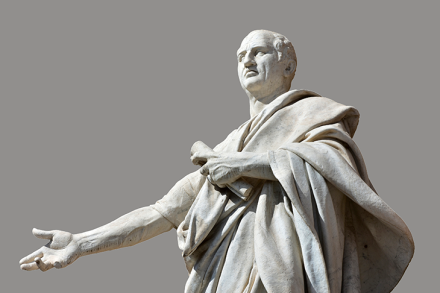
Cicero would have been quick to end the lockdown

From our UK edition

The Prime Minister recently quoted Cicero’s famous dictum salus populi suprema lex esto, translating it as ‘Let the health (salus) of the people be the supreme law’. No surprise there: he had just returned from his sick bed. But as he knows very well, that injunction was military: salus meant ‘security, safety’. The consuls must do whatever was needed to ensure the state’s survival. The state’s survival today is not a military but an economic issue. One interesting consequence is that it has become fashionable among the old to express a desire to help by being unlocked at once and so swept away by Covid-19. Then the young, most of them hardly affected by the virus, could get back to business as normal.

A happy hebdomaversary to The Spectator

From our UK edition

The Spectator’s 10,000th hebdomaversary (hebdomas, ‘a group of seven’: a weekly cannot have an anniversary) will surely be celebrated with the same enthusiasm that units of a thousand evoked in the ancients. But for them a thousandth-year celebration had to be symbolically significant. That required careful manipulation of dates. For example, the really big moment in both Greek and Roman history was the Trojan War. Greeks produced nine different dates for the fall of Troy, one of which was 1334 bc. That was the choice of Alexander the Great, who a thousand years after that date (334 bc) began his invasion of Asia, repeating and confirming Greek superiority over Asian peoples.