Owen Matthews

Owen Matthews

Owen Matthews is an Associate Editor of The Spectator and the author of Overreach: The Inside Story of Putin’s war on Ukraine.

Russia’s complex relationship with the ruble

From our UK edition

The most impressive banknote I have ever seen is the 500 ruble note produced by the Imperial Bank of Russia between 1905 and 1912. About four times the size of a modern £50 note, it is magnificently emblazoned with a portrait of Peter the Great and a profusion of cupids and classical pillars. It looks as high-denomination money should look – luxuriant, confidence-inspiring and valuable. The ruble (from ‘rubit’, to chop) was originally a chopped-off piece of Viking silver ingot Appearances can, of course, be deceptive. My Russian wife’s great-great-grand-father, the owner of the Volga Bread Bank of Saratov, unwisely chose to keep his considerable savings in the form of trunkloads of such 500 ruble notes.

After Putin: how nervous should we be?

From our UK edition

37 min listen

This week: In the magazine we look at the Wagner Group’s failed coup and its implications for Putin’s reign. The Spectator’s Russia correspondent Owen Matthews examines why the Kremlin permits the existence of private armies such as Prigozhin’s Wagner Group, and joins the podcast alongside Jim Townsend, former deputy secretary of defence for European and NATO policy under the Obama administration. (01:15) Also this week: The Spectator’s special projects editor Ben Lazarus writes this week about the claims made in the recent Mirror Group phone hacking trial, and the man orchestrating many of the accusations, Graham Johnson.

The Wagner Group isn’t Russia’s only private army

From our UK edition

Allowing a psychopath to form a private army of violent criminals may not, on reflection, have been Vladimir Putin’s greatest idea. But Yevgeny Prigozhin’s mutinous Wagner Group is by no means the only private army operating in Russia. Over the past couple of months no fewer than five armies have been fighting on Russian soil. Only one of them, the official Armed Forces of the Russian Federation, is directly subordinate to the Kremlin. Pay can run to £2,400 a month, an attractive offer when the average wage in the provinces is under £600 The 12,000-strong semi-irregular forces of Chechen president Ramzan Kadyrov, officially known as the 141st Special Motorised Regiment but more famous as the ‘Kadyrovsty’, are effectively the Praetorian Guard of a regional leader.

Prigozhin has made Putin more dangerous than ever

From our UK edition

As rebel tanks trundled up the highway towards Moscow yesterday morning, Vladimir Putin labelled the mutinous mercenary leader Yevgeny Prigozhin a ‘traitor’ – and vowed to crush him. But hours later Putin capitulated, allowing Prigozhin to retire to an honourable exile in Belarus and pardoning the 25,000-strong Wagner force which had spent the day in open, armed rebellion against the Kremlin’s authority. For Putin, who had built his image as Russia’s strongman protector, the particular humiliation of allowing an armed general to cross back over the Rubicon unscathed must have stung deeply.  Of course, things could have ended far worse for Putin.

Why Prigozhin rebelled

From our UK edition

Civil war broke on Russia like a thunderstorm, replacing weeks of mounting political heat with a deluge of fire and fury. The sound of rifles and mortars echoed around Rostov-on-Don hours after mercenaries of the Wagner private military company took over the headquarters of the Russian Army’s Southern command. Wagner troops were filmed placing anti-tank mines on intersections in downtown Rostov. In Voronezh, Russian army KA-52 attack helicopters rocketed a tank park, apparently to stop the armoured vehicles falling into the hands of the rebels, as a burning oil refinery outside Rostov sent flames hundreds of feet into the air. A column of Wagner tanks on low-loaders was filmed heading up the M4 highway from Voronezh to Moscow, 420 kilometres to the north.

Where’s Putin? The Russian leader is losing control

From our UK edition

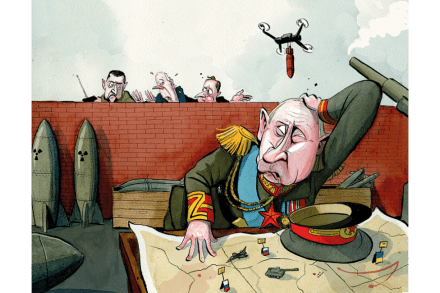
‘Does Putin even still exist? Where is he anyway?’ asked Igor Strelkov, former minister of defence of the self-declared Donetsk People’s Republic last month in one of the regular video rants he publishes on his Telegram channel. It’s a good question. Since 3 May, the Kremlin has been struck by two Ukrainian drones while up to 30 more have fallen among the billionaire dachas of Russia’s elite along the exclusive Rublevo-Uspenskoe highway. Anti-Putin Russians attacking from Ukraine have seized at least eight villages in Belgorod province, capturing Russian soldiers and sending drones to hit the regional capitals of Belgorod, Voronezh and Kursk.

Erdogan made himself indispensable – to Turkey and the West

From our UK edition

Some Turks voted for the devil they knew. More voted for the hero they knew. Either way, Recep Tayyip Erdogan’s re-election in the most fiercely contested election of his career last Sunday was a victory for fear over hope, for security over uncertainty, and of the past over the future.  Erdogan has, over the last five years, seen the economic miracle he helped create collapse into runway inflation, cronyism and gross economic mismanagement. Yet despite a litany of failures that would have demolished the career of any western European politician, it’s easy to see why over 52 per cent of Turks voted to stick with Erdogan. His opponent, the avuncular economist Kemal Kilicdaroglu, may have been the united opposition’s candidate.

Lithuania’s PM: ‘If Russia is not defeated it will come for somebody else’

From our UK edition

Vilnius In July, Lithuania’s Prime Minister Ingrida Simonyte will welcome Nato leaders to Vilnius for one of the most important summits in the alliance’s history. Top of the agenda will be how to help Ukraine push back Vladimir Putin’s forces. But a more thorny problem will be whether to formally offer membership to Kyiv – a move that would make Ukraine’s front lines Nato’s own. Simonyte believes that the war could have been avoided if Nato had accepted Ukraine and Georgia’s membership bids back in 2008. Before Putin invaded Ukraine last year, she says, ‘western leaders and western organisations were ready to abandon their positions every time Russia was pressing’.

Vladimir Putin must be praying that Lukashenko survives

From our UK edition

Belarus’s president Aleksandr Lukashenko has been missing from public view since being taken ill during a Victory Day parade in Moscow on 9 May. If Belarus’s dictator dies or is incapacitated Vladimir Putin – his neighbour, patron and only regional ally – will have a vast, even existential, problem on his hands. It was mass protests in Belarus’ capital Minsk in August 2020 after an election widely seen as stolen by Lukashenko that prompted Putin to decide that the West was irrevocably hostile to the Kremlin and was hell bent on fomenting regime change across the former Soviet Union – including in Russia itself.

Erdogan faces runoff vote in the Turkish elections

From our UK edition

Turkey is a strange kind of democracy. But nonetheless it is a democracy where an apparently invincible strongman can – in theory at least – be deposed after two decades in power by the will of the electorate. With over 99 per cent of the votes of Sunday night’s presidential vote counted, it looks like neither the 69-year-old Erdogan nor his challenger, the 74-year-old veteran leader of the Republican People’s party (CHP) Kemal Kilicdaroglu, have managed to break the required 50 per cent threshold to prevent a runoff. Erdogan is currently on 49 per cent, according to estimates by the official Anadolu Agency, while Kilicdaroglu is on 45 per cent.

Pushback against Russian sanctions grows in Germany and Italy

From our UK edition

Before Vladimir Putin invaded Ukraine, some of the Kremlin’s staunchest friends in Europe were the energy executives who lobbied for ever greater dependence on Russian gas and their political allies. The war – and the still-unexplained destruction of the two Nord Stream pipelines which connected Germany directly to Russia last September – sent Russia’s share of European gas supplies plummeting from over 40 per cent to around 5 per cent. Sweeping US and EU sanctions made doing business with Russian state-owned companies not only taboo but illegal.  Nonetheless, many of Europe’s energy tsars, industrialists and politicians still dream of restoring cheap Russian gas supplies – and are making increasingly public calls for a return to business as usual.

The Starmtroopers: Labour’s new recruits

From our UK edition

43 min listen

This week: In her cover piece for the magazine, The Spectator’s political editor Katy Balls writes that as Labour prepares for government, Keir Starmer is rooting out the far left sections of his party and replacing them with moderates. She is joined by John McTernan, former political secretary to Tony Blair, to discuss the return of the Blairites (01:06). Also this week: The Spectator’s Russia correspondent Owen Matthews writes about Putin's three most prominent political prisoners. He joins the podcast alongside The Spectator’s assistant online editor Lisa Haseldine to consider the cost of speaking up against the regime (17:50).

The terrible choice facing Russia’s opposition – stay, or go?

From our UK edition

There was a time before the invasion of Ukraine when even the Kremlin’s opponents would talk of living in ‘vegetarian’ times. Before 2022, independent news organisations like Dozhd TV, the New Times and Novaya Gazeta were marginalised but not banned. Public protest was punished, but for the most part with sentences in days and months, not years or decades. Even Alexei Navalny, the opposition’s highest profile leader, received a highly unusual suspended sentence after his conviction on trumped-up fraud charges in 2013. He remained free to goad the Kremlin with videos detailing massive corruption and run candidates in local elections until his poisoning by Russian secret police in August 2020. Save your skin and fight on, or keep your honour and be buried in the prison system?

‘Navalny is ready to fight and win’: meet the Russian rebel’s chief of staff

From our UK edition

Ever since the Russian opposition leader Alexei Navalny was arrested and imprisoned on trumped-up charges in January 2021, Navalny’s Anti-Corruption Foundation (FBK) has fought tirelessly to keep its leader in the public eye – and to continue his work exposing the corruption of the regime. Just under 130 million people viewed the FBK’s YouTube video ‘Putin’s Palace’, which detailed the outrageous luxury of a seaside palace built for Russia’s leader and the complex web of offshore schemes that financed it. The documentary Navalny – which details the opposition leader’s investigation into his own near-fatal poisoning by a team of FSB assassins in Tomsk in August 2020 – won the best documentary award at this year’s Oscars.

McSorley’s Old Ale House resists restoration

The late Christopher Hitchens once lamented that he left London for America because the “piss and vinegar” of the city had been swept away by an antiseptic tide of money. Manhattan, though, still has plenty of both, not only in the subway but also in the form of a series of old-school pubs that have somehow resisted the modern mania for restoring the life out of anything old and authentic. The granddaddy of them all is McSorley’s Old Ale House on East 7th, opened in 1854 and America’s oldest continuously operated bar. The front room of McSorley’s has no chairs or tables. There is sawdust on the floor. The place accepts only cash and has no till. It serves only two kinds of ale (light or dark) and house soda. A sleeve of crackers and a chunk of cheddar are the staple bar food.

mcsorley's

Ghost children: the pupils who never came back after lockdown

From our UK edition

33 min listen

This week:In her cover piece for The Spectator, Harriet Sergeant asks what's happened pupil absence which has increased since the pandemic. She is joined by The Spectator's data editor Michael Simmons to account for the staggering number of children who were failed by the government's Covid response (01:08). Also this week: Owen Matthews, The Spectator's Russia correspondent, looks at the opposition candidate who could usurp President Erdogan in Turkey. He joins the podcast alongside Turkish journalist Ece Temelkuran to discuss whether it really could be the end of Erdogan's two decade long hold over Turkish politics (14:48).

The mild-mannered economist who could end Erdogan’s rule

From our UK edition

In modern Turkey, as in ancient Byzantium, the factions and passions of the stadium crowds are a key bellwether of the people’s true mood. Last month the terraces of Istanbul’s Sukru Saracoglu stadium – home to the Fenerbahce team of which Turkey’s President Recep Tayyip Erdogan has been a proud member for 25 years – echoed with chants of ‘Erdogan, resign’ and ‘Lies! Lies! Lies!’. The same weekend, the home crowd of another major Istanbul club, Besiktas, had filled the pitch with a heartbreaking, minutes-long hail of soft toys thrown from the stands in memory of the thousands of children who lost their lives in the devastating earthquake of 6 February.

Were Ukrainians behind the Nord Stream bombings?

From our UK edition

Vladimir Putin has his story, and he’s sticking to it: the destruction of three of the four Gazprom-owned Nord Stream pipelines on 26 September 2022 was the work of the American government. Speaking to reporters in Siberia last week, Putin insisted that the Nord Stream attacks had been carried out on a 'state level’ and dismissed as 'sheer nonsense' a slew of recent stories pointing the finger at a group of freelance, Ukrainian-backed divers operating off a small hired yacht. But reported facts have been stacking up against Putin’s version of events.

Is Georgia seeing a ‘colour revolution’?

From our UK edition

On the face of it, the protests that rocked the Georgian capital of Tbilisi last week looked a lot like recent regional history repeating itself. Just as in Georgia’s own Rose revolution in 2003 or Ukraine’s Orange and Maidan revolutions of 2004 and 2014, vast crowds waving EU flags took to the streets to demand democratic change, to be met with police baton charges, tear gas and water cannons.  The cause of last week’s protests was a law passed by Georgia’s parliament requiring non-governmental organisations that received funding from abroad to register as ‘foreign agents’ – a requirement that looked uncomfortably similar to a longstanding Russian law which has been used by the Kremlin to crack down on civil society organisations and political opposition.