Owen Matthews

Owen Matthews

Owen Matthews is an Associate Editor of The Spectator and the author of Overreach: The Inside Story of Putin’s war on Ukraine.

Can Putin survive the coronavirus stress test?

From our UK edition

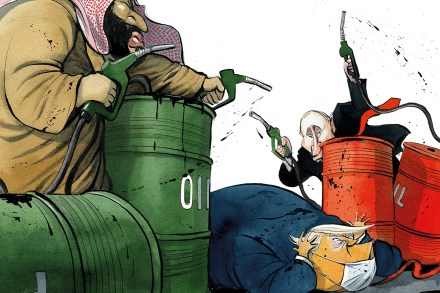
Vladimir Putin knows that a poor state is a weak state. As a middling KGB apparatchik in Dresden in 1989 he saw the USSR’s authority over its empire collapse along with its economy. Two years later, the Soviet state itself imploded, unable to feed its citizens or command the loyalty of its own security forces. Rebuilding Russia’s security apparatus back to Soviet levels and securing it against another systemic collapse has been the touchstone of Putin’s two decades in power. With the coronavirus crisis, the Putin system faces a stress test every bit as radical as that which brought down Mikhail Gorbachev. The proximate cause of the USSR’s collapse was a 1985 decision by the Saudis — with American encouragement — to crash the price of oil.

Moscow rules in London: how Putin’s agents corrupted the British elite

From our UK edition

In the past year alone, Russia-watchers have been treated to books entitled The Code of Putinism; Putin’s World; Putin vs the People; The Putin System and We Need to Talk About Putin — just to mention the ones with Putin’s name in the title. In addition, Robert Service’s Kremlin Winter, Sergei Medvedev’s The Return of the Russian Leviathan and Andrew Monaghan’s Dealing with the Russians have also offered their own insights into the history, politics and future of Putin’s Russia. In this crowded field, is there a place for Putin’s People? Happily, there is.

Oil wars: is this the real threat to the world economy?

From our UK edition

36 min listen

This week kicked off with an incredible fall in oil prices globally, so what on earth happened (00:50)? We also talk about the Budget, where Rishi Sunak set out in more detail how the government's 'levelling up' agenda will look (10:20). Finally, should we be doing more science research for curiosity's sake (23:05)?

The King of Christmas: A short story by Owen Matthews

From our UK edition

The Christmas King steps slowly from his house and sniffs the evening’s chill. His tread is dainty, for all his heft, and his handsome head swings proudly as he surveys a kingdom of carrot tops and mud. He smells woodsmoke, the sows’ reek, the night’s damp rising from the river. From the kitchen door he hears the teasing voices of boys, the clatter of scullions’ ewers loaded with his dinner. On the hill, Wytham Wood hisses like the sea. All summer Harry has dined on sour curds and burned crusts, lettuce roots and swedes, and the rich scrapings of the pottage pot. Now winter brings him even greater plenty. A mess of oats and gravy bones cooked special for his Majesty.

‘It wasn’t the Russian people who poisoned Skripal, it was just a few guys’: Alexander Lebedev interviewed

From our UK edition

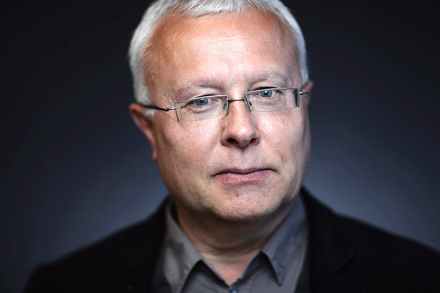
Who wants to be a billionaire? Not, apparently, Alexander Lebedev, the self-described ‘Russian ex-oligarch’ who has tried billionaredom and found it not to his liking. Lebedev opens his new book, Hunt the Banker, with a nostalgic riff on his happy youth in a tiny Moscow apartment and the observation that ‘the ideal menu consists of buckwheat (60 cents a kilo), extra virgin flaxseed oil, vegetables and a little fish’. Money, he reckons, ‘warms only a shallow soul. It shrivels the heart, gives no peace, and problems proliferate’. Why, then, did Lebedev leave a comfortable post as a KGB spy in London to pursue a career in banking in post-Soviet Russia?

In Ukraine’s presidential elections, life is imitating Netflix

From our UK edition

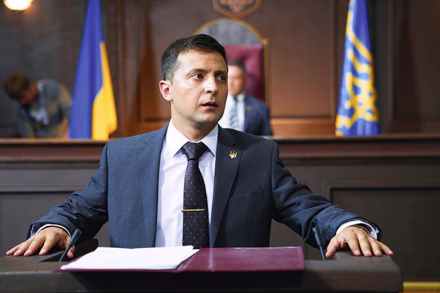
Servant of the People is a hilarious Ukrainian situation comedy currently running on Netflix. It opens with a young high-school teacher launching into a foul-mouthed rant against the corruption and venality of his country’s political class. ‘Why are all the honest people fools and the clever ones are thieves?’ shouts nerdy but honest history master Vasyl Holoborodko to a colleague. ‘What kind of people are we, that we keep voting for these mother--fucking liars knowing that they are crooks?’ One of Holoborodko’s pupils secretly films the rant through a window. The video goes viral. Millions of Ukrainians crowdfund the honest teacher to stand in an upcoming presidential election, which he unexpectedly wins.

The diplomat expulsion game is a pointless charade

Diplomats are poker chips. The pomp and mystery that accrues to the diplomatic and intelligence services en poste overseas conceal a simple truth: in today’s world, journalists, bankers, NGOs and bloggers are, far more often than not, better informed than diplomats about the countries in which they operate. I know this to be true in Russia – I speak to senior British and US diplomats in Moscow regularly. Believe me when I say that I can think of half a dozen veteran foreign correspondents in Russia who have considerably more extensive, diverse and senior contacts in the Russian establishment than any Western diplomatic mission.

Ukraine’s reality TV

From our UK edition

Servant of the People is a hilarious Ukrainian situation comedy currently running on Netflix. It opens with a young high-school teacher launching into a foul-mouthed rant against the corruption and venality of his country’s political class. ‘Why are all the honest people fools and the clever ones are thieves?’ shouts nerdy but honest history master Vasyl Holoborodko to a colleague. ‘What kind of people are we, that we keep voting for these mother--fucking liars knowing that they are crooks?’ One of Holoborodko’s pupils secretly films the rant through a window. The video goes viral. Millions of Ukrainians crowdfund the honest teacher to stand in an upcoming presidential election, which he unexpectedly wins.

Apocalypse Dau

From our UK edition

Dau is not so much a film as a document of a mass human experiment. The result is dark, brilliant and profoundly disturbing. For three years up to 400 people, only one a professional actor, lived for months at a time on a city-sized set specially built for the shoot near Kharkov, Ukraine. Modelled on the real Kharkov Institute of Experimental Physics between 1938 and 1968, every detail on the set was scrupulously in period, from the light fittings to the lavatory paper. The participants — who included a real-life Nobel Prize winner and famous orchestra conductor as well as real former KGB and prison officers — were required to live in role 24 hours a day, eating Soviet food, wearing Soviet underwear and undergoing Soviet-style total surveillance.

Bullets across the strait

From our UK edition

On Europe’s eastern borderlands, trouble is brewing. Two headstrong leaders — Vladimir Putin and his Ukrainian counterpart Petro Poroshenko — both with authoritarian tendencies and both facing sagging popularity at home, have swapped trading insults for exchanging bullets across the Strait of Kerch. The frightening truth is that war would suit both presidents’ short-term interests. Poroshenko faces re-election in March, and with his ratings running at 15 per cent he stands little chance of victory without a nation-uniting conflict to boost his standing.

Fact cats

From our UK edition

Bellingcat is an independent group of exceptionally gifted Leicester-based internet researchers who use information gleaned from open sources to dig up facts that no other team of journalists has been able to discover. Or, Bellingcat is a sophisticated front used by western intelligence agencies to disseminate stories that would be considered tainted if they came from an official source. Which is it?

At constant risk of violent death

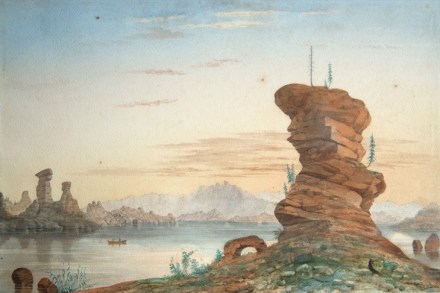
Russia has always attracted a certain breed of foreigner: adventurers, drawn to the country’s vastness and emptiness; chancers, seeking fortunes and new beginnings in the Russian rough and tumble. Romantics, all of them, men and women in search of soulfulness and authenticity — the experience of life lived on and beyond the edge of the civilised world’s conventions. Thomas Atkinson was all those things — in addition to being a self-taught architect and stonecutter of middling skills, a decent watercolourist, a stoic traveller of apparently inexhaustible curiosity, and a bigamist.

The road to Ekaterinburg

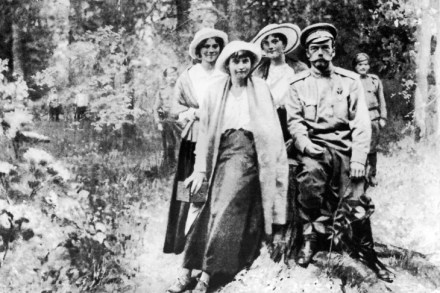
The true tragedy of the last Romanovs was a failure of imagination. Both during his last disastrous months in office and throughout the slowly unfolding catastrophe of his imprisonment, Nicholas II failed to conceive of how quickly the world around him could change, or just how desperate and ruthless the revolutionaries could be. A similar naivety was shown by his would-be rescuers. Helen Rappaport’s frank and brilliant study of the various efforts to save the Romanovs begins, intelligently, with the race to save them from themselves. Their downfall began in 1916 as the course of the first world war began to run against Russia.

Putin’s rot

This is Putin’s time. Next week, the Fifa World Cup kicks off in Moscow, and the Kremlin has spared no expense to showcase Vladimir Putin’s new Russia as a vibrant, safe and strong nation. Half a million visitors will be welcomed — with the Russian press reporting that the notorious ‘Ultra’ hooligans have been officially warned to behave themselves or face the full wrath of the state. Despite four years of rock-bottom oil prices, Putin has nonetheless found the cash to build or refurbish a dozen new stadiums. Moscow has undergone a two-year city-wide facelift that has left it looking cleaner, fresher and more prosperous than any European capital I have seen.

The 10 graphs that explain Vladimir Putin’s Russia

This is an edited version of a presentation given by Owen Matthews at The Spectator's What does Russia want? event. What I’d like to do is give a run-through of how we got to where we are with Russia. From the end of the Cold War onwards, focusing on the economy – and how the economy, in true Marxist fashion, has shaped the politics and political realities that we see in Russia today. The first metric is the big story of the post-Cold War world. Very simply, the graph above shows what’s happened between the collapse of the Soviet Union and the present day. It’s very clear: America's GDP has gone from $10 trillion to $18 trillion, China is catching up and Russia is flatlining.

What does Russia want?

From our UK edition

With Russian poisoners stalking the streets of Salisbury and the real possibility of a hot war with the Kremlin’s troops in Syria, The Spectator’s debate this Wednesday – What does Russia want? – could hardly be more timely. The line-up of guests we’ve assembled promises to be an explosive mixture. Russian Presidential candidate Ksenia Sobchak, who made a doomed run against Vladimir Putin in March’s elections on a platform of liberal reform, will lead the anti-Kremlin side. Sobchak is more than just a prominent liberal politician – she’s the ultimate political insider. Sobchak’s father Anatoly was an iconic liberal mayor of St Petersburg – and was Putin’s boss and political mentor in the years after he left the KGB.

Putin’s poison

From our UK edition

Vladimir Putin’s spies have a dizzying variety of weapons at their disposal. This week Britain learned of a new one: Novichok, a nerve agent used in an attempt on the life of a former Russian intelligence officer in Salisbury. But Putin’s real power, far more dangerous than all the rockets and poisons in his arsenals, lies in his toxic ability to corrode truth. Putin lies, barefacedly and repeatedly. So do his acolytes. Even when the forensic evidence is massive and incontrovertible, Putin tells palpable falsehoods with easy fluency. In March 2014 he insisted that there were no Russian troops in Crimea, claiming that ‘anyone could buy’ Russian military uniforms. Within a month, he publicly thanked the troops that had participated in the annexation.

Political football

From our UK edition

Authoritarian regimes love grand international sporting events. There’s something about the mass regimentation, the set-piece spectacle, the old-fashioned idea of nation states competing for glory that appeals to leaders who wish to show off the greatness of their country to the world. Berlin ’36, Moscow ’80, Sochi ’14 — nothing says ‘we’re here, get used to it’ better than a giant sporting jamboree. The 2018 football World Cup doesn’t offer quite the same degree of validation as an Olympic Games. But for Vladimir Putin, it’s still a major opportunity to demonstrate not only Russia’s new-found greatness but also its continued membership of the civilised world.

Turkish delights | 30 November 2017

From our UK edition

Patricia Daunt’s collection of essays is a fascinating exploration of some of Turkey’s most beautiful and evocative places, from the crumbling grandeur of Count Ignatiev’s Russian embassy summer villa on the upper shores of the Bosphorus to the remote and fog-bound manor houses of the Black Sea. But the Palace Lady’s Summerhouse is much more than a beautifully illustrated book: it’s about the people who lived — and live — in these buildings, and a portrait of the vanishing worlds they represent. We meet the gentlemanly descendants of a dynasty of grand viziers who quizzically watch the maritime traffic of the modern world passing by their ancestral waterside palace.

Ukraine’s last best hope

From our UK edition

You have to hand it to Mikheil Saakashvili: the man doesn’t give up. After a tumultuous nine years as president of Georgia, which began with a furious anti-corruption purge, culminated in a short but disastrous war with Russia in 2008 and ended with accusations of embezzlement and authoritarian practices, he is determined to return to power — not in his own country, but in Ukraine. Saakashvili is brilliant and divisive. His many fans, principally drawn from the educated and the young of Georgia and Ukraine, see him as exactly the kind of clear-thinking, fearless leader who can sweep away the tangle of cronyism that has turned most former Soviet states into kleptocratic autocracies.