Owen Matthews

Owen Matthews

Owen Matthews is an Associate Editor of The Spectator and the author of Overreach: The Inside Story of Putin’s war on Ukraine.

Vladimir Putin’s empire of lies

From our UK edition

According to Russian state television, flight MH17 was shot down by Ukrainian government forces who believed they were targeting Vladimir Putin’s jet returning from a summit in Brazil. An unnamed Spanish air traffic controller allegedly overheard two Ukrainian fighter pilots talking about the secret operation at Kiev’s Boryspil Airport. Ukrainian jets were supposedly seen tailing the doomed flight just before it exploded. Or, no — the plane was actually downed by a surface-to-air rocket fired from Kiev-controlled territory. Russian spy satellites recorded the whole incident, apparently.

The conflict in Crimea will be the downfall of Putin

From our UK edition

Earlier this year, Owen Matthews discussed in the Spectator how the conflict in Crimea will be the making of Ukraine and the end of Vladimir Putin: David Cameron says that Russia’s annexation of Crimea ‘will not be recognised’. Ukraine’s Prime Minister Arseniy Yatsenyuk promises that ‘we will take our territory back’. They are both misguided. Let Crimea go: it will be the making of Ukraine and the end of Vladimir Putin. Without Crimea, there will never again be a pro-Moscow government in Kiev. Ukraine will have a chance to become a governable country — a strongly pro-European one with a Russian minority of around 15 per cent. Putin will have gained Crimea but lost Ukraine for ever.

No, Putin didn’t plot to invade Ukraine. But now he might have to

From our UK edition

So what, exactly, does Vladimir Putin want? ‘To start World War Three,’ according to the embattled Ukrainian prime minister Arseny Yatseniuk. ‘To rule as president for life with powers on par with the tsars,’ according to Alexei Navalny, leader of Russia’s tiny opposition. To ‘force a major change of boundaries on Europe… and break the post-Cold War consensus,’ according to Radek Sikorski, Poland’s foreign minister. Actually, Putin himself has always been rather clear about his ambitions. ‘Russia has been a great power for centuries, and remains so,’ Putin told the State Duma in his first speech as prime minister, back in August 1999.

How did revolution become Istanbul’s new normal?

From our UK edition

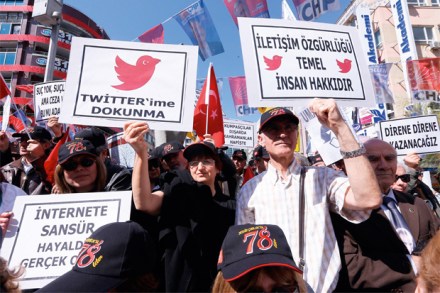
On a recent weekend I was thinking of taking my sons to downtown Istanbul to do some bazaar browsing. ‘Bad idea’,  a fellow expatriate warned me, ‘revolution on Taxim Square. Again.’ Revolt has become the new normal in Istanbul, a constant of urban life to be followed like the weather. Every few months the ritual dance erupts, chanting crowds on one side and sinister and well-drilled riot police on the other, followed by water cannon and the artillery-like noise of tear-gas canisters being fired into the crowd. How has Turkey come to this? Twelve years ago, Turkey’s then-new prime minister Recep Tayyip Erdogan promised to be an ‘Islamic Democrat’ in the sense that Germany’s Christian Democrats were Christians.

Let Putin have Crimea – and it will destroy him

From our UK edition

David Cameron says that Russia’s annexation of Crimea ‘will not be recognised’. Ukraine’s Prime Minister Arseniy Yatsenyuk promises that ‘we will take our territory back’. They are both misguided. Let Crimea go: it will be the making of Ukraine and the end of Vladimir Putin. Without Crimea, there will never again be a pro-Moscow government in Kiev. Ukraine will have a chance to become a governable country — a strongly pro-European one with a Russian minority of around 15 per cent. Putin will have gained Crimea but lost Ukraine for ever. And without Ukraine, as former US national security adviser Zbigniew Brzezinski famously said, ‘Russia can no longer be an empire.’ Crimea is a gangrenous limb on Ukraine’s body politic.

Ukraine’s turmoil highlights Vladimir Putin’s battle lines

From our UK edition

After two decades in the economic basket, Russia is decisively back as an ideological force in the world — this time as a champion of conservative values. In his annual state of the nation speech to Russia’s parliament in December, Vladimir Putin assured conservatives around the world that Russia was ready and willing to stand up for ‘family values’ against a tide of liberal, western, pro-gay propaganda ‘that asks us to accept without question the equality of good and evil’. Russia, he promised, will ‘defend traditional values that have made up the spiritual and moral foundation of civilisation in every nation for thousands of years’.

Vladimir Putin’s new plan for world domination

From our UK edition

[audioplayer src="http://traffic.libsyn.com/spectator/Untitled_2_AAC_audio.mp3" title="Anne Applebaum and Matthew Parris discuss how far we should let Putin go"] Listen [/audioplayer]It’s been a generation or so since Russians were in the business of shaping the destiny of the world, and most of us have forgotten how good they used to be at it. For much of the last century Moscow fuelled — and often won — the West’s ideological and culture wars. In the 1930s, brilliant operatives like Willi Muenzenberg convinced ‘useful idiots’ to join anti-fascist organisations that were in reality fronts for the Soviet-backed Communist International.

Putin’s own Cold War

From our UK edition

Whose side is Vladimir Putin on? It’s a question worth asking, because of late the Kremlin has come closer and closer to the tipping point between obstreperousness and outright hostility towards the West. Last week Barack Obama cancelled a September summit with Putin after Russia offered asylum to the National Security Agency whistleblower Edward Snowden. But in truth the Snowden affair is only the latest and most trivial of a long and growing list of issues where Russia and the US are on radically opposite sides. Syria probably tops the list — at least in terms of urgency and human cost. Russia has offered diplomatic support to the Assad regime by using its veto on the UN Security Council to block sanctions and intervention.

China: the Middle East’s new power broker

From our UK edition

It’s exactly ten years since Iranian dissidents first blew the cover of a secret uranium-enrichment facility under a mountain at Natanz, in a bleak stretch of desert near Isfahan. Ever since, relations between Israel and Iran have headed inexorably towards war. Israeli leaders have insisted that they are ready to launch a military strike — unilaterally if necessary — against Iran if the uranium enrichment continues. Iranian leaders, liberals and hardliners alike, have been equally adamant that the centrifuges will continue to spin. For Israeli hawks like prime minister Benjamin Netanyahu, the question has been not whether to strike Iran, but when.

Who killed Newsweek?

From our UK edition

So farewell then, Newsweek magazine, which published its last print issue this week. After 79 years — 15 of them as my employer — the venerable old rag is to disappear into an uncertain, web-only future. Many newspapers and magazines have folded as advertising shrinks and readers go online but Newsweek is perhaps the first of the titans to fall. Its demise is all the more resonant because it was one side of one of the great twin peaks of the press: Time and Newsweek, the New York Times and the Washington Post, the Times and the Daily Telegraph. In its heyday Newsweek was an essential part of America’s national conversation. It was controversial, liberal, usually half a step ahead of Middle America.

Istanbul: Going Deeper

From our UK edition

You’ve done the sights: the Hagia Sofia and the great imperial mosques, the Topkapi Palace and the Grand Bazaar, the Bosporus cruise and Basilica Cistern. With the tourist boxes ticked and the past squared away, it’s time to start exploring the real, living city. You may have had enough of museums, but Orhan Pamuk’s new Museum of Innocence in the Bohemian neighbourhood of Cihangir is worth a visit, if only for the abiding oddness of the concept as much as anything in the exhibits. The museum and Pamuk’s eponymous novel were conceived at the same time, and as Turkey’s Nobel Prize-winning author wrote the book about love and obsession set in 1970s Istanbul, he also collected artefacts.

Set art free | 10 March 2012

From our UK edition

Let’s not waste more millions ‘saving’ Old Masters Last week the National Gallery and National Gallery of Scotland proudly announced that they had jointly raised £45 million to buy Titian’s ‘Diana and Callisto’ from the Duke of Sutherland, thereby ‘saving it for the nation’. A few days before, Turkey’s Ministry of Culture and Tourism announced that it would be blocking export licences for various exhibits due to be displayed at the Metropolitan Museum of Art in New York, the British Museum and the Victoria & Albert Museum. The Turks said they would not release the artifacts until items in UK and US museums excavated in Anatolia during the 19th century were returned to the Turkish state.

A crackdown on kleptocrats

From our UK edition

The law is catching up with Russia’s corrupt oligarchs Moscow’s White House is a fairly pleasing pile, at least by the standards of late Soviet architecture. Its colonnaded white stone façade enjoys handsome views over the Moscow River, and its interiors are a symphony in green malachite, light teak and gold ormolu, a mid-1990s decorating style best described as mafia rococo. From the corner offices, now occupied by the Prime Minister, Vladimir Putin, and his deputies, one can gaze over gridlocked traffic, enlivened by the blue flashing lights of government Mercedes as they charge down the reserved central lane. ‘Do you remember Mabetex?’ I asked one of Putin’s deputy premiers a few months ago.

There’s something rotten in the state of Russia

From our UK edition

There is a chilling sequence in Tsar, Pavel Lungin’s dark and brilliant new film about Ivan the Terrible. Ivan, played by the mercurial rock musician Pyotr Mamonov, steps out of his private chapel wild-eyed after a long session of wheedling and bargaining with his God. The Tsar walks, lost in thought, through a series of rooms. As he shuffles along grovelling boyars ceremonially dress him. One group gently places a cloth-of-gold gown over his shoulders. Another group presents an embroidered collar, then cuffs, a crown and staff. Finally the Tsar emerges into the winter sunlight, golden and terrible. The crowd of people who have been waiting for him since dawn prostrate themselves in the slush and the shit of the palace yard. Silence falls.

Russia’s ignorant still hate Solzhenitsyn

From our UK edition

In Russia, writers are more than just writers. Russians look to their literary heroes not simply for beauty and entertainment, but for a philosophy of life. Writers do more than simply tell the truth to the temporal power — they are Russia’s spiritual legislators. The stern old God of Orthodoxy provides an immutable baseline of good and evil. But it is in the works of Dostoyevsky and Tolstoy and Pushkin and Chekhov that Russians find their universal truths, the nuts and bolts of people wrestling with freedom and oppression. Russians look to their writers not just to think but to live more deeply than ordinary mortals; the best ones end up crucified on crosses of their own weakness, or of the state’s disapproval. This was certainly true of Alexander Solzhenitsyn.

The mystery of Moscow’s empty supermarket shelves

From our UK edition

My local supermarket in Moscow is, by any standards, a well-heeled place. It’s called the Alphabet of Taste, and its mission is to present its wealthy Moscow consumers with refined new ways of parting with their money. The deli counter offers more than 80 cheeses (including such exotica as Bûche d’Affinois and two sorts of Stilton), as well as buckets of fresh black caviar and delicious salads of quails’ eggs and Kamchatka crab. The clientele is as classy as the stock. The thick-fingered meathead types who used to pass for Russia’s elite in the rough-and-tumble of the Yeltsin years have been replaced by a sleeker, more civilised model.

The price of protection in a lawless land

From our UK edition

The village clubhouse at Nikolina Gora, a well-heeled dacha village just outside Moscow, is usually a delightfully sedate place. Local residents Mstislav Rostropovich and Sergei Prokofiev used to give recitals for their neighbours on the clubhouse terrace. On Sunday afternoons lesser musicians still keep up the tradition and the strains of Mozart drift through the pines. Hardly an appropriate venue, one would think, then, for a hostile takeover bid by corporate raiders — but at last month’s annual residents’ meeting tempers were running high as the village’s elected committee decided how to face just such a raid. Nikolina Gora’s troubles offer a nasty insight into the way business is done in Russia.

Diary – 5 November 2005

From our UK edition

Baghdad Just because you’re not paranoid doesn’t mean they’re not out to get you, and someone’s definitely out to get us. Last week the Palestine hotel, home to many journalists here, was almost demolished by a particularly telegenic truck bomb. The neat mushroom cloud rose a thousand feet into the sky, shedding a geometrically near-perfect ring of falling debris about halfway up. It was terribly beautiful. Our security minders tell us that the attack was a sign that all journalists in the city are now fair game. Some of us have reacted by going into lockdown mode, retreating behind the walls of the world’s greatest fortress, Baghdad’s Green Zone, guarded by Georgian troops in American uniforms and Gurkha mercenaries hired by Global Security.

Ankara should be wary of Brussels

From our UK edition

Earlier this month Turkey’s bid to join the European Union crept past the tipping point from possibility to probability. The European Commission recommended that accession negotiations be opened with Ankara, and the outgoing enlargement commissioner Günter Verheugen announced that ‘no further obstacles remain’ on Turkey’s path. The news sent the Turkish press into frenzies of enthusiasm, with headlines screaming, ‘Europe, here we come!’, as though egging on the national sports team in the Euro championships, or a conquering Turkish army on its way to, say, Vienna. While no one was actually dancing in the streets, they no doubt will when the EU’s Council of Ministers sets a starting date for talks come December.

Bagged by the USA

From our UK edition

Owen Matthews goes on patrol with American soldiers in Afghanistan’s ‘Indian Country’ and sees them capture and interrogate suspects It was one of those wonderfully luminous Afghan days, the spring sky a vibrant baby-blue, the heat of the day cut by a breeze which blew though fields of poppies and winter barley. We were on the edge of the Khost highlands, where the fertile Khost plain starts to rise into the mountains of the Pakistani border — also known, not so affectionately, by the soldiers of Task Force One of the US army’s 501st Parachute Infantry Regiment as ‘Indian Country’. Band-i-Khel, the small village we had surrounded with our armoured cars and Humvees seemed deserted.