Owen Matthews

Owen Matthews

Owen Matthews is an Associate Editor of The Spectator and the author of Overreach: The Inside Story of Putin’s war on Ukraine.

Turkey’s dilemma: whose side is Erdogan on?

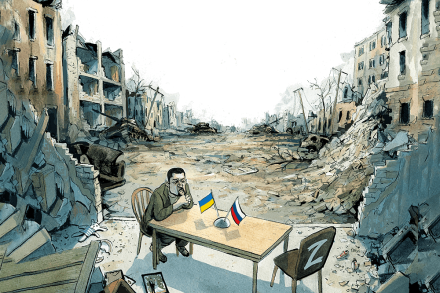
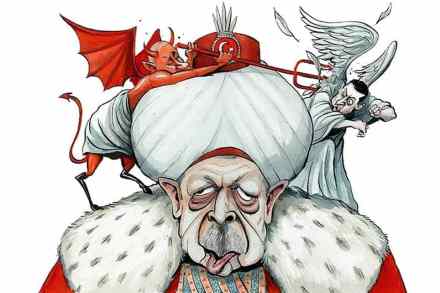
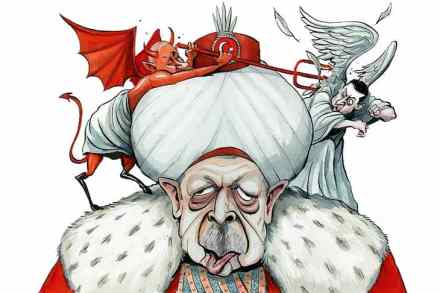
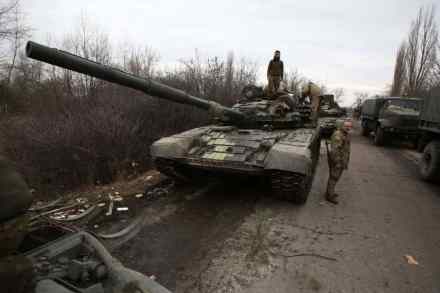
Istanbul Vladimir Putin’s ill-conceived blitzkrieg in Ukraine has failed thanks, first and foremost, to the guts of Ukrainian soldiers and civilians. British and US-supplied anti-tank weapons have played a crucial role, too. But it’s Ukraine’s Turkish--made TB2 Bayraktar drones that have been the war’s most unexpectedly effective weapon. Unexpected not just because of their battlefield killing power but because the father-in-law of the TB2’s inventor and manufacturer is Recep Tayyip Erdogan – the only European leader to have once described himself as a friend of Vladimir Putin. Erdogan, with a foot in the East and West, has emerged as the war’s key power-broker – and his loyalty is being actively courted by both Moscow and Washington.

My one-way ticket out of Moscow

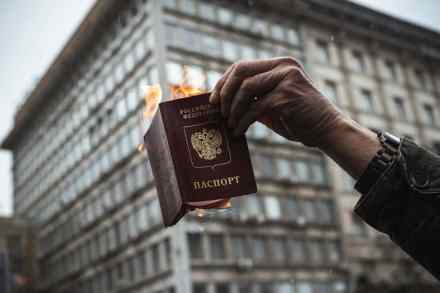
Things fall apart. Moscow friends call to say that I have to urgently send my 19-year-old son out of Russia. He is travelling on his Russian passport and a new law says that he is obliged to register for the military draft. Nikita is on a gap year working at a Moscow theatre and he begs not to be sent away. I dismiss the warnings. A day later, a friend’s nanny shows up at our door and hands me an inch-thick packet of high-denomination euros to take out of the country for her employer. The money’s owner is already en route to Israel on a private jet. I overrule my son and open up Skyscanner. Europe, the US and Canada have closed their airspace to Russian planes and the Kremlin has reciprocated. Istanbul is the only European destination still accepting flights from Moscow.

Putin’s rage

38 min listen

In this week’s episode: What’s the mood on the ground in Ukraine and Russia?For this week’s cover piece, Owen Matthews asks whether the invasion of Ukraine will mean the end of Putin’s regime. And in this week’s Spectator diary, Freddy Gray reports on pride and paranoia on the streets of Lviv. They join the podcast, to talk about Russia’s future and Ukraine’s present. (00:49)Also this week: Is Germany ready to tackle its dependence on Russian gas?In response to Russia’s invasion, Germany has abandoned its Nord Stream 2 pipeline, sent lethal weapons to Ukraine and, most strikingly of all, has committed to the Nato target of spending 2 per cent of GDP on defence - a €100 billion fund.

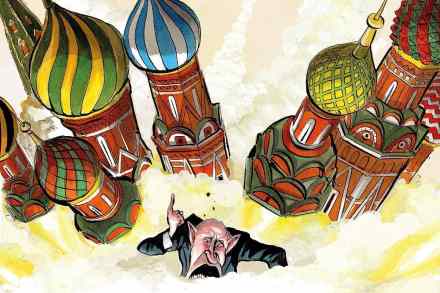
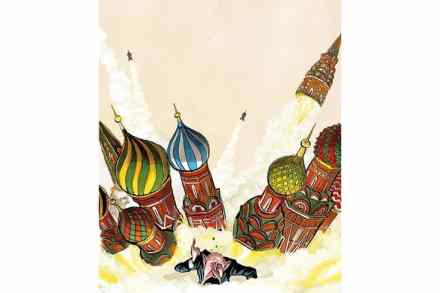
Putin’s rage: the Russian President won’t be easy to topple

 Moscow How will Vladimir Putin’s hold on power end? Will he be quietly retired by Kremlin rivals angry at a national humiliation, like Nikita Khrushchev after the debacle of the Cuban missile crisis? Deposed by KGB men even more hawkish than himself, like Mikhail Gorbachev? Overthrown by a popular revolt, like Tsar Nicholas II? Or will he die in his bed still the undisputed tyrant of a police state, like Joseph Stalin? Prediction has become a risky business in Russia ever since Putin threw his usual calculation and caution to the wind and launched a rash and fundamentally unwinnable war against Ukraine.

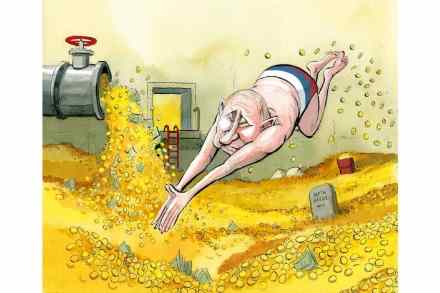
Will western sanctions really hurt Putin?

Boris Johnson has announced that the UK will impose personal sanctions on Vladimir Putin and his foreign minister Sergei Lavrov – and is as drawing up a ‘hit list’ of Russian oligarchs to target. ‘We have to make it deeply painful for the oligarchs that support the Putin regime,’ said foreign secretary Liz Truss. ‘There are over a hundred Russian billionaires … We will come after you.’ Will such actions actually work? For many top Russians, they are a badge of honour. ‘What? You haven’t been sanctioned yet?’ asked one Russian senator of the head of a Duma committee during a break in a Russian television show on which I was also a guest in 2019. ‘What kind of patriot are you?

Ukraine under siege – what now?

15 min listen

Vladimir Putin has launched an attack on multiple fronts across Ukraine. In a televised speech, the Russian leader announced a 'military operation' in Ukraine's Donbas region.Today, Boris Johnson has vowed to hit Russia with a 'massive' package of sanctions. But who will really suffer from these sanctions? And will it be enough to deter stop Putin in his tracks?All to be discussed as Katy Balls speaks to James Forsyth and Owen Matthews, The Spectator's Russia correspondent.

Has Putin lost the plot?

Sitting alone at the end of an absurdly long table or marooned behind a vast desk in a palatial hall, Vladimir Putin’s idea of social distancing has gone beyond the paranoid and into the realm of the deranged. His distance from reason and reality seems to have gone the same way. In little more than 48 hours, Putin’s sensible, peace-talking statesman act flipped into something dark and irrational that has worried even his supporters. As Putin’s hour-long address announcing official recognition of the breakaway republics of Donbas went out on Monday, a producer on Kremlin-controlled TV texted me: ‘Boss okhuyel [the boss has wigged out].’ Indeed.

The western press is giving Putin what he wants

Why does Vladimir Putin need Russia Today and Sputnik News when the western media are doing such a great job on his behalf? Throughout his two decades in power, Putin has yearned for international respect. Failing that, he’ll settle for fear. And what more satisfying outcome could there be for a serial sabre-rattler like Putin to have his bluff finally taken seriously? For weeks, British papers and TV have been filled with images of scary Russian tanks, warships and artillery blasting away — mostly provided, if you check the photo credits, by Russia’s Ministry of Defence. Since November, the US and British governments have been issuing increasingly strident warnings that Putin is preparing an imminent and massive attack on Ukraine.

How western journalists became Putin propagandists

Why does Vladimir Putin need Russia Today and Sputnik News when the western media are doing such a great job on his behalf? Throughout his two decades in power, Putin has yearned for international respect. Failing that, he’ll settle for fear. And what more satisfying outcome could there be for a serial sabre-rattler like Putin to have his bluff finally taken seriously? For weeks, British papers and TV have been filled with images of scary Russian tanks, warships and artillery blasting away — mostly provided, if you check the photo credits, by Russia’s Ministry of Defence. Since November, the US and British governments have been issuing increasingly strident warnings that Putin is preparing an imminent and massive attack on Ukraine.

The phoney war

39 min listen

In this week’s episode: Will Putin invade Ukraine? For this week’s cover story, Owen Matthews argues that if Putin is going to invade Ukraine, he will do so later rather than sooner. He joins the podcast, along with Julius Strauss who reports on the mood in Odessa for this week’s magazine. (00:42)Also this week: Is Brexit working?This week marks the second anniversary of Brexit. But how successful has it been? Joining the podcast to answer that question is Lord Frost who was Chief Negotiator of Task Force Europe from January 2020 until his resignation in December last year - and the journalist Ed West, who runs the Substack, Wrong Side of History (13:12)And finally: What is the allure of a classified ad?

The phoney war: what’s really going on between Boris and Putin

What a lucky coincidence. At the start of a week that could see the ignominious collapse of Boris Johnson’s premiership, an opportunity to go fully Churchillian has appeared out of the blue. In an unprecedentedly detailed and direct memorandum, the British Foreign Office announced that it had exposed Russian plans to mount a coup in Kiev. Johnson was quick to back the alarming news with a grave warning to Vladimir Putin. ‘The intelligence is very clear that there are 60 Russian battle groups on the borders of Ukraine, the plan for a lightning war that could take out Kiev is one that everybody can see,’ Johnson told reporters on Monday. ‘We need to make it very clear to the Kremlin that that would be a disastrous step.

Haunted: the spectre of revolution is stalking Putin

A spectre is haunting the former Soviet Union — the spectre of people power. Every time it appears, Vladimir Putin leads an unholy alliance of all the reactionary autocrats of the former Soviet space to try to exorcise it. Last week, Putin sent 3,000 Russian paratroopers to Kazakhstan at the request of its president to crush a sudden revolution that left at least 160 protestors and 12 security officers dead. For the time being, it looks like Putin’s timely intervention — as well as an internet shutdown that paralysed protestors’ ability to coordinate — has successfully quelled the flames.

Putin is more rational than Nato realises

Over the last nine weeks Vladimir Putin has moved more than 90,000 troops to the borders of Ukraine and, according to US intelligence, ordered his military planners to draw up detailed blueprints for a full-scale invasion. Putin insists the build-up is defensive. Russia is acting only in response to a ‘growing threat on our western border’, he told an audience of newly accredited diplomats in the Kremlin earlier this month, and to accuse Moscow of escalating tensions would be ‘laying the blame at the wrong door’. Call it the Kennedy defence. In September 1962 US intelligence uncovered secret Soviet plans to station short- and intermediate-range nuclear missiles in Cuba. President John F.

Russia syndrome: it’s easy to blame Putin for everything

When thousands of migrants massed on the Polish-Belarusian border, the Polish Prime Minister Mateusz Morawiecki lost no time in identifying who he believed the true culprit to be. Belarusian leader Alexander Lukashenko was just an ‘executor’, Morawiecki told his parliament. The true ‘enabler’ was ‘President Putin, who shows a determination to carry out the scenario of rebuilding the Russian empire, the scenario that we, all Poles, have to forcefully oppose’. The columns of refugees were part of the ‘neo-imperialist politics of Russia’, Morawiecki said. ‘They are part of a more coordinated attack, a new kind of war.’ Without a doubt, Polish fears of Russian imperialism are well grounded in history.

Putin’s plan for Ukraine

Vladimir Putin’s message was as clear — and familiar — as his method. The Kremlin has begun another major build-up of troops along Ukraine’s border. The reason? Retaliation: last month, president Volodimir Zelenskiy flew to Washington to renew his plea that Ukraine be allowed to join Nato.  The massive show of force — the second this year — prompted US Secretary of State Antony Blinken to warn his European allies that Russia showed dangerous signs of invading its smaller southern neighbour.

Douglas Murray, Owen Matthews, Lionel Shriver

29 min listen

On this week's episode, we’ll hear Douglas Murray on how the Prevent scheme has lost sight of its founding intention. (00:43)Then Owen Matthews on Rome’s rubbish. (12:35)And finally, Lionel Shriver gives her review of Dave Chappelle’s transgressive new Netflix Special.

How Rome’s rubbish became a political problem

‘Excommunication,’ reads a stone plaque on the wall of the church of St Theodore in Rome, ‘and a fine of 200 gold ducats for any person who should dare to unload… waste of any kind and cause a stink outside these precincts.’ This threat might have worked when the plaque was erected in 1703, but it certainly doesn’t work now. A few paces down the street, a waist-high pile of stinking rubbish bags festers in the autumn sunlight, pecked at by seagulls. In Rome, even the rubbish is eternal. Italy’s capital is strewn with litter — geological layers of the stuff. In a pile of last year’s crumbled leaves by my house on the Tiber embankment I found a beer bottle with a sell-by date of September 2020.

The mystery of Vladimir Putin’s mistresses

There’s an odd thing about 18-year old Luiza Rozova’s instagram feed. You can see photos of her breakfasts (sliced exotic fruit on heart shaped plates); her bikini selfies and her smart Paris apartment; her new shoes and her trips to the Louvre (heavily masked). But you never see her face. Take a look at screen-grabs of her insta feed before it was purged of all recognisable images and you realise why. Luiza – born Elizaveta Vladimirovna Krivonogykh – bears a striking resemblance to Vladimir Putin. It’s the same story with her mother, Svetlana Krivonogykh. The blonde 46-year-old’s social media pages were once full of photos of Svetlana in a helicopter and of charming views over the Vieux Port of Monaco taken from the balcony of a waterfront apartment.

Journey to the end of the world: the full horror of the Belgica’s Antarctic expedition

The epic story of the Antarctic voyage of the Belgica (1897-9) has all the ingredients of a truly glorious misadventure: an aristocratic expedition commander who carries the pride of a small nation on his shoulders; an eccentric American surgeon who was to become known as one of the greatest frauds in the history of polar exploration; a cantankerous crew, racked by madness, scurvy and mutiny; a desperate sunless polar winter stuck in shifting sea ice that threatens to crush the ship; and finally an escape plan that involves half a ton of explosives and hand-sawing through a mile and a half of sea ice.

The Biden-Putin summit was a diplomatic nothingburger

From our US edition

There was a time when summit meetings between the presidents of Russia and the US were world-historical events on which the balance of world peace rested. Today — not so much. Joe Biden and Vladimir Putin didn’t even manage to fill the five hours allotted for their talks in Geneva today in large part because they simply didn’t have much to talk about. Russia today threatens no US vital interests, commands no alliances or strategic resources and remains a world power in only two areas, both inherited from the Cold War — its large nuclear arsenal and its UN Security Council veto.

biden putin