Olivia Potts

Olivia Potts

Olivia Potts is the Guild of Food Writers’ Cookery Writer of the Year 2025. She hosts The Spectator’s Table Talk podcast and writes Spectator Life's The Vintage Chef column

With Alexander Downer

30 min listen

Alexander Downer is an Australian former politician and diplomat, whose roles have included Leader of the Liberal Party, Minister for Foreign Affairs and High Commissioner to the United Kingdom.  On the podcast he discusses his earliest memories growing up on a farm in Southern Australia, the role of food and wine in successful diplomacy, and why George W Bush is the perfect dinner party guest.

A twist on the toastie: how to make a croque monsieur

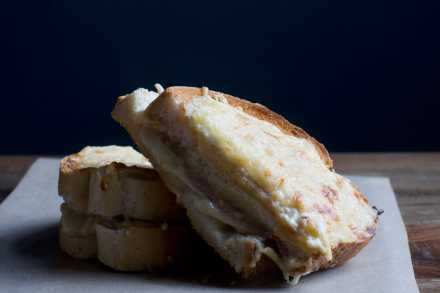
When I was little, toasties were my father’s domain. Many of his fillings cruelly haven’t made it on to mainstream toastie menus (tinned chicken curry was my mother’s favourite) – but his corned beef and onion one has stood the test of time in our household, and toasties remain a mainstay in my grown-up home. The croque monsieur is the more cosmopolitan, French version of the toastie. A croque monsieur is ham and cheese between two slices of toasted bread, often with a bechamel sauce inside and on top, bubbling and golden. There are lots of variations: the most famous is the croque madame, in which a fried (or sometimes poached) egg is placed on top of the croque monsieur.

The haunting of Rishi Sunak

39 min listen

This week: the haunting of Rishi Sunak. In her cover piece for The Spectator Katy Balls says that Rishi Sunak cannot escape the ghosts of prime ministers past. She is joined by former Chief Secretary to the Treasury and New Statesman contributor David Gauke to discuss pesky former PMs (01:05).  Also this week: In the magazine Julius Strauss writes about Black Tulip, a volunteer-led humanitarian organisation who recover the war dead from the front line in Ukraine. He is joined by Mark MacKinnnon, senior international correspondent at the Globe and Mail in Canada, to talk about the time they spent with the Black Tulip (16:45).

The rise of the nursery spy app

Do you know what you were doing at 10.03 a.m. last Tuesday? Or what you had for breakfast three weeks ago? I don’t. You probably don’t either – unless you’re a spy, or you’re putting together an alibi for a murder. But like millions of parents, I know these things about my son. Not because I was there, but because I wasn’t. NurseryCam is supposed to be about peace of mind for the parent. It feels like a slippery slope My one-year-old goes to a local nursery three days a week. On those days, I know his every movement, bowel or otherwise. This is thanks to an app that parents are asked to download when their child enrols.

A French revelation: how to make Breton galette complête

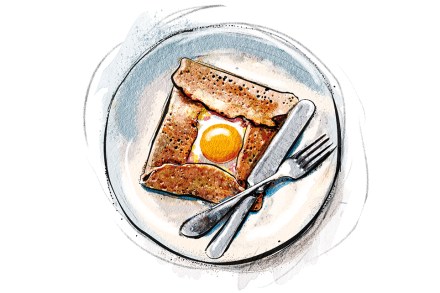
When we were little we used to go on holiday to the same place in Brittany, a picturesque, quiet coastal town. There wasn’t a lot to do there for children, but I always looked forward to the holidays because of the food. It was the first time I was exposed to French food, and it was a revelation. The finished galette, unlike paler, softer crèpes, is dark gold, crisp and lacy I was an adventurous eater, taking after my father. Anything he ordered, I would try. Even as a little girl, I remember a sense of pride in my fearless eating: huge pots of mussels, big shell-on prawns, strong  cheeses – I was game for anything. But there was one exception. Brittany has its own crèpe, the savoury  galette, and I could not get on with it.

Cosmo Landesman has no time for feel-good-grief memoirs

‘This is a book about how you don’t get over it,’ You Are Not Alone begins. If you’re new to bereavement, looking for a way through the death of a loved one, perhaps this doesn’t scream of optimism. But Cariad Lloyd’s warmth, generosity and gentle pragmatism makes her book one of the most reassuring I have read. She is a member of ‘the club’ – the Dead Dad Club. Her father died 24 years ago of pancreatic cancer when she was 15. She is also the host of the award-winning podcast Griefcast, through which she has interviewed many bereaved individuals – comedians, writers, actors, chefs, artists – who have suffered the loss of children, parents, grandparents, siblings, friends and pets.

With Harriet Hastings

20 min listen

Harriet Hastings is the founder of hand-iced biscuit delivery company Biscuiteers which delivers over 2 million biscuits worldwide every year.  On the podcast she speaks to Lara and Liv about growing up as a fussy eater, the trials and tribulations of starting her own business, and her desert island meal.

A slice of comfort: how to make a proper apple pie

Apple pies are synonymous with domesticity: both here and across the pond, the image of an apple pie, fresh from the oven, possibly cooling on a windowsill, speaks of family, and of homeliness. While they’re not difficult to make, they take time and care, and the making of one is an act of love. Perhaps that’s why they are such a simple and clear shorthand for comfort.

Sussex pond pudding: the perfect January pick-me-up

I always feel pulled toward citrus at the start of the year. Initially it was subconscious: I’d just find myself in the kitchen making a lemon drizzle cake. But now I actively plan my citrusy January. As Christmas recedes, I make notes of recipes that I’m craving, and almost all of them call for a whack of lemon or grapefruit or orange. It doesn’t take much analysis, does it? It’s a bit like having a dream about doing an exam unprepared – what could it possibly mean?! The literal brightness of the fruit and the figurative brightness of the flavour – its zinginess – bring you back to life; it is the perfect ingredient for fresh starts, for leaves turned over. This is so much more than a lemony sauced pud.

With Luke Farrell

28 min listen

Luke Farrell is a restauranteur and founder of two of London's fieriest new openings, Plaza Khao Gaeng and Speedboat Bar. He has spent the last few years dividing his time between Thailand and his nursery in Dorset, where he grows a 'living library' of south-east Asian herbs and spices.  On the podcast they discuss memories of Chinese cuisine, the thrill of Thai speedboat racing and why, despite his adventurous pallet, he can no longer eat raw oysters.

Pasta bake: a recipe to cure the January blues

I love pasta bake more than is reasonable: I would struggle to name a dish that brings the same level of comfort even from first thought. From the moment I consider making one, I am already reassured: confident in the knowledge that it is a dish which will deliver everything that is required for culinary succour. This isn’t your average student pasta bake: slow-cooked ragu, a topping cooked at a hot temperature until blackened in places and blistering; a time investment that means delayed gratification, but for the most part can be left to its own devices, to simmer, to bubble, to bake. Saucy and deeply savoury, hot and packed with carbs: it can’t fail to please.

When street hawkers were a vital part of London life

If you read only the title of Charlie Taverner’s book Street Food you could be forgiven for assuming it was an exploration of the stalls that line the trendier streets of our cities, offering bibimbap and bao, jerk chicken and jian bing. But the author’s focus predates brightly coloured gazebo hoardings and polystyrene packaging and looks instead at the working lives of the itinerant traders who populated London before 1900, touting everything from oysters to milk, and what their work meant for a changing capital city. By placing these vendors at the centre of the story rather than as faintly comic support acts, Tavener provides something that goes beyond individual characters.

In defence of duck à l’orange

Duck à l’orange is so deliciously retro, it’s almost a cliché of kitsch. It seems hard to believe that there was a time when it was genuinely regarded as elegant, or subtle-flavoured, let alone exciting; that it wasn’t always a byword for naff. But as its name suggests, duck à l’orange had chic origins. And perhaps (contrary to its name) Italian ones. The French may have made it one of their defining dishes, but it’s often suggested that it may have Italian roots: brought to the French court by Catherine de Medici when she married the Duke of Orléans, the son of the King of France, in 1533.

With Amber Guinness

22 min listen

Amber Guinness is a cook, author, journalist and co-founder of The Arniano Painting School. Her first book, A House Party in Tuscany, is out now.  On the podcast she discusses growing up in Tuscany, how to host a successful Tuscan dinner party and the best places to eat in Florence.

Smoked salmon blinis: bitesize luxury for New Year’s Eve

I tend to hunker down on New Year’s Eve, eschewing parties for my own home. Even when I was young, the prospect of sleeping on someone else’s floor or braving the night bus home in the early hours of the morning didn’t really appeal. But sometimes I worry that that can lead to the night being a damp squib. The way to fix this is a little bit of luxury. Perfect bitesize tastes of luxury. And for me, that means blinis topped with the fanciest, most delicious morsels I can lay my hands on. Drink them with something cold and sparkly, and you won’t regret staying in for one moment. If you are more sociable than I am, these also make the most impressive party snacks – and ones that suggest far more preparation and skill than they actually require.

Owen Matthews, Christopher Howse and Olivia Potts

23 min listen

On this episode, Owen Matthews examines the original sin of Russia’s exiled media (00:44), Christopher Howse says Handel’s Messiah is as much a Christmas tradition as a pantomime (09:08), and Olivia Potts gives her recipe for boiled fruit cake (18:01). Get the full recipe to Olivia’s boiled fruit cake here: https://spectator.

A last-minute alternative to Christmas cake: boiled fruit cake

This time last year, I was disgustingly well organised. Awaiting the arrival of my first baby, with a late December due date, I’d ensured everything was squirrelled or squared away. I’d bought all my presents by October, wrapped them by December; I’d made my Christmas cakes and bought my Terry’s Chocolate Orange. For the first time in my life, I sent Christmas cards to everyone in my address book. I’d even made and frozen the gravy weeks in advance. It was my way of nesting – the baby could arrive when it liked. I was prepared. It can feel that every homemade edible component of Christmas demands commitment: puddings, cakes, mincemeat, it should all be made wildly in advance, and given time to mature. Well, that level of forward-planning has gone out of the window.

You don’t need a fondue set to make fondue

‘This dish is very you,’ my husband says, as I serve up 650g of melted, boozy cheese to the two of us for a weekday lunch, alongside a teetering pile of bread cubes. He is, I’m afraid, right: it really is my favourite kind of eating. There’s nothing better than a communal pot in the centre of the table, with everyone leaning over each other. Fondue is fun, as well as being pleasingly old-fashioned, its gooey and silky texture demanding dunking and swooping. And I’d probably treat anyone who didn’t leap at the chance to eat a lot of stringy cheese and bread with mild suspicion. Until now, my life has been mostly fondue-less, thanks to not owning a fondue set. The caquelon, or cauldron, has a low flame underneath it, which keeps the cheese hot while diners eat it.

With John-Paul Flintoff

25 min listen

John-Paul Flintoff is a journalist, writer and artist who has written a number of books including his most recent, Psalms for the City: Original poetry inspired by the places we call home.  On the podcast they discuss John-Paul's early aversion to peas, memories of his mother's experimental cooking and how food aided his recovery from a mental breakdown.

Bread pudding is the perfect bridge from autumn to winter

I am incapable of throwing anything away in the kitchen. In my fridge, there must be at least half a dozen pots of bits and bobs, dishes of leftovers and scraps. In my freezer, a bag of parmesan rinds has filled slowly, each intended to be chucked into a pot of soup or stew to bring savoury depth, and there’s even an optimistic box of pea pods that I’m convinced I will one day turn into a stock to make an authentic risi e bisi. All await a future transformation, some kitchen wizardry that will rescue something that is a little past its best. Although I confess I sometimes find myself buying a bunch of ingredients just to use up something I’ve squirrelled away, or plain forgotten about and left a touch too long.