Michael Tanner

Opera: Maria Miller is a candidate for inclusion in a Dictionary of Political Philistinism; The Answer to Everything; Giulio Cesare

From our UK edition

Maria Miller, the new Minister for Culture,  Media and Sport, indicated in her first speech on culture that when she hears that word she reaches for her calculator. ‘When times are tough and money is tight, our focus must be on culture’s economic impact’ is already a candidate for inclusion in a Dictionary of Political Philistinism, though it is the kind of thing we have come to expect from a politician of any party in the past 20 years or so, when they have gone out of their way to distance themselves from any ‘elitist’ activity.

Opera: The Turn of the Screw – review; remembering Sir Colin Davis

From our UK edition

The conducting career of Sir Colin Davis, who died a fortnight ago, more than that of most interpretative artists, had the aspect of a personal pilgrimage. Though I had no personal acquaintance with him, and don’t know much more about his life than can be gleaned from Wikipedia, I did attend his operatic performances from 1956 until 2011. In fact I realised recently, to my surprise, that he conducted far more of the operas I have been to than any other person. I first heard him and heard of him in 1956, when I attended a concert performance of Le Nozze di Figaro which he gave in Cambridge’s Guildhall with the Chelsea Opera Group, of which he was for about a decade the main conductor.

Opera: Der fliegende Holländer and Sunken Garden

From our UK edition

Scottish Opera’s new production of The Flying Dutchman, performed in German but advertised in English, is almost a triumph, and very well worth going to see. I reflected, as I travelled by train back from Glasgow to Cambridge, changing only at Edinburgh, York, Peterborough and Ely, that this raw and in some ways crude opera, Wagner’s first to remain in the canon, benefits from the restrictions imposed by a budget as tight as Scottish Opera’s, though I can imagine the participants not entirely agreeing with me. The production, by Harry Fehr with designs by Tom Scutt, is simple and clear. The opera is relocated to Scotland, where Wagner originally set it, as the home of Gothick, and Daland becomes Donald, Erik becomes George; and the time is mid-20th century.

Richard Wagner at 200

From our UK edition

‘The overpowering accents of the music that accompanies Siegfried’s funeral cortège no longer tell of the woodland boy who set out to learn the meaning of fear; they speak to our emotions of what is really passing behind the lowering veils of mist: it is the sun-hero himself who lies upon the bier, slain by the pallid forces of darkness — and there are hints in the text to support what we feel in the music: “A wild boar’s fury”, it says, and: “Behold the cursed boar,” says Gunther, pointing to Hagen, “who slew this noble flesh.” The words take us back at a stroke to the very earliest picture-dreams of mankind.

Kafka Fragments at the Linbury Studio; Nabucco at the Royal Opera House

From our UK edition

Yes, well...aphorisms are never easy to deal with, they are a naturally intimidating form of utterance. If you admit that you don’t understand them, you may well be thought thick. If you reject a request for an explanation of one, on the grounds that what it says can’t be put any other way, you may well get away with it. Many aphorisms are intended to shut down a line of thought, La Rochefoucauld’s for instance, while the best of Nietzsche’s say, in his words, ‘what other people would take a book to say, and would still leave unsaid’. Setting them to music sounds a bright idea for certain composers, but mainly aphorisms advertise their self-sufficiency and ward off any kind of expansion or addition.

Agony and ecstasy | 28 March 2013

From our UK edition

For its penultimate HD cinema relay this season the New York Met enterprisingly put on a revival of its production of Zandonai’s Francesca da Rimini, with enormous solid sets necessitating three intermissions, and clothes that are a cunning blend of 13th century and art nouveau, and quite ravishing.  The audience applauded the Act I set; it is that kind of show. The text is by D’Annunzio, the arch-decadent poet and warrior, and airs some of his gamey obsessions, doomed love and physical grotesqueness among them.  Zandonai’s idiom is perfectly suited to this medieval farrago, and if only he could have thought of a memorable melody, a single one, Francesca would have less of a fringe place in the repertoire than it does.

Reason over passion

From our UK edition

This year’s London Handel Festival got under way, as usual, with an opera production at the Royal College of Music’s Britten Theatre. Imeneo, a late opera of Handel, is unusual in several respects. While it is concerned with amorous intrigue and frustration, there is no dynastic or other political dimension, a welcome change, and one that results in the work’s lasting only two hours. There seems, too, to be an element of self-parody: in Act III the central female character Rosmene, with whom both the chief male characters, Tirinto and Imeneo, are in love, manages to avoid responsibility for her choice between them by feigning madness, singing randomly and swooning.

Written on Skin review: sex, murder and cannibalism at the Royal Opera House

From our UK edition

George Benjamin’s Written on Skin is a work of compelling fascination, all the more so in that it is elusive and possibly wilfully puzzling. I want to see it again as soon as possible, and of how many new operas can that be said? Actually, of three that have been premièred at the Royal Opera in the past decade — Adès’s The Tempest, Birtwistle’s The Minotaur and now this, though it has already been performed in Europe. Three apparent masterpieces of opera from England in a decade is impressive, indeed unprecedented. And they are all quite different, with Skin being the most opaque, though the experience of sitting through it, just over an hour and a half, mercifully without an interval, may be the most intense.

Mozart magic

From our UK edition

It was some time since I’d been to a performance of Mozart’s greatest though not his deepest opera, Le Nozze di Figaro, one of the works of which I can’t imagine ever tiring. And it is, despite some heavy vocal demands, an opera which normally suits students at the music colleges well. There weren’t any obvious grave shortcomings in the first night’s performance of it at the Guildhall School of Music & Drama, but it annoyingly failed to achieve lift-off. Nerves may well have a lot to do with that: the playing of the Overture had enough problems of intonation among the winds, which later played beautifully, to suggest that.

Le Nozze di Figaro

From our UK edition

I went to two of the most familiar operas in the repertoire this week, one in HD from the New York Met, the other at the Royal Opera. Both were given in decent if not, with some exceptions, outstanding performances. The experiences led me to think again about the differences between seeing an opera onstage in a theatre and seeing one ‘live’ in the cinema. Our intermission hostess, Renée Fleming, repeated the usual formula about how there is no substitute for actually being present in the theatre where the opera is taking place, but I wonder what she would say if challenged on that point.

Spurned women

From our UK edition

I saw three operas this week, all centrally concerned with spurned women. That’s not surprising, given the general subject matter of the art form, but it sometimes makes me wonder why we prefer to see, and more importantly to hear, love-tormented women more than men. The only major exception to spring to mind is Wagner’s Ring, which gets under way with a dwarf teased and rejected by three mermaids. But even Alberich spends much more time elaborating on his plans for world domination than on lamenting lost love; the Ring is quite a big exception, but one still wonders why it is female suffering from despised love rather than the male version of the same complaint that excites operatic composers and their listeners so much.

Double vision | 14 February 2013

From our UK edition

This week has featured new productions at the Royal Opera and English National Opera of staples of the repertoire, both subjected to drastic rethinking. Tchaikovsky’s Eugene Onegin is the first production at the Royal Opera of the new Director of Opera, Kasper Holten, and on this showing I very much hope it will be the last. It has been reviewed coolly on the whole, but I haven’t read anyone being sufficiently abusive — adequately, that is, to the experience of sitting through a flawed but moving masterpiece that is systematically, though I’m sure involuntarily, slaughtered from the opening moments to the wretched close. This is an opera that Holten loves, and he has made clear that he learnt Russian to get to the heart of it.

Blank canvas | 7 February 2013

From our UK edition

I approach any production of Mozart’s last opera, La clemenza di Tito, in a state of acute trepidation: it’s not pleasant sitting bored through nearly three hours of one of your favourite two or three composers, one whom you regard as perhaps the most astonishing artist who ever lived. But that is how La clemenza di Tito has nearly always affected me — first, before it was revived in theatres, on a dodgy old Nixa recording, then, fairly often since, in various opera houses, its having now become a repertoire piece, something which was inconceivable only 40 years ago. Still, despite its canonisation, its defenders — its admirers still, significantly, regard themselves in that way — tend to strike one or another defiant or uneasy note.

Addicted to myth

From our UK edition

The revival of Harrison Birtwistle’s opera The Minotaur is the most significant artistic event at the Royal Opera since its première, almost five years ago. Unlike Thomas Adès’s more immediately accessible The Tempest, The Minotaur has not gone on to have an international career, though it unquestionably deserves one. With its ideal cast and direction, this production should tour the world’s major opera houses, demonstrating that at irregular but not too large intervals a new masterwork can still be forthcoming in this form, whose decline and decease has often been announced.

Orchestral tour de force

From our UK edition

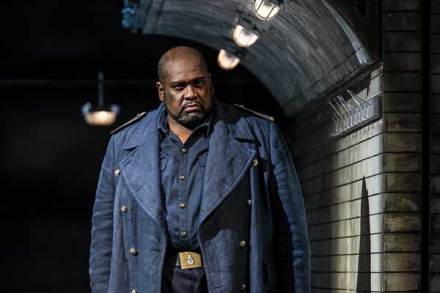
There is only one test that a performance of Verdi’s Otello has to pass: do you come out of the theatre drained, desperate at the suffering that human beings who love one another can nonetheless inflict, so that they torture or even kill the object of their love? Shakespeare’s play is about other things besides, indeed that may not be the major test of a production of it.

Acting up | 17 January 2013

From our UK edition

There was a time when the major objection to operatic performances, by those who were wondering whether or not to give them a try, was the level of acting in them. That was in the days before ‘elitism’ and other excuses had been invented. I haven’t heard much about that lately, though of course there are complaints about specific singers and performances. But 30 to 40 years ago people who were used to going to plays would regularly contrast the level of acting in them with the alleged level in opera. So I’m led to wonder whether there’s a general feeling that things have improved. My own feeling is that they have got more complicated, with many more factors to consider.

Trojan triumph

From our UK edition

Opera has naturally made no start at all in 2013 in the UK, the month surrounding Christmas being a culture-free zone. By contrast the New York Met has entered the new year with a thrilling production, revived from 2003, of Berlioz’s Les Troyens, a resounding success in all major respects except one. Lovers of this great masterpiece usually have a chance to see it about once a decade, but only a few months ago it was staged by the Royal Opera in a production that had a muted response.  Les Troyens is one of those works which either shakes you to the core or leaves you mildly, or even very bored.

Dutch treat

From our UK edition

The Flying Dutchman, Wagner’s first masterpiece, has had a rough passage in the UK over the past few decades. I recall a production at the Royal Opera in the mid-1980s which revealed to me for the first time the possibility that an insensitive director can completely destroy a great work, something which is now commonplace. In between there have been further productions, in London and in Wales, which have done nothing to penetrate the work’s grandeur and freshness, so that the idea of a concert performance was even more welcome than usual. Zurich Opera came over for one night to the Royal Festival Hall and can have left no one in doubt as to the stature of Holländer or the quality of the performers, with one minor exception.

Talk of the devil

From our UK edition

In one of his finest essays, Gore Vidal recalls that when he worked as a scriptwriter for MGM the Wise Hack always used to advise his toffee-nosed team that ‘shit has its own integrity’. If crap is what you’re producing, make sure there are no signs in it that that’s what you think it is. Meyerbeer’s Robert le diable fails that test, I think, as do the rest of his operas. And at the Royal Opera, where a new production by Laurent Pelly, shared with Geneva, is on display, there are plenty of indications that no one involved takes it seriously either.

Jumping the gun

From our UK edition

2012 has been an undistinguished year in opera, at any rate in the UK. A combination of cutbacks and the promise of stops being pulled out next year for the bicentenaries of Verdi’s and Wagner’s births and the centenary of Britten’s has led to the big companies counting on our anticipation. Except that, in the case of Wagner, though oddly not of Verdi, the gun has been jumped. We have already had the Royal Opera’s Ring, four cycles of it in just over a month, so that there will be no staged Ring in London next year, only a concert version. It will be left to Longborough, for those who have the money, the time and the transport, to see it on stage, and judging from the individual parts that have been mounted in the past four years, the results should be tremendous.