Michael Tanner

I’m sick of productions like the Met’s Tristan und Isolde

From our UK edition

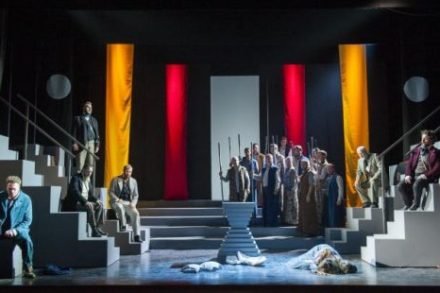
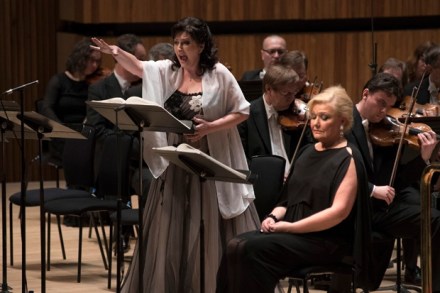
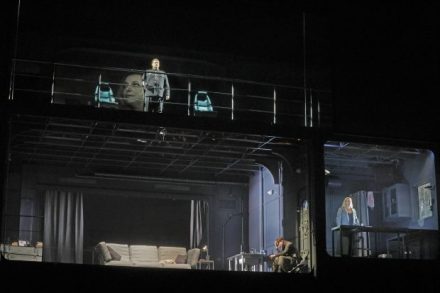
Tristan und Isolde Met Opera Live I am sick to death of productions of Tristan und Isolde which leave me bewildered, alienated, distracted from the work and its significance, unable to concentrate on the music. I haven't seen a Tristan which didn't do all these things for many years, and had vowed never to go to another, until the Met advertised its new production, with a starry cast and with Simon Rattle, a conductor who at his best, as he has been recently, is quite wonderful, even revelatory. My hopes were soon dashed.
Hole in the heart | 6 October 2016

From our UK edition

Richard Jones’s new production of Don Giovanni at ENO bears some passing resemblances to the opera as envisaged by its librettist and composer. Mainly, however, it goes its own way, refusing most of the time, especially at key moments, to listen to the music Mozart wrote, with consequences that Jones no doubt regards as ‘creative infidelity’. When we enter the auditorium we see a contemporary streetlight and a phone booth, straight out of Jones’s production of Siegfried at the Royal Opera 20 years ago. The curtain rises on a huge ‘Wanted’ poster of Christopher Purves, followed by a depressing series of bleak rooms, in one of which the Commendatore is bedding a prostitute and wearing white boxers, signifiers of nudity at ENO.

Super Norma

From our UK edition

The Royal Opera has opened the season with a triumph, and in one of the most difficult of operas, Bellini’s Norma. Not only is the work itself extraordinarily demanding on its three leading singers, but it is the one opera which is now so indelibly linked to one singer that all later performances are defined by whether they are in the same mould or whether they are resolutely different. One can’t envy listeners who have never heard Callas, in one or another of her many recordings of Norma, because it is so overwhelming an experience, but it would make life less disappointing than it already tends to be. I preferred not to go to Bartoli’s recent performance in Edinburgh, having heard her interpretation on CD.

This charmless man

From our UK edition

I was looking forward to going to Malcolm Williamson’s opera English Eccentrics set to a text by Edith Sitwell at the Peacock Theatre this week partly because my only experience of meeting the composer was so bizarre, not to say traumatic, that I haven’t been able to face listening to any of his copious output since. Not that there have been many opportunities, since he seems to be neglected in concert, on the radio and to a large degree on CD.

What’s love got to do with it?

From our UK edition

Tchaikovsky’s The Queen of Spades is probably his greatest opera, certainly the one in which his characteristic strengths are on display. Pondering on them inevitably leads one to think about what the operas lack, too, and it turns out be quite a lot. Unlike the finest opera composers, of whom there are regrettably few, he can’t create complete characters: what he is interested in is characteristics, especially — or perhaps only — obsessions, even if the obsession, as with Eugene Onegin, is with not being obsessed with anything, until close to the end.

One of Grimeborn’s most striking rediscoveries: Mozart & Salieri at the Arcola Theatre reviewed

From our UK edition

Mozart & Salieri Grimeborn, Arcola Theatre, until 13 August I have been a fairly conscientious reviewer of Dalston's Grimeborn festival for the last eight years. The name is less suitable now than it was. The Arcola Theatre, where the operas are performed, is now only a stone's throw from Dalston Square, with its chic apartment blocks and bars and the resplendent C.L.R. James library, and the whole neighbourhood is upwardly mobile. The Arcola itself remains a ramshackle place, and you can expect the usual late start, inadequate provision of programmes, and general air of administrative amateurism. This year's season began on 23 July, and runs till 8 September.

Dorset’s winning formula

From our UK edition

Dorset Opera seems to receive far less coverage than the rest of the country-house summer shows, although it is in most respects well up to the standard of any of them except Glyndebourne, which is in a category, social and artistic, of its own. The Dorset productions take place in the Coade Theatre of Bryanston School, and are the result of a brief but what must be an incredibly intense period of preparation, with some big names in the major roles, and the smaller parts and chorus taken by a large collection of young singers who are strenuously trained for the week-long rehearsals. I like going on the last day, when one opera is performed at 2 p.m. and another at 7 p.m.

Will I ever see a production of Die Fledermaus that does this masterpiece justice?

From our UK edition

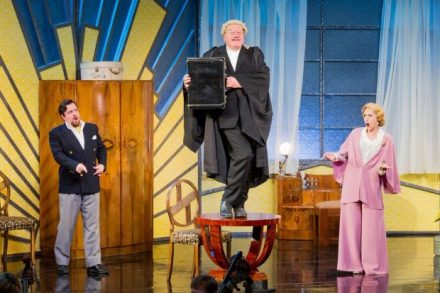
Die Fledermaus Opera Holland Park, until 5 August Johann Strauss's opera Die Fledermaus is a masterpiece that I have had a lifelong passion for, a passion which productions, whether in England or abroad, are obstinately determined should remain unrequited. I hadn't seen it, until Opera Holland Park's new production, since the 2003 production at Glyndebourne, which almost killed my passion, with its endless laborious prosiness. All the great operas and operettas with spoken dialogue have the same problem, how to keep the interest going when everyone is waiting for the next musical item, and one would of course feel hard done by if the performance simply jumped from one to the next, as is shown in those ill-advised recordings where the spoken dialogue is omitted.

Longborough’s Tannhäuser is a major relief after ENO’s abysmal Tristan

From our UK edition

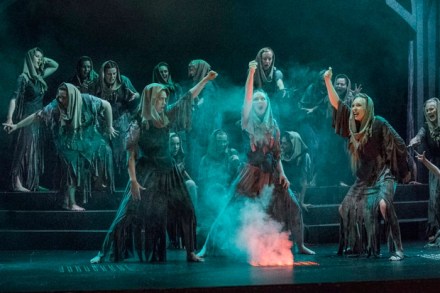
Tannhäuser Longborough Festival Opera, until 18 June The Longborough phenomenon continues, indeed if anything gets more remarkable each year. This year they are tackling Wagner's least popular opera, Tannhäuser, and making it actually thrilling, at least when the title role is taken by Neal Cooper. There really is nothing to be done with parts of Tannhäuser except to get a move on, and that is what the great Wagnerian Anthony Negus does. This is one of the shortest performances I have seen or heard: since Wagner never got the opera into the shape he wanted, there are many possibilities, from his alterations over the years, for adding or subtracting a sizeable chunk.

Wardrobe malfunction

From our UK edition

It is at the Coliseum that I have seen the most wonderful Tristan and Isoldes of my life, both of them under Reginald Goodall, in 1981 and, even more inspired, in 1985. Neither was particularly well produced, but nothing stood in the way of the musical realisation, as complete as I can ever imagine its being. After last year’s quite glorious Mastersingers, I had the highest hopes of Edward Gardner’s conducting of this new production, but they were dashed — in the case of the music, not drastically; but the idiocy of the costumes and the production is so gross that no performance could survive it. The settings are fashionably by Anish Kapoor, but though they aren’t repulsive they do nothing to help our understanding of the drama.

The supremes

From our UK edition

When I interviewed Richard Farnes in Leeds six years ago about Opera North’s project of performing the complete Ring, he struck me as the most modest conductor I had met or could imagine, with the possible exception of Reginald Goodall, who actually at a deep level wasn’t modest at all. Everything I had heard Farnes conduct had been on the highest level, but none of it had been Wagner. I wasn’t sceptical of his ability to do a complete Ring cycle, just bemused in a general way about the boundless ambition of the work and the unassertiveness of the man who would lead it. Year by year my highest hopes have been fulfilled, as each of the four parts of the Ring received the best performance that I have heard live for many years, certainly during the present century.

Myth-making

From our UK edition

For years I have been telling people that they should listen to, in the absence of staged performances, Enescu’s opera Oedipe, preferably in the marvellous EMI recording from 1990, still available. It only occurred to me when I was preparing to go to the Royal Opera’s new production that I haven’t actually listened to a recording for many years — it seems to belong with its contemporary Busoni’s Doktor Faust as something more admired in the breach than the observance. My feelings now, after seeing the production by La Fura dels Baus, are mixed. There is a lot of lovely music here, and some strong drama. I’m not sure that the music, mostly, supports the drama or indeed that it, the music, has any specific qualities.

Verdi

From our UK edition

Verdi has a peculiar if not unique place in the pantheon of great composers. If you love classical music at all, and certainly if you love opera, then it is almost mandatory to love him. The great and good of the musical world, the kind of people who sit on the boards of opera houses and other cultural institutions, go out of their way to advertise their adoration of Verdi, usually at the expense of the other considerable operatic composer who was born a few months before him in 1813, Wagner. In fact, Verdi’s status and stature are often established by comparing the two.

Was Opera Rara justified in reviving Bellini’s first opera? Oh yes

From our UK edition

Adelson e Salvini Barbican First operas by composers who later became great or anyway expert in writing them tend to be at best of biographical interest, to be revived mainly for people who are interested to hear premonitions of the achievements that lay ahead. Up to a point that is the case with Bellini's Adelson e Salvini, which he wrote in his early twenties, and which at the time was a big local success, being performed every Sunday for a year.

Bell canto

From our UK edition

Cursed, or perhaps blessed, with almost no visual memory at all, I had almost completely forgotten what the Royal Opera’s current Tannhäuser, directed by Tim Albery and with set designs by Michael Levine, looks like. Or perhaps it was the natural tendency to repress the memory of unpleasant experiences. Wanting to enjoy the Overture, I closed my eyes until the moment the Venusberg ballet that Wagner composed for the doomed Paris version in 1861 began. However many hundreds of times I hear that Overture, with its wind chorale and weary strings, I still hang on every bar. It was instantly clear that Hartmut Haenchen, the conductor of this first revival, was going to be lighter and fleeter than Semyon Bychkov had been first time round. Mainly, Haenchen’s way is preferable.

Sound and vision | 28 April 2016

From our UK edition

Janacek’s Jenufa, his first great opera, had a one-night stand at the Royal Festival Hall last Monday, courtesy of the wonderful Czech Philharmonic Orchestra conducted by Jiri Belohlavek, the Czech Philharmonic Choir Brno, a large body that had all of five minutes’ singing, and a mainly excellent cast, with Karita Mattila making her transition from the title role, which she has so often performed to powerful effect, to that of the Kostelnicka, the terrifying figure of rectitude who drowns her daughter-in-law’s illegitimate baby rather than bring disgrace on the family.

There will be blood | 14 April 2016

From our UK edition

Lucia di Lammermoor is one of the two or three Donizetti operas that have never fallen out of the repertoire, and the more of his operas it’s possible to see, or at least to hear on CD, the less explicable that becomes. The late and rightly venerated Rodney Milnes called Lucia ‘a blazing masterpiece’, but that does seem to be overdoing it, and in fact several of his other works are more worthy of that accolade. Throughout much of its history Lucia was prized primarily for its glorious sextet, and for the maddest of all mad scenes, added to by generations of sopranos until it became the ultimate coloratura showpiece.

Original sin | 17 March 2016

From our UK edition

The Royal Opera has bitten the bullet so far as Musorgsky’s Boris Godunov goes, and opted to stage the original 1869 version, with no modifications or additions from his revised 1874 edition, which used to be called ‘definitive’ but which seems to be under a cloud nowadays. Rimsky-Korsakov’s version has been pushed right to the back of the doghouse, so that it might soon be revived for its historical interest. Before I launch into my praise of the new production, which is an unqualified triumph, I would like to register some reservations about the work itself, in any of its versions. It’s routinely said that the hero of the opera is not Boris but the Russian people, tormented and downtrodden as they have always been and still are.

Manon Lescaut is a shambolic opera – but the Met’s production is mainly excellent

From our UK edition

Manon Lescaut Met Opera Live Puccini's Manon Lescaut is his first opera worth seeing and hearing, and marks an astonishing progress from what preceded it. But Puccini had yet to learn how to bully his librettists into producing the well-constructed dramas of his later operas, and for all its delights Manon Lescaut is a shambles. Richard Eyre has updated it to France in 1941, to stress the moral ambiguity of everything there and then, with occupying forces, indecisive leading characters, a general unease. That works reasonably well, though the real problem is that Puccini is uncertain about the motives of his central characters, especially Manon herself, who veers between helpless anxiety and ruthless scheming.

…Long live ENO!

From our UK edition

The three most moving, transporting death scenes in 19th-century opera all involve the respective heroines mounting a funeral pyre — partly, no doubt, a matter of operatic convention and fashion, but also recalling opera to its duty as a rite of purification. Berlioz’s Didon in Les Troyens, like her creator, is so relentless in her grasp of the truth that she fails to achieve anything but a vision of Carthage overcome by Rome, and ends in despair and execration. Brünnhilde in Götterdämmerung rides into Siegfried’s pyre in a state of ecstasy, imparted to the audience with all Wagner’s unlimited capacity for exaltation.