Michael Tanner

Painful triangle

From our UK edition

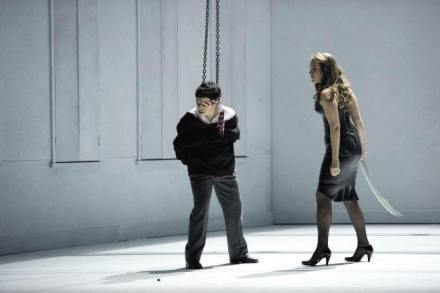
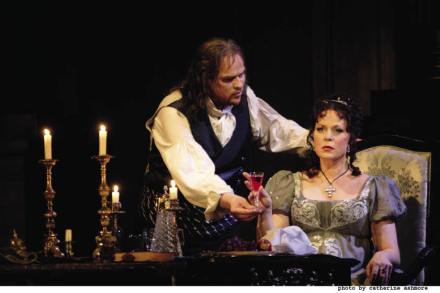
The Royal Opera’s season isn’t awash with new productions, in fact until Christmas only has two thirds of one, but that was what it got under way with: all three short operas of Puccini’s Il Trittico, with Gianni Schicchi revived, and Il Tabarro and Suor Angelica fresh; they are all produced, and mainly very well, by Richard Jones, but each with a different designer. For the gritty naturalism of Il Tabarro (The Cloak), Ultz provides a range of blacks and greys, hardly redolent of the Paris where the opera is set, but adequately lowering to the spirits. Tabarro begins with a swaying Debussy-esque figure, conveying the movement of the river and barges, but, also, cleverly in this production, the eternal procession of weighed-down stevedores.
North star

From our UK edition

Das Rheingold used to have the reputation of being a difficult opera, in that it not only lasts for two and a half hours without a break, but also involves a considerable amount of discussion, immense quantities of plot, and lacks stretches of lyricism, with a few obvious exceptions. It is one of the operas that have shot up in popularity and esteem thanks to surtitles. Now that it is possible to follow every movement of the drama, audiences find it to be an enthralling, extremely anti-romantic study of some fundamental human urges, and a great deal more complex than the usual ‘love versus power’ formula that it used to be characterised by.

But is it any good?

From our UK edition

Writing to his friend and fellow-author William Dean Howells in 1907 about the Prefaces to the New York edition of his novels, Henry James said, ‘They are, in general, a sort of plea for Criticism, for Discrimination, for Appreciation on other than infantile lines — as against the so almost universal Anglo-Saxon absence of these things; which tends so, in our general trade, it seems to me, to break the heart.’ Happily for him, he wasn’t at all interested in music, or specifically in opera, otherwise his heart might have broken a long time before it did.

Short and sweet | 3 September 2011

From our UK edition

During August the only opera-going possibility used to be a festival, of a fairly grand kind, but in recent years the small, ‘alternative’ opera companies that are proliferating have sensibly taken either to continuing throughout the summer, as the big opera houses don’t, or to having their own festivals. During August the only opera-going possibility used to be a festival, of a fairly grand kind, but in recent years the small, ‘alternative’ opera companies that are proliferating have sensibly taken either to continuing throughout the summer, as the big opera houses don’t, or to having their own festivals.

Inspired by Mahler

From our UK edition

The Bamberg Symphony Orchestra will be giving the concluding two concerts of this year’s Edinburgh International Festival under its chief conductor Jonathan Nott. The Bamberg Symphony Orchestra will be giving the concluding two concerts of this year’s Edinburgh International Festival under its chief conductor Jonathan Nott. The programmes aren’t what you might expect from one of Germany’s leading orchestras, but then very little is typical about the Bamberg Symphony Orchestra. It will be performing Messiaen, Bartók and Ravel.

Love in the Alps

From our UK edition

Opera Holland Park has as its speciality little-known Italian operas from the last decade of the 19th century and the first decade of the 20th. It’s a period that seems to have been swarming with composers who were eager, somehow, to combine the ardours of Verdi with the larger symphonic constructions that were being created across the Alps. OHP has turned up some worthwhile specimens, of which last year’s Francesca da Rimini by Zandonai was one of the classiest. This year is La Wally by Catalani, of which everyone knew, or still does, the hit number ‘ebben?...N’andro lontana’ thanks to the movie Diva. Alas, that turns out not only to be the best thing in the score, but also to have been composed, as a song, 15 years earlier.

Dorset delight

From our UK edition

Dorset Opera dates back to 1974, but I have only just been for the first time. The quality of what I saw and heard was such that I’m annoyed with myself, ashamed even, for not having been before. The annual effort begins each year as soon as the Bryanston School holidays start; everyone involved in the performances lives in the school accommodation: that includes the star singers, the conductors, directors, the chorus, largely consisting of young people from around the country, and the orchestra, freelance professionals; and no doubt many more. They assemble on a Saturday and the – this year – five performances take place during the second half of the second week.

A hole-hearted Siegfried

From our UK edition

Everything is there – except the central character English Wagnerians really can’t complain about what they’ve been offered this year, so long as they can get around the country, and particularly around the countryside. In London we have only had ENO’S Parsifal, but that was musically magnificent. Many of us found Glyndebourne’s Meistersinger tremendous both musically and as a production, and in the north there have been acclaimed performances, with more to come, of Das Rheingold in concert, a treat I have still in store; and a memorable Walküre, also in concert, in Manchester three weeks ago, which introduced a potentially great Wotan, Egils Silins.

Spellbound | 30 July 2011

From our UK edition

Die Walküre (Bridgewater Hall, Manchester) What is the best way to introduce someone to Wagner, granted that, for assorted reasons, his art is thought to be exceptionally forbidding? I have always found that it’s enough to provide a few dates, to place him in respect of his forebears and contemporaries; to say a few things about his artistic aims — which involves saying a little about how he thought art, opera in particular, relates to society — give a brief outline of the plot of whichever opera is to be performed, and make sure that the tyro follows the words. And that is all. Anyone who takes to Wagner’s music-dramas is likely to want, in the first place, to hear and see more of them, and then to find out more about the man who wrote them.

Present imperfect

From our UK edition

Handel’s Rinaldo, the product of a composer of 25, we should remind ourselves, is not thought, nowadays, to be a masterpiece even by the most fervent Handelians, though when it was first produced in 1711 it was wildly successful, thanks to acres of coloratura and some very elaborate scenic effects. Handel’s Rinaldo, the product of a composer of 25, we should remind ourselves, is not thought, nowadays, to be a masterpiece even by the most fervent Handelians, though when it was first produced in 1711 it was wildly successful, thanks to acres of coloratura and some very elaborate scenic effects.

Stunning Cinderella

From our UK edition

Massenet’s late opera Cendrillon brings the Royal Opera’s low-key season to an effervescent if somewhat vapid close. Massenet’s late opera Cendrillon brings the Royal Opera’s low-key season to an effervescent if somewhat vapid close. I doubt whether a better case could be made for it than in this production, imported from Santa Fe. Laurent Pelly, an expert in contriving ingenious and non-stop action, keeps the first two acts, building up to Cinderella’s enforced departure from the ball, bowling along against an appealing background, designed by Barbara de Limburg, of wall-sized pages of Perrault’s tale, which slide away in favour of, usually, scarlet settings.

Figure of mystery

From our UK edition

What is wrong with Peter Grimes, the central figure of Britten’s eponymous opera? Or should the question be: what is wrong with Peter Grimes? For though there is no question that the opera makes a powerful and disturbing impression in a decent performance, it turns out always to be rather difficult to locate the focus of the work. What is wrong with Peter Grimes, the central figure of Britten’s eponymous opera? Or should the question be: what is wrong with Peter Grimes? For though there is no question that the opera makes a powerful and disturbing impression in a decent performance, it turns out always to be rather difficult to locate the focus of the work.

The ultimate challenge

From our UK edition

Tristan und Isolde is one of the greatest challenges that an opera house can take on, in some ways the greatest of all. So it is wonderful to be able to report that at Grange Park it has been mounted with a large degree of success, and that most of the things that are wrong with it could easily be righted, though they won’t be. The most remarkable thing about it is the level of singing, almost uniformly high, and certainly with no weak link. Isolde is Alwyn Mellor, Longborough’s Brünnhilde, and also scheduled to sing that role for Opera North and for Seattle.

Growing old gracefully | 25 June 2011

From our UK edition

Michael Tanner says that the Wigmore Hall, celebrating its 110th birthday, combines Edwardian grandeur with contemporary appeal The Wigmore Hall is so expert in advertising itself with taste and discretion that it manages to give the impression, simultaneously, of belonging to a previous era and thus having all the charm of the Edwardian age at its most appealing, while also showing its adaptability to contemporary technology and, at least as important, to contemporary music. Even its website contrives to have a winningly traditional air, while of course being completely up-to-date. Certainly the building itself, especially as you approach it, evokes the age in which it was constructed, 110 years ago, with its pointed glass canopy and its lengthy, narrow, mahogany-lined entrance hall.

Verdi without dignity

From our UK edition

Simon Boccanegra is distinctive, among all Verdi’s operas, for its darkness of tone, and for abjuring the vitality which, in his other works, the characters display, despite or because of the desperate situations which they are in. Simon Boccanegra is distinctive, among all Verdi’s operas, for its darkness of tone, and for abjuring the vitality which, in his other works, the characters display, despite or because of the desperate situations which they are in. One comes away from this opera with the sound of baritones and basses in one’s head, no melodies — there are hardly any — and the sense that reconciliation between old foes can only be truly resolved when one of them dies.

Puccini’s riddle

From our UK edition

Puccini’s last, incomplete opera Turandot is a work that I usually find disgusting and boring, so much so that it is one of the very few repertoire works that I avoid seeing. Puccini’s last, incomplete opera Turandot is a work that I usually find disgusting and boring, so much so that it is one of the very few repertoire works that I avoid seeing. However, having loathed Christopher Alden’s production of A Midsummer Night’s Dream so intensely a fortnight ago, I couldn’t resist the opportunity to see Turandot done by Welsh National Opera in his production of 1994, now revived, and I wasn’t disappointed: I found it disgusting and interesting. Alden and Turandot are made for one another.

Royal rewards

From our UK edition

Macbeth may not be Verdi’s greatest opera, in fact it’s hard to imagine anyone’s claiming it is, yet in a performance that is as musically inspired as the one I saw at the Royal Opera last week (the second of the run) it comes across as an inspired work, almost all the way through, and one which can be considered seriously alongside Shakespeare. Macbeth may not be Verdi’s greatest opera, in fact it’s hard to imagine anyone’s claiming it is, yet in a performance that is as musically inspired as the one I saw at the Royal Opera last week (the second of the run) it comes across as an inspired work, almost all the way through, and one which can be considered seriously alongside Shakespeare.

Master piece

From our UK edition

Wagner’s Die Meistersinger von Nürnberg is one of the most taxing of all operas to stage, with a large cast, gigantic proportions and requirements of stamina, both musically and emotionally, such as very few works make. Wagner’s Die Meistersinger von Nürnberg is one of the most taxing of all operas to stage, with a large cast, gigantic proportions and requirements of stamina, both musically and emotionally, such as very few works make. Yet it has received two superb productions in the UK in the past 12 months, the second of which opened at Glyndebourne last Saturday, before an extraordinarily attentive and rapturous audience.

Spark of the divine

From our UK edition

With its new production of Janácek’s last and in some ways most intractable opera, From the House of the Dead, Opera North shows once more that it is the most intelligently adventurous company in the UK, using its money where it is most needed: not on elaborate and perverse staging, but on high-class soloists and a small but excellent chorus, and an orchestra that can rival any in the country.

Berlioz traduced

From our UK edition

After its brief detour into magnificence with The Return of Ulysses at the Young Vic, ENO has returned to its hell-bent form with, appropriately enough, a dramatisation of Berlioz’s The Damnation of Faust. After its brief detour into magnificence with The Return of Ulysses at the Young Vic, ENO has returned to its hell-bent form with, appropriately enough, a dramatisation of Berlioz’s The Damnation of Faust.