Michael Tanner

Offenbach hotchpotch

From our UK edition

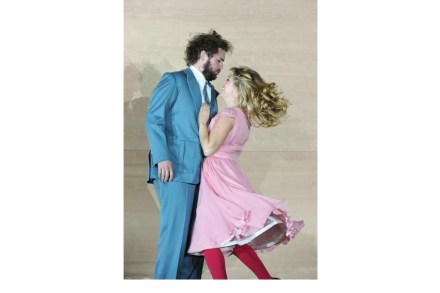
Is any opera more frustrating than Offenbach’s The Tales of Hoffmann? It persistently arouses hopes which it almost as persistently fails to realise. Because there is no such thing as an authoritative text, one always hopes that a new production will have hit on a solution to its numerous problems. I’ve seen enough accounts of it now to feel miserably confident that any production will be a mixture of pleasures and let-downs. This new effort by ENO, a co-production with the Bavarian State Opera, is as good an attempt as any I ever expect to see, and its shortcomings are emphatically not to be attributed either to Richard Jones and his team, or to the performers, the strongest cast that ENO has had for anything for a long time.
Great expectations | 11 February 2012

From our UK edition

Bellini’s Norma is an opera that I not only adore: it obsesses me, too. Whenever I listen to it, I have to hear it again very soon, and parts of it lodge in my mind, playing over and over again, to an extent that very few other pieces do. It was the work through which I first came to realise Callas’s lonely greatness, and it was through her that I came to see how great Italian opera could be, too, having childishly dismissed it tout court as superficial compared with the great German traditions. I still think that Norma operates on a level different from any other work by Bellini or his contemporaries, or even, I am inclined to think, Verdi. The only Italian composer who rivals it for purity and passion is Monteverdi, to whom Bellini owes nothing and has no resemblance.

Devoid of ideas

From our UK edition

When you see two of the undisputed masterpieces of the repertoire in one week in one of the world’s leading opera houses, competently performed, and remain largely unmoved, you’re bound to ask yourself the question: have I been to these things, and heard them on record, too many times? It is, after all, possible to get tired even of the greatest works if you have experienced them regularly in the same productions, and without any special ‘magic’ ingredients, such as can bring back to life, or sustain, a standard work. It was a question I found myself asking with special poignancy this week, after seeing two of Mozart’s greatest works in the space of four days at the Royal Opera House: Don Giovanni on Tuesday and Così fan tutte on Friday.

Mixed messages

From our UK edition

The Enchanted Island is a baroque concoction at the New York Met which has been widely touted and last Saturday was relayed worldwide to cinemas, a transmission that went less smoothly than any I have seen before, with some sharp variations of volume and a temporary complete breakdown. On the whole, the sound level is very high, as if everyone is singing at the top of their voice; while it’s nice to have ample volume, it is clearly and disconcertingly a misrepresentation. Danielle de Niese, for instance, has a small voice which just about fills Glyndebourne’s house. Here she sounded like a Wagnerian on the make, with coloratura sounding like ‘Hojotoho!’.

Look at life

From our UK edition

Giulio Cesare was the first of Handel’s operas to return to general favour after more than a century and a half of neglect, and I suppose that it is still the most frequently performed. That isn’t surprising, since its plot is, by Handelian standards, simplicity itself, and the level of inspiration in the arias is astonishingly high. There is a problem with it, at least in the UK at the moment, and that is that David McVicar’s Glyndebourne production of 2005 has been so widely and wildly acclaimed, and distributed, that new productions are bound to be seen in its shadow.

The opera of all operas

From our UK edition

As I’m not the first person to have pointed out, the Royal Opera has indulged in a truly phenomenal number of performances of La Traviata this season, in the largely traditional production by Richard Eyre, which opened in 1994 with Angela Gheorghiu making her name. The three main roles have been cast differently for these three runs of performances, of which the last has just begun.

Special relationships

From our UK edition

‘It is impossible that you should not have sensed,’ wrote Wagner to Ludwig II shortly before the first performance of Die Meistersinger von Nürnberg, ‘under the opera’s quaint superficies of popular humour, the profound melancholy, the lament, the cry of distress of poetry in chains, and its reincarnation, its new birth, its irresistible magic power achieving mastery over the common and the base.’ The King, and anyone else, might well not sense that in the latest revival of Graham Vick’s production of the opera at Covent Garden.

Beyond compare

From our UK edition

Bernard Levin once wrote an article in the Times called ‘But seriously, how can anyone compare Verdi with Wagner?’ (or something very like that). I can’t remember the article in detail, but its drift was ‘No one can seriously compare them’, something that I had and have always felt. Yet there is the temptation: they were born within a few months of one another in 1813, they were indisputably the two greatest opera composers of the 19th century, and each of them is thought to embody some of the most striking characteristics of their country.

On top form

From our UK edition

Having seen and been most impressed by two New York Met relays of Wagner operas on the big screen, I was interested to see how the largely close-up medium would cope with a Handel opera, where the challenges are quite different. Both composers have single characters singing for large stretches of time, but, while Wagner’s are always involved in a process of feeling, so that there is a sense of exploration at every moment, Handel’s are immersed in states of feeling.

Highs and lows

From our UK edition

This year’s Christmas offering at the Royal Opera is yet a further revival of Richard Eyre’s production of La Traviata, which began the season and is being revived again early in 2012. The main reason I went again to an opera for which I usually feel distaste was to see and hear Simon Keenlyside in the role of Germont père, hoping that he might make me see the opera in a different light. And, with a few gestures and in magnificent vocal form, that is exactly what he did. Normally I object strongly to Violetta’s giving in to the old bully, and then asking him to bless her, when if there is any blessing to be done it should be the other way round.

Ticking boxes

From our UK edition

Dante didn’t have the foresight to create or depict a circle of the Inferno designed expressly for opera critics, with intrepid explorers of new operas with social agendas as an extra. That was left for almost seven centuries until the Royal Opera House came up with the idea of the Linbury Studio Theatre, which answers the most stringent requirements for such a place of torment. You go down, down again and then down, sit in acute and always freshly experienced discomfort, and try to concentrate on yet another exploration of inequality, multiculturalism, a variety of shocking discriminations.

Concealed passion

From our UK edition

ENO’s new production of Tchaikovsky’s Eugene Onegin has created something of a stir by departing from the house almost-tradition of postmodernist, stunningly intrusive and invariably grotesquely irrelevant presentations that began in earnest sometime last year. The set designs for this opera, by Tom Pye, and the costumes, by Chloe Obolensky, update it to the late 19th century, but that is just a nervous tic. More surprisingly, Deborah Warner’s direction of the characters and actors is so unobtrusive that one wonders if she told anyone to do anything in particular. The most sensational departure from what we normally see is that Lensky wears glasses (not sunglasses) for the duel, gently stressing his bookish otherworldliness; and one other touch, to be mentioned later.

Continuous fun

From our UK edition

The time of year is approaching when Nutcrackers take over from opera, and then a further round of Traviatas gets under way. But that does at least mean that it’s also the time when the schools of music put on their end-of-term operas, and this season is unusually promising. Next week Sir Colin Davis is conducting Berlioz’s Béatrice et Bénédict at the Royal Academy of Music, and the week after the Royal College of Music is staging two equally rare Bizet operas, Djamileh and Le Docteur Miracle. I doubt whether either of them will give me more, or as much, pleasure as the Guildhall School’s production of Nicolai’s Die lustigen Weiber von Windsor (The Merry Wives).

Skirting the sensational

From our UK edition

I only very recently began going to live Met relays in the cinema, but if you can get in it’s very well worthwhile. In Cambridge, where the sound is so-so, as I discovered going to Siegfried, there is no hope of getting in except on the day booking starts. In Huntingdon, where the sound is fantastic, there was just a handful of oldsters for Die Walküre in May, who were rewarded with the best Act I that I have ever seen, thanks to the electrifying conducting of James Levine and the amazing Siegmund of Jonas Kaufmann; and the rest of the performance was of a high standard. Siegfried skirted the sensational, thanks to the last-minute replacement in the title role, Jay Hunter Morris. Remember that name.

Heaven and hell | 5 November 2011

From our UK edition

Rameau is the great baroque master who has yet to be properly rediscovered, at any rate in the UK. It isn’t easy to see why, when one contemplates the Handel-mania that has been sweeping the land for the past quarter-century. Rameau is at least as melodically fertile, his scoring is extraordinary and often extraordinarily lovely, and his plots are far easier to grasp. And while Handel’s operas grind to a dramatic halt every few minutes for an extended expression of feeling, and there is only rarely the sense of interaction between characters, with Rameau we have that sense constantly. The main trouble, I think, certainly the main trouble for me, is the fairly frequent intrusion of dance sequences, which can drain the urgency from the action with lethal efficiency.

Der fliegende Holländer

From our UK edition

Compelling, succinct, elemental, The Flying Dutchman, Wagner’s first indisputable masterwork, wouldn’t seem to present any great problems for an opera house, unless his directions about heaving ships are taken too literally — very unlikely — so why does one never see it well produced? The Royal Opera has made especially heavy weather of it, but not in the right sense, for the last quarter-century. Tim Albery’s 2009 production has egregious faults, and few merits: above all, it fails to establish any potent atmosphere, and the singers are left largely to their own devices, with unhelpful scenery to stagger around on. The present revival is nonetheless very worthwhile, thanks to the powerful rendering of the two leading roles.

Xerxes

From our UK edition

English Touring Opera, under the inspiring directorship of James Conway, is the most energetic and enterprising operatic company in the country, not only taking three operas round the country this autumn, and another couple next spring, but also touring sacred works by Buxtehude, Gesualdo and Bach to 15 destinations, mainly ecclesiastical. ETO is working with a new orchestra for its baroque repertoire, a director-free group formed earlier this year calling itself the Old Street Band. On the second night of Handel’s Xerxes, which I went to at the Royal College of Music’s Britten Theatre, it seemed to be a first-rate group, and with Jonathan Peter Kenny conducting incisively, sometimes perhaps a bit too much, this fairly lengthy piece almost sped by.

Cause for alarm

From our UK edition

Whereas Don Giovanni seems, for assorted reasons, to be unfloatable at present, The Marriage of Figaro is virtually unsinkable, with Così somewhere between. In general it seems that comedies go in and out of favour and fashion more than tragedies or ‘straight’ works, though Figaro may be a glorious exception, like Die Meistersinger. It is horrible to contemplate the possibility of a world which was indifferent to their charms and profundities. Even so, the new production of Figaro at ENO gives some cause for alarm. Fiona Shaw, who has not previously produced a classic opera, sees the work as a maze, a harmless enough notion unless you take it that in the middle of a maze there must be a Minotaur, the only candidate for that in Figaro being the Count.

Beguiled by Weill

From our UK edition

  Street Scene may well be Kurt Weill’s most successful work from his American period, but seeing it in as good a production as the Opera Group’s at the Young Vic was cause for both enjoyment and reservations. In the next couple of weeks it will be touring to Basingstoke, Edinburgh, Newcastle and Hull, so plenty of people will have and should take the chance of seeing it. I’d go again if I were nearer one of those places, for Weill is always at least interesting, though not always quite in the way that he wanted to be — he intended, like Brecht, that we should be filled with indignation about many of the scenes he presents, but we’re much more likely to be beguiled by catchy melodies.

Chance encounter

From our UK edition

Is it possible to write a great opera, or a great work of art of any kind, about Auschwitz? One thing is clear: it would have to be truly great. The very idea of a fairly good work, or for that matter a fairly bad one, with such a subject is absurd. And not only absurd, but also revolting. Take Bernhard Schlink’s novel The Reader, which was published to much acclaim 14 years ago, but which was soon seen to be a meretricious concoction by discerning readers, just on account of its attempting to illuminate the Holocaust by relating it to subsequent events and ‘relationships’. The most moving and powerful writing on the subject is Primo Levi’s If This Is a Man, and that is factual and baldly so.