Michael Simmons

Michael Simmons

Michael Simmons is The Spectator's economics editor.

Michael Simmons, C.J. Farrington and Aidan Hartley

From our UK edition

16 min listen

On this week's episode, we’ll hear from Michael Simmons on some of the most ridiculous Covid fines. (00:52) After, C.J. Farrington on the light and darkness of Russian culture. (04:10) And, to finish, Aidan Hartley on the return of the buffalo. (11:07)Produced and Presented by Sam HolmesEntries for this year's Innovator Awards, sponsored by Investec, are now open. To apply, go to: spectator.
Six graphs that show how the NHS is collapsing

From our UK edition

If you called an ambulance last month you probably faced quite a long wait. Figures released this morning show the average time for an ambulance to arrive after a ‘category two’ call-out was 51 minutes, only slightly down from 61 minutes in March. This is still nearly three times longer than the 18 minute target for category two emergency calls, which include serious conditions such as strokes or chest pain.  Pressure is mounting within hospitals too, with 12 hour A&E waits reaching a new high: one in 20 patients now have to wait half a day or more for treatment after arriving at hospital.

From snowball fights to delivering birthday cards: Britain’s 136,000 lockdown penalty charges

From our UK edition

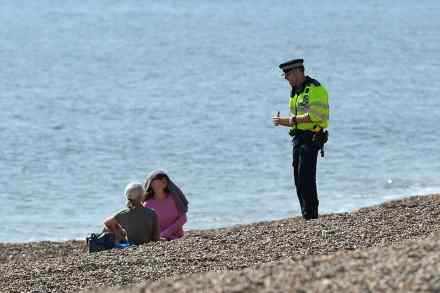
While Boris Johnson and Keir Starmer await the police’s judgment, there has been no end to the fines issued to others caught by their lockdown rules. At last count, some 136,000 fixed penalty notices had been issued in Britain. Durham police – a fairly easygoing force by Covid standards – have handed out just 1,090. Is it a bit mean to fine someone for having had a glass of wine or a beer at work? Perhaps. But no more so than the fines still being issued under the lockdown rules that Johnson and Starmer both voted through. A student in Leeds was fined £10,000 for organising a snowball fight. A beggar was fined £434 for having his cap out at King’s Cross station.

The 2022 local election results in five charts

From our UK edition

Local elections results are still coming in but one thing is already clear: it’s been a bad night for the Tories. The Conservatives have lost 184 seats and ten councils, not as bad as the 800 councillors they had been forecast to lose. But still hardly a result for Boris Johnson to celebrate. Labour haven’t quite lived up to their highest hopes either. Just over two thirds of councils have declared and Labour have gained 48 councillors and five councils so far. But despite these gains, their vote share appears to be up by around only one per cent on 2018, when these seats were last contested. The biggest gains were made by the Liberal Democrats who have 84 new councillors so far and taken control of Hull from Labour.

What happened to the SNP’s dodgy dossier?

From our UK edition

In the final weeks before the 2014 Scottish referendum, the last independent Clydeside shipbuilder went bust. The SNP was boasting about ‘one of the world’s wealthiest nations’ going it alone, so when it went pop something had to be done. A millionaire adviser to Alex Salmond was lined up to buy it on the understanding that he’d bid for government contracts. A year later, a £100 million deal was struck to build two ferries. That deal quickly ran aground. There was no sign of the ferries by 2018 and the bill had doubled to £200 million.

Will Scotland’s census extension ruin the results?

From our UK edition

The debacle over Scotland’s census will not, it seems, have a happy ending. Nearly a quarter of households (some 604,000) are yet to complete their return, and had been facing £1,000 fines from today. It could have been a prosecution of unprecedented scale, but the deadline has been extended to the end of May. Sir Tom Devine, perhaps Scotland’s best-known historian, has said he thinks all is lost. ‘Such is the scale of the disaster the authorities have had little choice but to offer a new deadline,’ he said. ‘Will the extension work? It is very doubtful.

Why Scotland’s census blunder matters

From our UK edition

Around 700,000 Scottish households – a quarter of the country – are facing £1,000 fines for failing to complete the census. Eleven years ago, the last time the census was run, it took 10 days to reach the current response rate of 74 per cent. This time it’s taken over a month. There’s not much hope in getting the rate up either. Studies from the US show census return rates don’t improve after the first few weeks.  If 700,000 households are to be fined this would be the largest prosecution in Scottish legal history, probably British too. In 2011 – where the final response rate was 94 per cent and over 90 per cent in all council areas – just five people were reported to prosecutors. By the following February there’d only been one conviction.

Katy Balls, Michael Bryant and Michael Simmons

From our UK edition

20 min listen

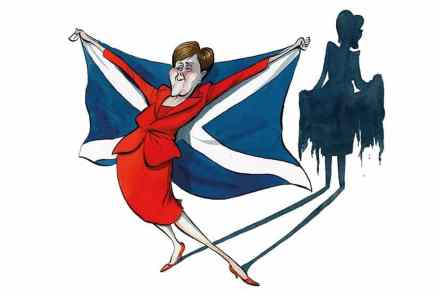
On this week's episode, we'll hear from Katy Balls on the changing face of No.10. (00:49)Next, Michael Bryant on the history of War Crimes. (06:16)And finally, Michael Simmons on Nicola Sturgeon’s secret state. (11:08)Produced and presented by Sam HolmesSubscribe to The Spectator today and get a £20 Amazon gift voucher.

Is Macron in for a surprise?

From our UK edition

14 min listen

Ahead of the first round of France's presidential elections on Sunday, Katy Balls asks whether Emmanuel Macron will be able to justify his apparent distance from the campaign trail. Taking part in the discussion with Katy Balls are Spectator contributor Jonathan Miller, Georgina Wright, from Institute Montaigne, and The Spectator's data journalist Michael Simmons.

How much is Europe (still) paying Putin for oil?

From our UK edition

When sanctions were imposed on Russia there was a big exception: Europe was still buying and paying for oil – leading to a bizarre situation. The West was doing everything it could to help Ukraine while still sending Putin hundreds of millions of dollars a day. But how much was that revenue worth to the Kremlin? As sanctions began to hit Russia, the price of Brent crude (the oil benchmark) soared to $130 a barrel, the highest since the 2008 financial crisis: an increase of over 90 per cent. It’s fallen since then but today it's still sitting between $107 and $115 dollars a barrel – well above where it had been weeks ago. But are these price rises making money for the Kremlin?

Will Nicola Sturgeon’s mask restrictions have any effect?

From our UK edition

As England axes the last of its Covid regulations, Nicola Sturgeon is extending Scotland’s – saying that mask wearing in shops, on buses, trains and taxis will be continued ‘for a further short period’. You can see why. Cases are surging and Scottish hospitals have more Covid patients than at any point during the winter. Weekly Covid-related deaths are 14 per cent higher than in England. But given that England didn’t bring in any additional Christmas restrictions and ended mask wearing at the end of January – and now has lower Covid cases than Scotland – it seems fair to ask: will Sturgeon’s measures actually help?

Covid is rising again. Should we worry?

From our UK edition

For some time now, Covid has been rising in Scotland - there are now more Scots in hospital with Covid than at any time throughout the winter. A freak, or a sign of what’s to come nationally? The ONS survey answers that question today, confirming that Covid cases are rising nationally: some 4 per cent of England’s population, it says, would test positive. In Northern Ireland it’s closer to 8 per cent and in Scotland 5.7 per cent. Have waning vaccines created space for another wave - and do we need to worry? Just as Gauteng and South Africa then Lambeth and London were the early warning signs for Omicron’s rise and speedy peak, so seems to be Scotland now. The ONS survey have shown cases rising there for weeks and it’s been puzzling scientists.

Sage admits its models were ‘at variance to reality’. But why?

From our UK edition

The Sage committee was set up as a pool of experts on tap to advise government. During the pandemic, it mutated into something different: a group whose advice ended up advocating long lockdowns. Its regular meetings have now been discontinued, with questions being asked in No. 10 about whether it’s time to disband Sage and set up a new structure – in the same way that Public Health England was reformed and became the UK Health Security Agency. There will be plenty of lessons to learn. But we might not have much time to learn them: a new variant or (given the growth of genomic sequencing) a new pathogen could come along at any time. This matters.

Is Scotland really the most vaccinated part of the country?

From our UK edition

'Scotland right now is the most vaccinated part of the UK,' said Nicola Sturgeon on the Sunday Morning show this weekend. And if you look at the UK dashboard figures that’s certainly true. A reported 92 per cent have had a first jab and 68 per cent are boosted compared to 91 per cent and 64 per cent in England. But are these numbers reliable? If you look at vaccination in certain age groups in Scotland the rollout has been impressive. In the over-50s, 101 per cent are vaccinated, restricted to over-70s it’s 103 per cent. More jabs than people. But how can more than 100 per cent of a population have been vaccinated? Obviously, they can’t. The problem lies in the denominator. Vaccination rates are based on an absolute number divided by an estimate.

Sage ‘scenarios’ vs actual: an update

From our UK edition

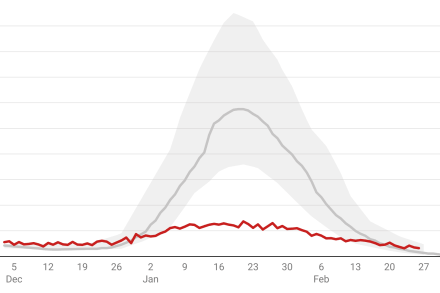
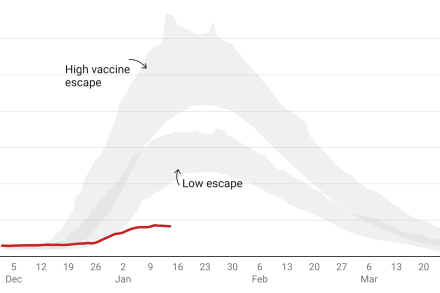
Given that lockdown was very nearly ordered on the advice of Sage last month, it’s worth keeping an eye on the ‘scenarios’ it published, and how they compare to the situation today. Another week of data offers more food for thought. This week was the period when deaths were supposed to be peaking – so given that no extra restrictions were ordered, it’s interesting to compare the peak the models predicted for this week with what actually happened. Deaths were said by Sage to peak at anything from 600 to 6,000 a day (the latter figure, predictably, hogged the headlines).

Omicron is on its way out

From our UK edition

Omicron peaked in England in early January, according to figures just released by the ONS. The estimates from the weekly infection survey show that cases in the UK peaked at around four million before falling. In the week ending 15 January, 1 in 20 had Covid in England, Scotland and Northern Ireland, and 1 in 25 in Wales. We shouldn't be surprised by this We shouldn't be surprised by this — this is how Omicron seems to go world over. As in Gauteng, as in South Africa, as in Lambeth, as in London and now in the UK: it falls almost as fast as it rises. Quite simply, the variant is so infectious that it quickly reaches levels of prevalence that are unsustainable because so many people have been vaccinated, infected and become immune.

Sage scenarios vs actual: an update

From our UK edition

‘Deaths could hit 6,000 a day,’ reported the newspapers on 17 December. A day later documents for the 99th meeting of Sage were released which said that, without restrictions over and above ‘Plan B’, deaths would range from 600 to 6,000 a day. A summary of Sage advice, prepared for the Cabinet, gave three models of what could happen next: Do nothing (ie, stick with 'Plan B') and face "a minimum peak" of 3,000 hospitalisations a day and 600 to 6,000 deaths a dayImplement ‘Stage 2’ restrictions (household bubbles, etc) and cut daily deaths to a lower range: 500 to 3,000.

Will Omicron overwhelm the NHS? The crucial missing data

From our UK edition

If you catch Omicron your risk of ending up in hospital is between 50 to 70 per cent less likely than if you’d had Delta. That’s according to a new analysis released this evening by the UK Health Security Agency. It’s another blow to the case for lockdown. That case for lockdown goes like this: Omicron is growing exponentially and its casualties will overwhelm the NHS unless action is taken to slow the growth. The cautious course of action is to wait until we know more about crucial unanswered questions, such as: What is the limit to Omicron’s growth?How much milder than Delta is it?Is Imperial’s figure of 45 per cent fewer hospitalisations robust? And independently verified?

Omicron is now Britain’s dominant Covid strain

From our UK edition

If you test positive for Covid now in Britain, the odds are that it’s Omicron: it’s now the dominant strain in England and Scotland. Data released this evening by the UK Health Security Agency showed that by Tuesday, 54 per cent of PCR tests were positive for S-gene target failure (a proxy for Omicron). For perspective, it has only taken eight days for the variant to become dominant: Delta took nearly a month. North of the border, Sturgeon said that the ‘tsunami [of cases] was starting to hit’ and confirmed that in Scotland more than half of cases were Omicron too. Again, that’s using S-gene dropout as a proxy. Some 13,741 Omicron cases have been confirmed in England so far: 696 in Scotland, 313 in Northern Ireland and 159 in Wales.

Christmas Special

From our UK edition

90 min listen

Welcome to the special Christmas episode of The Edition! In this episode, we look at five major topics that dominated the news this year and the pages of The Spectator. First up a review of the year in politics with our resident Coffee House Shots' team James Forsyth, Katy Balls and Isabel Hardman. We discuss how Boris seemed to make such a strong start to the year through the vaccine rollout, but squandered this goodwill with several own goals. We also touch on some of the big political moments of the year: Partygate, the Owen Paterson affair and of course Matt Hancock. (00:39) Next, we go global and look at three of the major powerhouses that took headlines this year. The EU, who ends the year in a panic over Russia, extreme Covid measures, and upcoming elections.