Michael Simmons

Michael Simmons

Michael Simmons is The Spectator's economics editor. Contact him here.

US and China slash tariffs

From our UK edition

The White House has announced a breakthrough in trade negotiations with China following two days of talks in Switzerland. Yesterday, Treasury Secretary Scott Bessent said the two sides had made ‘substantial progress’. This morning, he said that the US would lower tariffs on China to 25 per cent from 145 per cent for 90 days, and that China would lower tariffs on the US to 10 per cent from 125 per cent for 90 days. Trump’s trade chief Jamieson Greer (who gave his first European interview to Unherd last week) said yesterday it had been a ‘very constructive two days’. He added: ‘It’s important to understand how quickly we were able to come to agreement, which reflects that perhaps the differences were not so large as maybe thought.

How scuzzy is your neighbourhood?

From our UK edition

Voters turned to Reform in the recent local elections for many reasons, but one theme resonated more than most: the state of our streets, neighbourhoods and communities.  Across Britain – as Gus Carter writes for the cover of this week’s magazine – the same pattern repeats. Whether it’s car thieves smashing windows in London, shops being looted in daylight, or fly-tippers trashing local parks, anti-social behaviour is rife, and no one seems to do anything about it. Councils fob you off. Police don’t turn up. Victims give up reporting crimes because nothing happens. This, as Gus put it, is Scuzz Nation. It’s a country where taxes are high, services are broken, and the social contract has frayed.

US trade deal: ‘a political win, not an economic win’

From our UK edition

11 min listen

On Thursday afternoon Prime Minister Keir Starmer gave a speech about closing the long-awaited UK-US trade deal. Not that his announcement went without a hitch however; after first directing lobby journalists to the wrong Jaguar Land Rover factory in Coventry, Starmer then had his limelight stolen by the election of a new Pope. Although, Labour’s ‘historic’ trade deal has pipped the Pope on most front pages. The reception has been positive across government too, with many heralding a political win for Labour – just when they really needed one after the local elections. But is this an economic win as well? Critics say the deal is shallow, clearly just a start, and are at pains to point out that we are still in a worse trading position than earlier this year.

White smoke on a US trade deal

From our UK edition

15 min listen

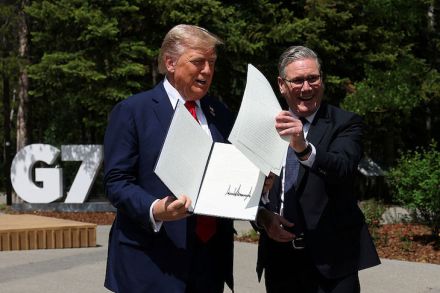
It’s a massive day for the Labour government and for Keir Starmer, as the UK becomes the first country to sign a trade deal with the US following the tariff turmoil of last month. Donald Trump described it as a ‘full and comprehensive deal’ … although we are still waiting for some of the details to be thrashed out. What we do know is this: the 25 per cent tariff on UK steel and aluminium has been removed and the rate on most car exports has been slashed from 27.5 per cent to 10 per cent. In return, the UK is removing the tariff on ethanol for US goods and has agreed ‘reciprocal market access on beef’. So far there is no word on the digital services tax, and Britain is still liable to pay the 10 per cent baseline tariff rate.

Why Britain is cutting interest rates – and the US isn’t

From our UK edition

Interest rates have been cut to 4.25 per cent. The Bank of England’s Monetary Policy Committee (MPC) voted by five to four for what will be the fourth rate reduction since August. The decision breaks with the direction of the US Federal Reserve, which held rates yesterday after refusing to bow to pressure from President Donald Trump who wants to see rates cut. Jerome Powell, the Fed’s chairman, said America’s economy was ‘highly uncertain’ making it difficult to push ahead with a rate reduction. The government will hope that a trade deal will free Britain from the worst effects of the tariff war Back home, analysts are now anticipating the sharpest fall in the cost of borrowing since the financial crisis.

What would a US trade deal mean for the UK?

From our UK edition

Later today, Donald Trump is reportedly set to unveil a trade deal with the UK. He’ll make the announcement alongside ‘a big and highly respected country’ which is said to be Britain. If the reports are true then it would make the UK the first country to secure a deal since Trump’s tariff turmoil began.  The announcement will come at 3 p.m. UK time and could be worth billions in what would be an unarguable win for Rachel Reeves and Keir Starmer.  Britain has already been somewhat shielded from the president's wrath (and tariffs) because our trade in goods with the Americans is pretty much balanced (roughly £59 billion each way).

Do the Tories hate free trade? Plus, Reform hits new polling high

From our UK edition

15 min listen

Lots to talk about today, including new polling which puts Reform on 29 points compared to the Tories on just 17. We’ve also just had the first PMQs since the local elections. But the trade deal announced yesterday between the UK and India is dominating the headlines, with many concerned about some of the concessions made – namely the decision to exempt some short-term Indian workers from national insurance as part of the new agreement. This comes barely a week after the local elections, where immigration has been widely considered the most salient issue.

Starmer can’t afford a winter fuel U-turn

From our UK edition

Keir Starmer has ruled out a U-turn on the government’s decision to cut the winter fuel payment, with the Prime Minister’s spokesman insisting there ‘will not be a change to the government's policy’. This came after a report in the Guardian suggesting No.10 was considering softening the £1.4 billion cut, possibly by raising the threshold that defines who qualifies as poor enough to receive it. We can’t keep living in a state totally consumed by propping up its welfare system That a U-turn was even floated reflects two pressures: disquiet among Labour’s backbenchers, and the electoral warning shot fired by Reform UK in last Thursday’s local elections and by-election.

Labour’s benefits cuts aren’t working

From our UK edition

Britain’s welfare crisis may have slipped from the front pages following Liz Kendall’s £4.8 billion worth of cuts announced ahead of the Spring Statement, but the problems haven’t gone away. Figures quietly released by the Department for Work and Pensions (DWP) this week show that, despite Labour’s planned ‘reforms’ to the benefits system, nearly a million more people will end up on incapacity benefits by the end of the decade, at an additional cost of £9 billion. Kendall’s reforms have only chipped away a few pebbles from Everest Last autumn, the DWP’s own forecasts projected welfare spending on disabled and sick Britons passing £120 billion by 2030.

Are things beginning to look up for Rachel Reeves?

From our UK edition

The Chancellor will meet America’s top economic official, Treasury secretary Scott Bessent, today as she concludes her trip to the International Monetary Fund’s Spring Meetings in Washington. As discussed on Coffee House this week, Rachel Reeves will use her meeting to attempt to make an Anglo-American trade deal a realistic possibility.  Yesterday, the Chancellor put in a surprise appearance on one of Donald Trump’s favourite news channels, Newsmax, and said she understood that both her government and the Trump administration were elected by voters who felt globalisation had not worked for working people. The tone of her interview was very much aimed at the President and his team.

Can Rachel Reeves woo Trump’s team – without alienating the EU?

From our UK edition

The government is on a charm offensive in Washington. Tonight, Britain’s ambassador to the US, Lord Mandelson, will host officials from Donald Trump’s government and American business figures at the British embassy. Tomorrow, the Chancellor will meet her counterpart, Treasury Secretary Scott Bessent. Rachel Reeves is looking to permanently end the punishing 25 per cent tariff on British cars and 10 per levy on other exports. Reeves has given an interview to one of Trump’s favourite channels, Newsmax, in which she was asked about her upcoming meeting with Bessent.

Who do voters trust most on the economy?

From our UK edition

12 min listen

Chancellor Rachel Reeves has been in Washington D.C. this week at the IMF’s spring meetings, and will meet US Treasury Secretary Scott Bessent tomorrow. Cue the ususal talk of compromising on chlorinated chicken. Not so, reports the Spectator’s economics editor Michael Simmons, who explains that Reeves may offer a reduction in long-standing tariffs already imposed on American cars. But, it’s been a bad week of economic news for the Chancellor as the IMF downgraded the UK’s growth forecast.  We’re also one week away from the local elections – Starmer’s first big test since last year’s general election.

Britain’s borrowing is spiralling out of control

From our UK edition

Britain borrowed nearly £152 billion in the financial year to March – almost £21 billion more than at the same point in the last financial year, according to the Office for National Statistics (ONS). The latest public finance figures reveal that borrowing in March was the third highest since records began in 1993. Crucially, it’s also nearly £15 billion more than what the Office for Budget Responsibility (OBR) had expected for this point in the financial year. The £9.9 billion headroom Rachel Reeves left herself at the Spring Statement already looks to be in serious doubt. The current budget deficit, which is borrowing to fund day-to-day spending and the metric used to judge the Chancellor’s ‘ironclad’ fiscal rule, was nearly £75 billion.

Why the IMF has downgraded UK growth

From our UK edition

The waves from Donald Trump’s tariff upheaval continue to ripple through the global economy. The International Monetary Fund (IMF) has downgraded its forecasts for global growth to 2.8 per cent for this year and 3 per cent for 2026, down from previous estimates of 3.3 per cent for each year. The UK isn’t immune: the IMF expects British growth to come in at 1.1 per cent this year and 1.4 per cent next year. US growth, meanwhile, falls to 1.8 per cent followed by 1.7 per cent. These cuts were widely expected, but they sharpen the focus on the costs of the current trade tensions. The downward pressure on demand is likely to reduce inflation risks that the Bank of England had worried were becoming sticky.

Britain is not out of the woods on rising inflation just yet

From our UK edition

Price rises have unexpectedly eased. The Consumer Price Index rose by just 2.6 per cent in March, down from 2.8 per cent the month before and slightly lower than analysts’ expectations of 2.7 per cent. The figures, just published by the Office for National Statistics, show that the slowdown was driven by falling fuel costs and flat food prices compared to a year ago. Most of the fall was due to lower prices at the pumps, with both petrol and diesel down by 1.6p last month. Meanwhile, prices in some sectors continued to rise – most notably in education, where costs jumped by 7.5 per cent year-on-year, largely due to the introduction of VAT on private school fees.

The Bank of England’s mission to tame inflation just got harder

From our UK edition

Much to the concern of the Bank of England, British workers are continuing to bank inflation-busting pay rises. Figures just released by the Office for National Statistics (ONS) show that over the three months to February, the average worker received a pay increase of 5.6 per cent. Remove inflation and that works out as a 2.8 per cent real-terms rise.  The persistence of strong pay growth is likely to alarm the nine members of the Bank of England’s Monetary Policy Committee. They have repeatedly warned that they consider sustained wage increases to be a key sign of entrenched inflation. The committee has previously said it wants to see pay growth slow before resuming interest rate cuts.

Tariff turmoil: the end of globalisation or a blip in history?

From our UK edition

17 min listen

Globalisation's obituary has been written many times before but, with the turmoil caused over the past few weeks with Donald Trump's various announcements on tariffs, could this mark the beginning of the end for the economic order as we know it? Tej Parikh from the Financial Times and Kate Andrews, The Spectator's deputy US editor, join economics editor Michael Simmons to make the case for why globalisation will outlive Trump. Though, as the US becomes one of the most protectionist countries in the developed world, how much damage has been done to the reputation of the US? And to what extent do governments need to adapt? Produced by Patrick Gibbons.

China is hitting back with even more tariffs

From our UK edition

China has retaliated against Donald Trump by raising duties on all American imports to 125 per cent from 84 per cent, declaring that it has no interest in responding further to what it calls a ‘joke’ policy. The higher rate will come into force from tomorrow. The announcement comes after the White House’s clarification that tariffs on Chinese exports have climbed to 145 per cent this year – a move China’s commerce ministry described as ‘economically meaningless’ and a tool for ‘bullying and coercion’. The world’s two largest economies exchange goods worth around $700 billion annually. Beijing has made it clear that it considers American goods effectively unmarketable within its borders.

The economy is growing!

From our UK edition

11 min listen

Finally, some good news for your Friday: the economy is growing! Just when everyone seems to be revising down expectations of growth, the Office for National Statistics (ONS) estimates that GDP grew by 0.5 per cent in February. It also revised January’s figures upwards to give growth for the last quarter of 0.6 per cent, and annual growth of 1.4 per cent. It looks – for now – that the Reeves recession has been put on hold and that Labour's growth agenda could be working. That said, Labour cannot afford to celebrate just yet. There is reason to believe the figures could be overstated, and there are some trust issues with the ONS – the government last week announced a review of its ‘performance and culture’.

Xi escalates China’s trade war with Trump

From our UK edition

China has announced it will impose 84 per cent tariffs on US goods imports from tomorrow, as the war of words and levies between the world’s two largest economies escalates. The new measures –  50 per cent on top of the 34 per cent already imposed by Beijing's finance ministry – are a like for like increase for the 50 per cent increase levied by Trump overnight, taking the US’s total tariff on Chinese goods to 104 per cent. The FTSE100 – which was already down more than 2.3 per cent this morning – plunged even further to 3.6 per cent following the midday news.  Beijing had vowed a ‘firm and forceful’ response to Trump’s additional tariffs yesterday, declaring, ‘The Chinese people’s legitimate right to development is inalienable’.