Melanie McDonagh

Melanie McDonagh

Melanie McDonagh is an Irish journalist working in London.

Why is Ofqual trying to dumb down English exams?

If you wanted a good working example of the concept of dumbing down in practice, look no further than Ofqual, the exams regulatory board, the one that covered itself in ignominy when it oversaw the exam algorithm fiasco during lockdown. Its latest idea is to get exam boards for English to replace ‘complex’ language elements, such as idiom, sarcasm and metaphor, with simpler alternatives in some assessments to make the tests more accessible for pupils. The temptation at this point to respond with sarcasm, irony, idiom and metaphor – not at all nice ones either – is almost irresistible, but let’s not go there.

How the pumpkin hijacked Halloween

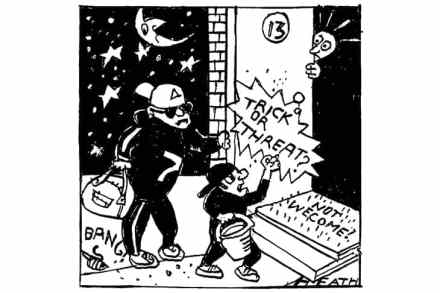
You see them everywhere in vast orange mounds: pumpkins, piles of pumpkins, large enough to be turned into a coach in Whole Foods, a bargain 65p in M&S. Halloween, in terms of retail, means orange for pumpkin and black for witches. Round our way, a pumpkin outside the front door means that the household is receptive to tots and teenagers coming round in costume looking for sweets. Pah! When I was small in Ireland, there was none of this pumpkin lark. We never saw pumpkins, except in Cinderella, where it was the exotic element of the story. Pumpkins are a visible symbol of what happened to All Hallows’ Eve, when the celebrations for the feast of ghosts and divination were taken to America with Irish emigrants… and then somehow came back again.

Giving up meat won’t make us greener

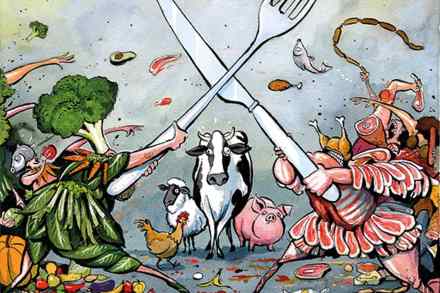
There was a nifty about-turn last week when the so-called Nudge Unit, the government’s behavioural policy advisory body, abandoned its proposals to get us to shift towards a plant-based diet and away from eating meat. Among other exciting intiatives it suggested 'building support for a bold policy' such as a tax on producers of mutton and beef. It pointed out that the government could get people used to a vegetarian diet through its spending in hospitals, schools, prisons, courts and military facilities – you can just imagine how that would go down with soldiers, prisoners and patients – and declared that a 'timely moment to intervene' would be when people are at university. But it also acknowledged that an 'unsophisticated meat tax would be highly regressive'.

There are no safeguards when it comes to euthanasia

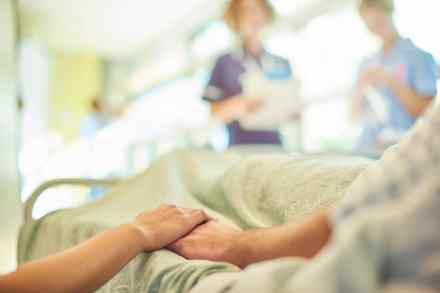
Molly Meacher, whose Bill to allow assisted dying gets its further reading in the Lords today, gave an interesting interview on BBC radio today – there was no other speaker to counter her arguments; an exchange of views came later in the programme. She explained that her engagement with the cause had been prompted by the lonely death of an aunt who had a terminal illness; she went on to describe the unpleasant conditions that could not be dealt with by palliative care. But then the interviewer, Martha Kearney, went on to ask about the problem that old people might be made to feel a burden.

Why is it so hard to live without a mobile phone?

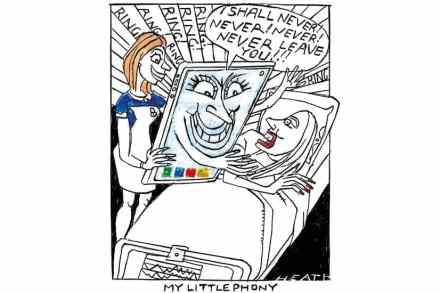
Last week, my mobile phone stopped working. No big deal you might think. If you can get emails on your computer, and you’ve got a landline and that old-fashioned thing, post, why, you’re not cut off, are you? There are, of course, people who wilfully eschew their phones so as to be more in touch with the present moment… birds, clouds, flowers etc. And I’m hardly a junkie. I don’t do social media. I’m a grown-up, so I’m not on Snapchat. Not having a phone should have been fine. But as I discovered, I was quickly cut out of society. First off, you can’t tell the time. Obviously, when you’ve got a phone you don’t need a watch. Or a clock.

David Amess and the sanctity of the Last Rites

Amongst the many appalling details from the murder of Sir David Amess, one detail jumped out at me in yesterday’s reports. Father Jeffrey Woolnough, a Roman Catholic priest, arrived at the police cordon stretching across Eastwood Road North offering to administer the Last Rites to the MP, whom he knew to be a practising Catholic. But he was not allowed through.  "I was refused entry," he said later. And he added that, as a consequence, he was unable to issue the sacrament.  "I’m so very sorry that I was not allowed to minister to Sir David at the end. The police had their instructions which I have to respect and abide by." But why on earth was he refused entry?

Why Lego is right to eliminate gender

So, is it farewell to the Friends Cat Grooming Car playset with Kitten, and the Disney Princess Ariel, Belle and Cinderella set? And what about Olivia’s Electric Car toy, Eco Education Playset? Or the Ninjago Legacy Fire Dragon Attack? Or the City Great Vehicles Refuse Truck? Lego, you may have gathered, is to eliminate gender stereotypes from its products, including labelling that marks toys for boys or girls. Look up Lego for boys or girls on Argos or similar, and you’ll see the full horror of what that entails. The girls’ stuff has a pink or mauve element plus a kitten or a princess or a castle or a hairdresser (though the Eco Education set has its very own wind turbine).

It’s time for James Bond to die

I saw the new James Bond last night, but after reading today’s reviews I’m not sure I watched the same film as the critics. Perhaps the glitz of the Royal Albert Hall and proximity to the stars make reviewers better disposed towards a film. Those of us watching in the Odeon, Leicester Square, eating Joe and Seph’s 007 Dry Martini popcorn (transmuted into caramel coating with five per cent vodka) were perhaps less carried away. The Bond of No Time to Die is, you’ll have gathered, terrifically in touch with his emotions.

The return of the milk round

How do you help the environment and improve your quality of life? Why, buy milk in bottles. Some of us can remember them – foil topped, left outside the door, washed, then returned…a virtuous cycle which worked because it made practical sense. Life went downhill when the milk industry was deregulated in the 1990s and milk turned up in plastic cartons, homogenised and in supermarkets, and so it has remained, until quite recently. But the rattle of the milk van is returning to the streets in parts of London and elsewhere…things, folks, are looking up. It was one of the great advances in human civilisation when we developed lactose to enable us to digest milk.

Britain’s abortion debate is horrendously one-sided

Notice anything about the coverage of the new Texas abortion law in Britain? I mean, quite apart from the fact that we’re obsessing about it in a way that confirms that culturally, Britain is more or less an offshore US state (the US is another country, no?). But on the actual issue, Texas has changed its abortion law to ban the procedure if there is ‘a detectable fetal heartbeat’ — in effect, after six weeks. The US Supreme Court has just upheld this in a very tight 5-4 vote. The justices are also due to hear an appeal against a 2018 Mississippi law that bans abortions after 15 weeks. South Carolina is moving the same way, passing its own ‘fetal heartbeat’ Bill in February.

Our school trip: how we sang for our supper

There were a few things that my school — St Mary’s Convent, Arklow — had going for it but as far as I was concerned, the choir trumped most other activities. That was on account of the nun in charge, Sister Agnes, who had been, we had heard, a professional singer before she entered the convent. She was brisk, upright, her habit immaculate, with beady blue eyes and the kind of focus that set her apart even in the convent. Her choir was legendary, at least in our circle. We won every competition we entered, and we entered lots: Dublin, provincial music festivals, Llandudno in Wales. Not winning would have been a source of collective shame, letting down past generations of choristers. But this time we went further, to Belgium, for a European schools competition.

Should we really be airlifting pets out of Kabul?

You could say that there’s something terribly British about the way that people are, in the grim situation in Afghanistan, rallying around 140 dogs and 60 cats. The animals are inmates of the charity Nozad, run by a former Afghan veteran Pen Farthing. Plus 68 of its human employees. Or you could say that there’s something worryingly typical of this administration in the way this affair has been handled.  The Ark Project, as the evacuation exercise has been named, has managed to secure permission for its specially chartered, privately funded aircraft to leave Kabul airport if the humans and their dumb chums manage to make it there. Other cleared refugees would occupy the remaining spaces, with the pets in the hold.

Why incels aren’t terrorists

Sometimes, a nutter is just a nutter, even when he's a homicidal nutter. In the case of Jake Davison, the Plymouth killer who murdered five people, then himself, the indications are that he was a sad, bitter, angry man with a grudge against society in general and women in particular. He didn't have a girlfriend, and, like every other sad case nowadays, from cannibals to neo-Nazis, he found company and a label online. At any other time, we'd be content to call him an evil creep, a sadistic coward or possibly a homicidal loon, and confine ourselves to the valid question of how his shotgun licence was renewed.

Is letting Alta Fixsler die really in her ‘best interests’?

There’s something grimly familiar about the case of little Alta Fixsler, the brain damaged toddler whose parents are contesting the decision of the Royal Manchester Children’s Hospital to withdraw her life support treatment. She hasn’t eaten or spoken since she was born, tragically prematurely, a misfortune that left her with permanent brain damage. The hospital wishes to turn off her support but her parents want her to be transferred to a hospital in the United States – her father has an American passport – or to Israel – her parents are Israeli citizens, as is she – where the leading paediatric hospital has volunteered to take her.

The futility of Meghan’s mentoring scheme

What, do you reckon you’d get from Princess Eugenie in 40 minutes, always supposing you were a woman trying to return to work, after furlough, or a baby or something? What insight would this amiable royal have to offer the rest of us? Sheryl Sandberg might conceivably have more to say but probably nothing you wouldn’t get from that fascinating book, Lean In, which I haven’t read but have read all about. Or Hilary Clinton? One would welcome her advice on marriage, obviously. Or how about Amanda Gorman, the attractive young woman whose very bad poem was the highlight of the Biden inauguration. Whatever, it wouldn’t be to do with mugging up on the basics, like grammar, before embarking on poetry.

Why wasn’t Gyles Brandreth chosen to host ‘Just a Minute’?

Turn aside if BBC Radio 4 isn’t your thing, still less its panel games. But for those of us who grew up with ‘Just a minute’ there was one obvious and outstanding candidate to replace the late Nicholas Parsons, who gave every indication that he was immortal until he was actually cut off at the age of 96. And it wasn’t the person who actually got the job. The obvious candidate was Gyles Brandreth – though if you’d put in a case for Andy Hamilton, the other genuinely funny man on radio, I’d give it serious thought. But Gyles didn’t get it, nor did Andy. Sue Perkins did. Brandreth is measurably better and more mellifluous than Perkins Perkins is, of course, a decent performer. She's also articulate and bossy.

Isabel Oakeshott, Melanie McDonagh and Jon Day

15 min listen

On this week's episode: Journalist Isabel Oakeshott on how she let the Matt Hancock scandal slip through her fingers a week before it turned up in The Sun (00:59). We’ll also be joined by Melanie McDonagh who's written about how high tea has gone from an affordable British staple to and oversized and overpriced, still delicious monstrosity (06:17). And finally Jon Day takes us into the wonderful world of competitive pigeon racing (11:18).

Cake expectations: afternoon tea has gone OTT

The other day, I came across a description of afternoon tea written by Alfred Douglas in 1920: ‘Two kinds of bread and butter, white and brown, cucumber and tomato sandwiches, cut razor thin, scones, rock buns and then all the cakes — plum, madeira, caraway seed — the meal had about it the lavishness of a Victorian dinner.’ There are a few things about this feast which I find striking. It includes two kinds of bread and butter. Sliced bread and butter never features on the modern table but a century ago, people used it to fill themselves up; it took the edge off your appetite. Note also the simplicity of the cucumber and tomato sandwiches. Both are excellent if they’re made from good stuff. The crucial thing was that they were cut thin.

The hypocrisy of Matt Hancock

Matt Hancock has not, we can agree, made it his business to lighten the public mood during the pandemic. That lugubrious face was designed by nature for a downbeat message. Who can forget his injunction to 'hug carefully' and responsibly as lockdown eased? (Before that, his regulations meant no one got within hugging distance of anyone.) He would, he said, be hugging his parents outside: 'I’m really looking forward to hugging you, dad, but we’ll probably do it outside and keep the ventilation going: hands, face and space'. Well!

Meghan Markle has demonstrated why children won’t like ‘The Bench’

Meghan Markle isn’t one to think small. In a statement on her Archewell website to thank those who put her book, The Bench, at the top of the New York Times' children’s picture book list, she wrote:  'While this poem began as a love letter to my husband and son, I’m encouraged to see that its universal themes of love, representation and inclusivity are resonating with communities everywhere. In many ways, pursuing a more compassionate and equitable world begins with these core values’. You’d never, think, would you, that this is a picture book for children. And one of the reasons why any sensible tot will hurl it from the cot is that it has an elephantine agenda.